Origin: Russia
Date: mid-18th century
Material: glass
Technique: blowing, cutting, engraving
Dimensions: 25.2 × 12.5 × 8 cm
Current Collection: The State Hermitage Museum
Inventory Number: ERS-57
Hermitage ID: 923390
Rudanovsky Connection: Entered the Hermitage in 1919 from the collection of A. K. Rudanovsky.
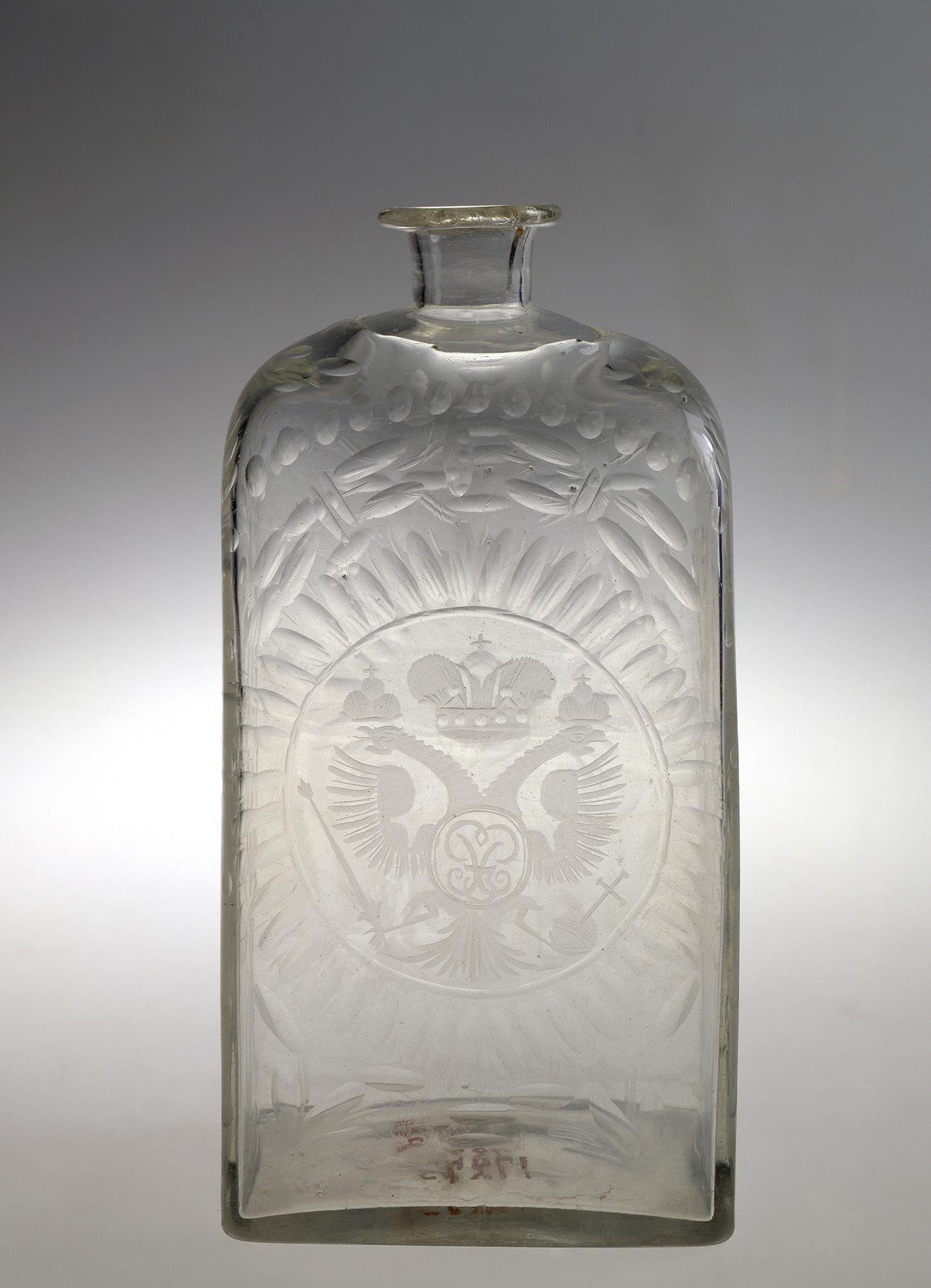
A Russian glass bottle of the mid-eighteenth century, engraved with the double-headed eagle.
Shtof Bottle. The State Hermitage Museum.
The bottle entered the Hermitage in 1919, handed over by the Department for the Protection of Monuments of Art and Antiquities and originally in the collection of A. K. Rudanovsky. It is not currently on permanent display.
It is a large glass bottle — 25.2 centimetres high — with a rectangular body, a short neck and an engraved eagle on the front.
The Object
The bottle has a flattened rectangular body, a sloping shoulder and a short, wide neck.
Its glass is clear and slightly greenish, and it is decorated with engraving: a laurel border, a radiance and, in the centre, a double-headed eagle.
The surface is worn and scratched, and the glass has a few chips and stains.
The Shtof
The bottle is a shtof.
A shtof was a Russian measure of volume, about 1.23 litres, and the word came to mean a large bottle of that size. Shtofs were used for vodka, wine and liqueur, and they were a common object of the Russian table.
The bottle’s size and shape are therefore functional: it holds a standard measure, and it is designed to stand on a table.
The Eagle
The double-headed eagle is the bottle’s central image.
It is engraved in the glass, with spread wings, two heads and a crown above. In its claws it holds a sceptre and an orb, and on its breast is a shield with a monogram.
The eagle is the emblem of the Russian empire, and it marks the bottle as an imperial or state object.
The Radiance
The eagle is surrounded by a radiance.
It is a circle of rays, engraved around the bird, and it gives the image a celestial, almost religious character. The radiance is a common device in Russian heraldic art.
The rays also catch the light, and they make the eagle appear to shine.
The Laurel
A laurel border surrounds the radiance.
It is a wreath of leaves, engraved around the edge of the body, and it frames the image. The laurel is a symbol of victory and glory.
The border gives the bottle its structure, and it turns the engraving into a complete design.
The Glass
The bottle is made of glass.
Russian glass of the eighteenth century was produced in imperial and private factories, and it was often engraved, cut and polished. Clear glass was a luxury, and it was used for the table and for display.
The glass here is slightly greenish, with a few bubbles, and it has the soft lustre of old glass.
The Engraving
The decoration is engraved.
The engraver cut the design into the glass with a wheel, and the cuts catch the light. The technique is related to the cutting of gems, and it requires great skill.
The engraving on this bottle is fine and detailed, and it shows the hand of an experienced craftsman.
The Neck
The neck is short and wide.
It has a flared lip, and it was closed with a cork or a stopper. The neck is the bottle’s opening, and it is designed for pouring.
A short neck is a feature of shtof bottles: it allowed the contents to be poured quickly, and it made the bottle easy to fill.
The Shoulder
The shoulder slopes from the neck to the body.
It is rounded, and it is where the engraving of the laurel border begins. The shoulder gives the bottle its silhouette, and it connects the neck to the flat body.
Bottles of this shape were designed to lie in a rack or stand on a table, and their shoulders are strong enough to bear the weight.
The Monogram
A monogram is engraved on the eagle’s breast.
It is small, and it is framed by a shield: it may be an imperial cipher or the initials of a patron. The monogram identifies the bottle’s owner or its maker.
Monograms of this kind are common on Russian glass of the period, and they give the object a personal mark.
The Table
The bottle was made for a table.
It stood among glasses and other bottles, and it was used for vodka, wine or liqueur. Its engraved eagle would have caught the candlelight, and its size made it a centrepiece.
That table is gone, but the bottle still carries its function: a vessel for a drink and a symbol of empire.
The Collector
The bottle came to the Hermitage with the Rudanovsky collection.
Rudanovsky collected Russian and European glass as well as porcelain, paintings and miniatures, and his collection included bottles, goblets and Easter eggs.
The bottle is therefore a double document: of Russian glass in the eighteenth century and of a collector’s taste.
The Base
The base of the bottle is thick.
It is a heavy pad of glass, and it gives the bottle stability. The base is full of bubbles and imperfections, and it records the blowing of the glass.
A thick base is a feature of eighteenth-century bottles: it protects the vessel, and it adds weight to the object.
The Bubbles
The glass has bubbles.
They are small, round and scattered through the body, and they are a sign of hand-made glass. Machine-made glass is uniform; this one is not.
The bubbles catch the light, and they give the glass its texture and its character.
The Weight
The bottle is heavy.
It is made of thick glass, and its weight is part of its function: it is stable on the table, and it does not tip when filled.
A heavy bottle is also a valuable object: the glass itself was expensive, and the weight is a sign of its quality.
The Light
The bottle is an object of light.
Its glass is clear, and its engraving is only visible when the light catches it. The eagle, the radiance and the laurel appear and disappear as the bottle is turned.
This play of light is the essence of engraved glass, and it is what makes the bottle a precious object.
Provenance
The bottle carries the inventory number ERS-57. It entered the Hermitage in 1919, handed over by the Department for the Protection of Monuments of Art and Antiquities and originally in the collection of A. K. Rudanovsky.
In the Hermitage
The bottle is preserved in the State Hermitage Museum in Saint Petersburg and is not on permanent display.
It is a fine example of Russian glass, and it preserves an image of empire: an eagle, a radiance and a laurel wreath, engraved on a bottle for the table.
It is a bottle, and it has carried an empire on its front for more than two centuries.
It is a vessel for vodka, and it has become a vessel for memory. And the eagle is still there, in the glass, in the light. It is, in the end, a very small monument, and a very clear one.