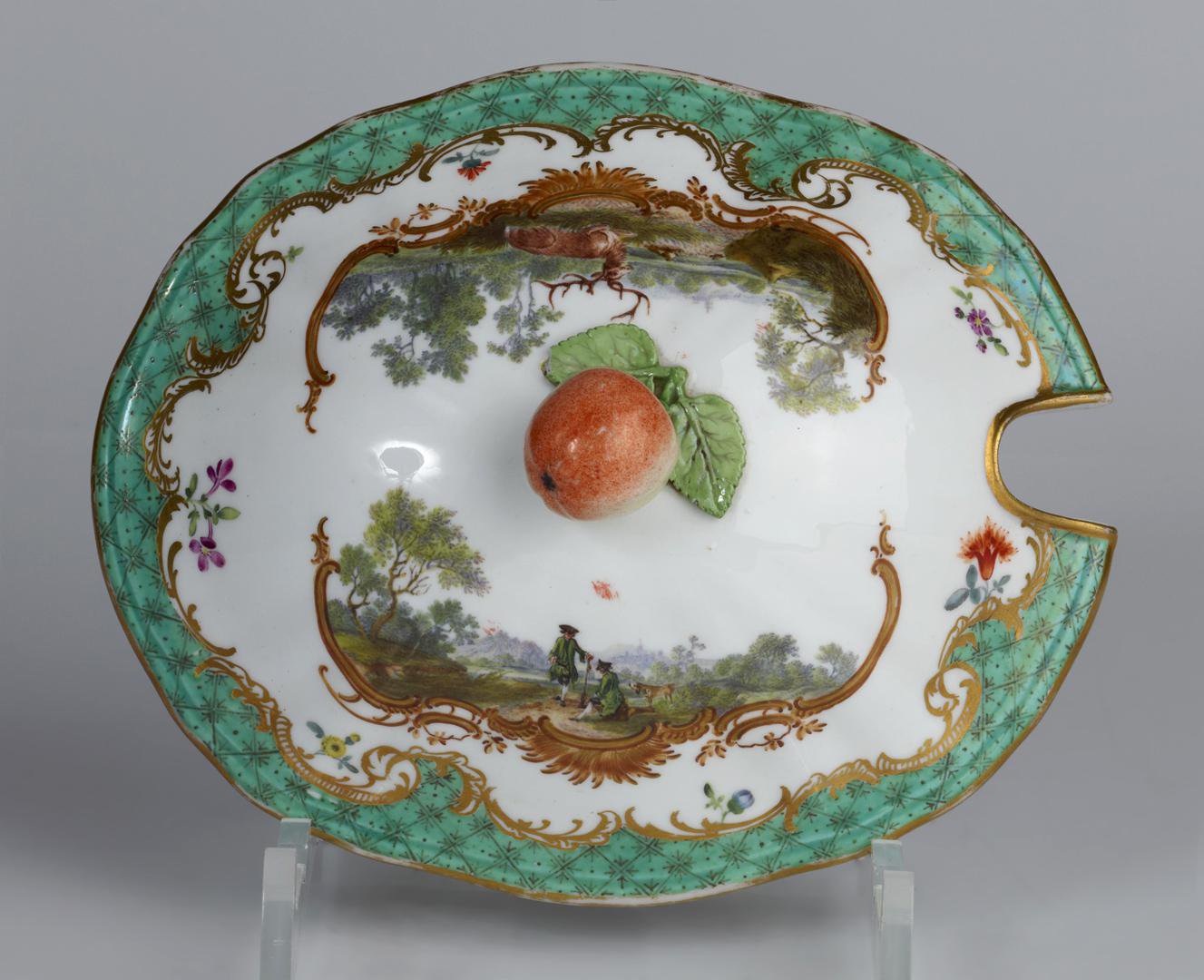
Organization: Meissen Porcelain Manufactory
Origin: Germany (Saxony), Meissen
Date: 1766–1768
Complex: Hunting Service
Material: porcelain
Technique: polychrome overglaze painting, gilding
Dimensions: height 24 cm; base diameter 15.4 cm
Current Collection: The State Hermitage Museum
Inventory Number: ZF-18724
Hermitage ID: 427169
Rudanovsky Connection: Entered the Hermitage in 1919; previously in the A.S. Dolgorukov collection
A Meissen porcelain candlestick of 1766–1768 from the «Hunting Service», painted with hunting scenes and now missing its candle socket.
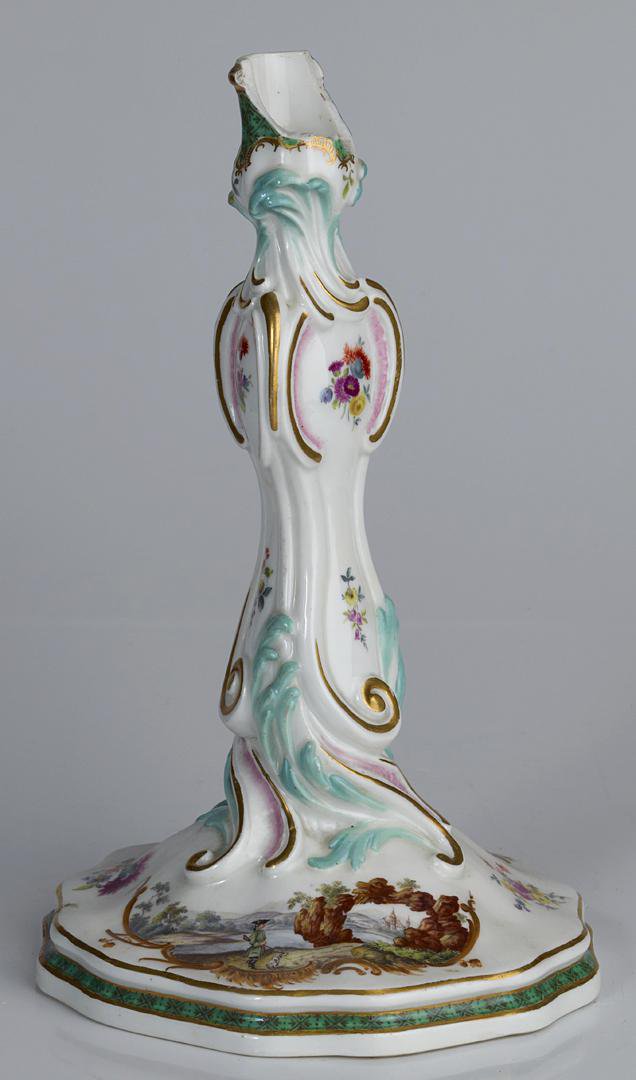
Candlestick Decorated with Representations of a Huntsman by the Grotto; a Deer Bathing. The State Hermitage Museum.
The candlestick entered the Hermitage in 1919, transferred from the Office for the Preservation of Monuments of Art and Antiquity. The record notes that it was previously in the A. S. Dolgorukov collection.
It is a tall candlestick — 24 centimetres high — with a twisting shaft, a wide base and a broken top.
The Object
The candlestick has a broad, lobed base and a slender, twisting shaft.
Its shaft is modelled as a tree trunk or a rocky stem, with scrolls and leaves, and it is painted in white, green and pink. The base carries a painted scene: a huntsman by a grotto, with a river and trees.
The top is broken: the candle socket is missing, and only a jagged edge remains.
The Shaft
The shaft is the object’s body.
It twists like a tree trunk, and it is modelled with scrolls, leaves and roots. Its form is rococo: asymmetrical, organic and full of movement.
The shaft is painted in soft colours, with reserves of flowers, and it is banded with gold. It is the most elaborate part of the candlestick.
The Base
The base is wide and lobed.
It is painted with a hunting scene: a huntsman by a grotto, with a river, rocks and trees. The scene is framed by a gold cartouche, and the edge of the base is banded with green diaper and gold.
The base is the candlestick’s picture, and it gives the object its subject.
The Scene
The scene shows a huntsman by a grotto.
He stands at the left, with a gun or a staff, and he looks toward a rocky arch. Water, trees and a pale sky fill the background.
A second scene is recorded on the candlestick: a deer bathing. Together, the two scenes make the object a small gallery of hunting subjects.
The Damage
The candlestick is damaged.
Its top is broken, and the candle socket is lost. The break is old, and its edge is rough and stained.
The damage turns a candlestick into a fragment: the object can no longer hold a candle, and it survives as a sculpture.
The Border
The base is bordered in green.
It is painted with a diaper pattern of small stars, and it is edged with gold. The border connects the candlestick to the rest of the service.
Borders of this kind are one of the signs of the «Hunting Service», and they unite its many pieces.
The Service
The candlestick belongs to the Meissen «Hunting Service».
The service was made in 1766–1768, and it was decorated with hunting scenes after paintings and prints. It was one of the most ambitious services of the eighteenth century.
Candlesticks were part of the dessert table: they lit the porcelain, and they turned the service into a small theatre of light.
The Provenance Note
The candlestick’s record is unusual.
Unlike most of the works in this group, it does not mention the Rudanovsky collection: it names the Dolgorukov collection instead.
This is worth stating plainly: not every object in this group came through the same hands, and the labels are not always the same.
The Grotto
The grotto is the scene’s centre.
It is a rocky arch, painted in browns and greys, with plants growing over it. Its opening frames the distance, and its shadow gives the scene its depth.
Grottoes are a classical motif in landscape painting: they suggest the wild, the ancient and the picturesque.
The Reserves
The shaft has reserves of flowers.
They are small oval panels, framed in gold, and each contains a bouquet of flowers. They break the twisting surface of the shaft, and they add a note of colour.
Reserves of this kind are a feature of rococo porcelain: they frame a small picture on a curved surface.
The Gold
The gold is applied in scrolls and lines.
It edges the reserves, frames the scene and covers the ornaments of the shaft. It was applied over the glaze, fired and burnished.
The gold gives the candlestick its richness, and it catches the light of the candle.
The Light
The candlestick was made for candlelight.
Its white shaft, its gold scrolls and its painted scene would have glowed in the flame, and its broken top once held the candle that lit them.
In a museum case, the candlestick is lit from above, but it was made for fire.
The Table
The candlestick was made for a table.
It stood on the dessert table, among the plates and dishes of the service, and it lit the porcelain around it. Its height made it a centrepiece.
That table is gone, but the candlestick still carries its function: a small object for light.
The Roots
The shaft ends in roots.
They spread across the base like the roots of a tree, and they are painted in greens and browns. They connect the shaft to the base, and they give the object its natural look.
Roots of this kind are a feature of rococo porcelain: they turn a support into a piece of nature.
The Break
The break at the top is old.
Its edge is rough, and the porcelain is stained. The socket is gone, and with it the candlestick’s function.
A broken object is still an object, and sometimes the break tells us more than the whole.
The Second Scene
The second scene shows a deer bathing.
It is recorded in the title, and it may have been painted on the other side of the base or on the shaft. A deer at the water is a peaceful subject, and it balances the huntsman by the grotto.
Together, the two scenes make the candlestick a small gallery of the hunt: the hunter and the quarry, the grotto and the water.
The Piece’s Number
The candlestick carries an inventory number, ZF-18724.
Numbers of this kind were given by the museum, and they identify the object in the collection. They are the modern equivalent of the old owners’ marks.
The number is a small trace of the object’s life after the table: it is a museum object now, and a damaged one.
Provenance
The candlestick carries the inventory number ZF-18724. It entered the Hermitage in 1919, transferred from the Office for the Preservation of Monuments of Art and Antiquity, and it was previously in the A. S. Dolgorukov collection.
In the Hermitage
The candlestick is preserved in the State Hermitage Museum in Saint Petersburg and is not on permanent display.
It is a fine, damaged object, and it preserves a hunting scene: a huntsman, a grotto and a twisting shaft, modelled in porcelain two centuries ago.
It is a broken object, and it is still beautiful, and it still holds its two scenes of the chase.