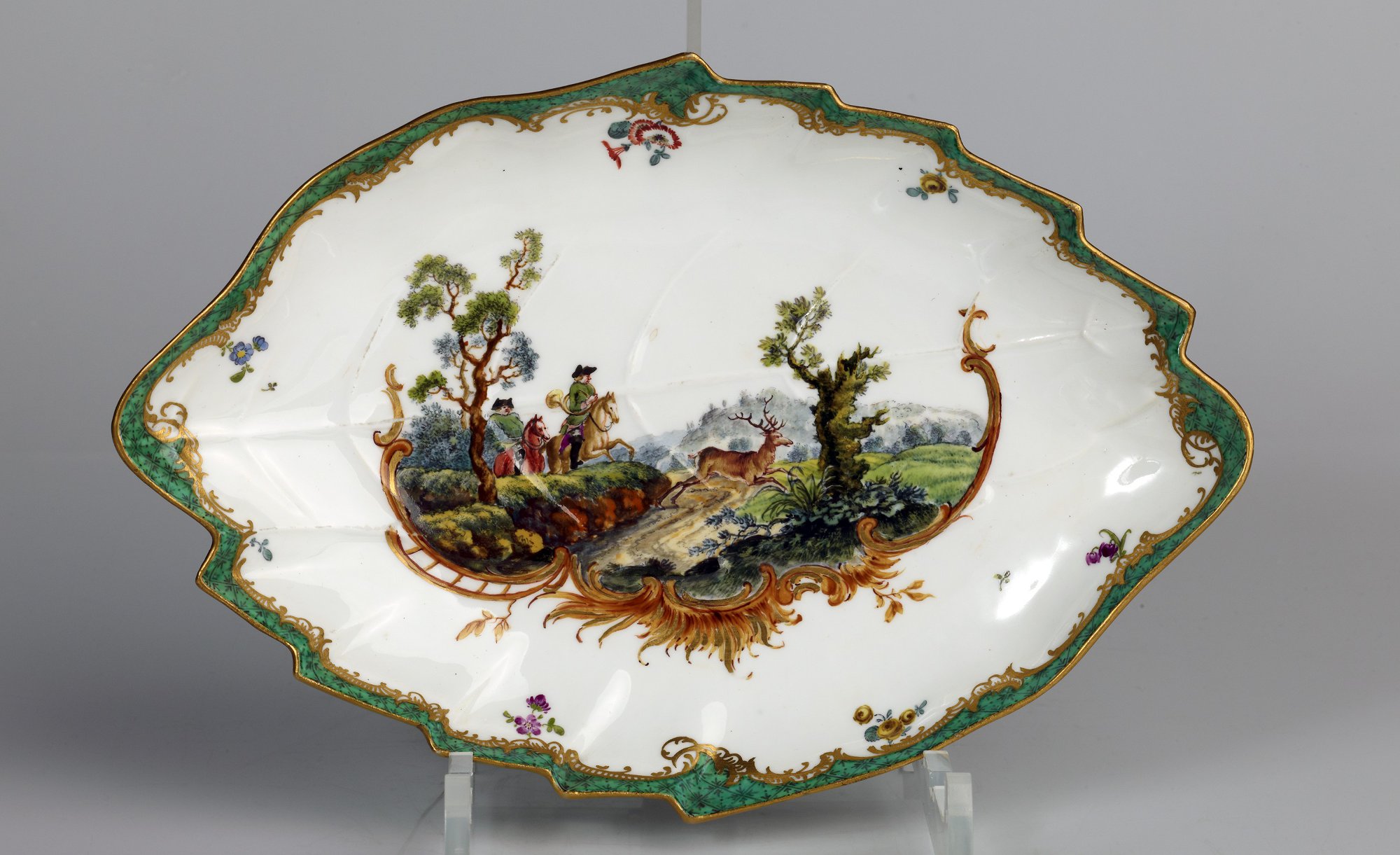
Organization: Meissen Porcelain Manufactory
Origin: Germany (Saxony), Meissen
Date: 1766–1768
Complex: Hunting Service
Material: porcelain
Technique: polychrome overglaze painting, gilding
Dimensions: height 6.7 cm; length 17.4 cm; width 14.3 cm
Current Collection: The State Hermitage Museum
Inventory Number: ZF-18725
Hermitage ID: 427170
Rudanovsky Connection: Entered the Hermitage in 1919; previously in the A.S. Dolgorukov collection
A Meissen porcelain cover of 1766–1768 from the «Hunting Service», painted with two hunting scenes and crowned by a modelled peach.
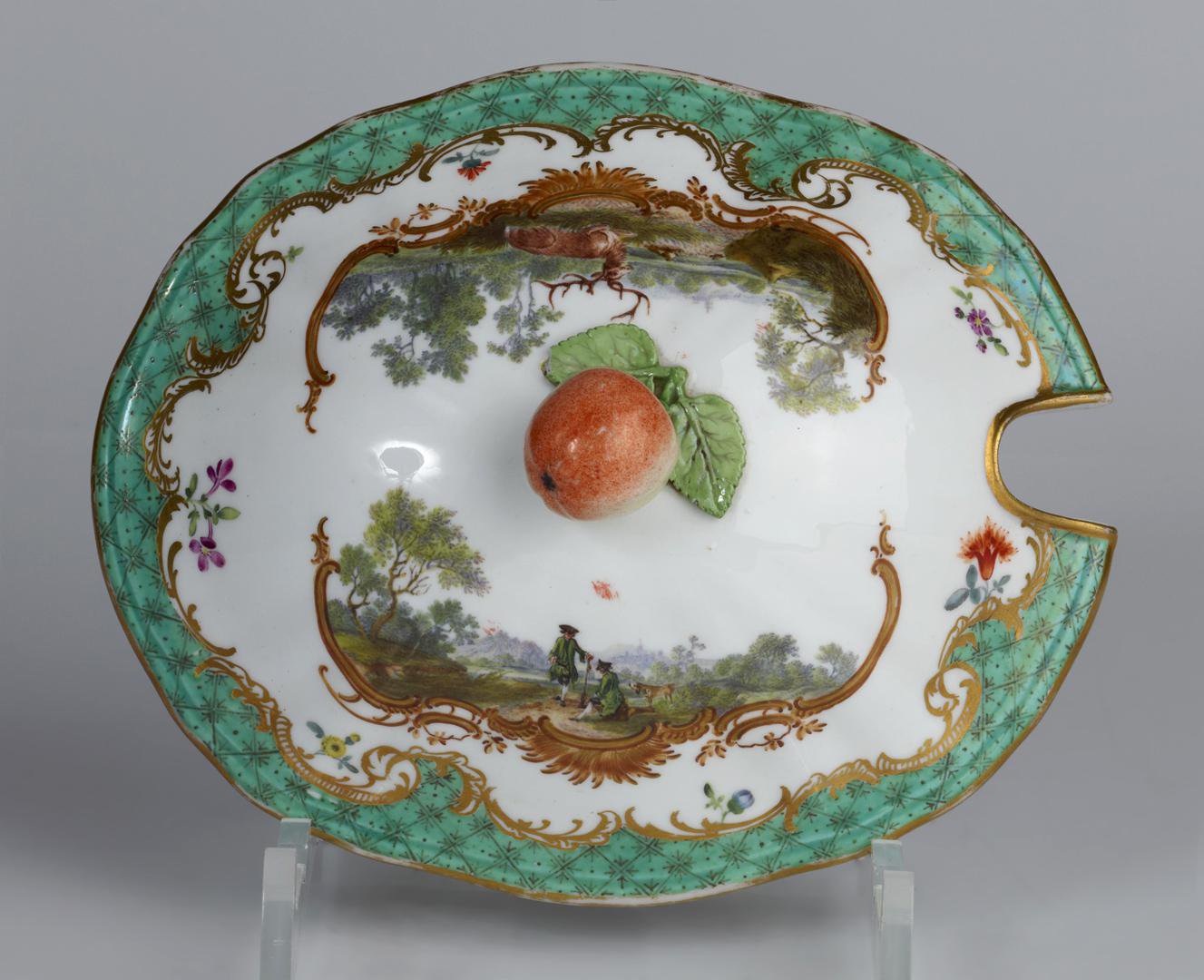
Cover Representing Hunting Scenes: a Resting Deer; Two Huntsmen by the Road. The State Hermitage Museum.
The cover entered the Hermitage in 1919, transferred from the Office for the Preservation of Monuments of Art and Antiquity. The record notes that it was previously in the A. S. Dolgorukov collection.
It is a domed cover — 17.4 centimetres long — with two painted scenes and a peach-shaped knob.
The Object
The cover is oval, with a lobed edge and a shallow dome.
Its border is green, painted with a diaper pattern, and it is edged with gold scrolls and flowers. Two gold cartouches frame two scenes: a resting deer above, and two huntsmen by a road below.
In the centre of the cover, a modelled peach sits on a green leaf, painted in soft reds and greens.
The Peach
The peach is the cover’s knob.
It is modelled in the round, with a soft, downy surface and a green leaf, and it is painted in warm reds and yellows. It is the object’s handle, and its most striking detail.
Fruit knobs were a favourite of eighteenth-century porcelain: they turned a lid into a small sculpture, and they added a note of nature to the table.
The Two Scenes
The cover carries two scenes.
Above, a resting deer lies under a tree, with a landscape behind. Below, two huntsmen stand by a road, with a dog, a gun and a distant village.
The two scenes are framed by gold cartouches, and they are arranged on the dome like two pictures on a wall.
The Resting Deer
The upper scene shows a resting deer.
It lies on the ground, its head raised, and it is painted in browns and whites. Trees and bushes surround it, and a pale sky fills the background.
The deer is a peaceful subject, and it contrasts with the hunting scenes of the rest of the service.
The Huntsmen
The lower scene shows two huntsmen.
They stand by a road, one in a green coat, one in blue, with a dog between them. One holds a gun, and they appear to be talking or resting.
The figures are small and precise, and they give the cover its human element.
The Border
The border is green.
It is painted with a diaper pattern of small stars, and it is edged with gold scrolls and flower sprays. Its colour contrasts with the white ground and the painted scenes.
The border is one of the signs of the service, and it unites its many pieces.
The Service
The cover belongs to the Meissen «Hunting Service».
The service was made in 1766–1768, and it was decorated with hunting scenes after paintings and prints. It was one of the most ambitious services of the eighteenth century.
The cover belonged to a tureen or a dish, and it completed the object: a lid that turned a vessel into a picture.
The Provenance Note
The cover’s record is unusual.
Unlike most of the works in this group, it does not mention the Rudanovsky collection: it names the Dolgorukov collection instead.
This is worth stating plainly: not every object in this group came through the same hands.
The Dome
The dome is the cover’s form.
It rises gently from the edge to the centre, and it carries the two scenes and the peach. Its curve catches the light, and it gives the object its volume.
A domed lid is a classical shape: it covers the vessel, and it gives the object its silhouette.
The Leaf
The peach rests on a green leaf.
It is modelled with a stem and a pointed tip, and it is painted in greens and yellows. The leaf gives the knob its base, and it connects the fruit to the porcelain.
Leaves of this kind are a common device in porcelain: they turn a knob into a small still life.
The Gold
The gold is applied in scrolls and lines.
It edges the border, frames the two cartouches and covers the small rococo ornaments. It was applied over the glaze, fired and burnished.
The gold gives the cover its richness, and it frames the scenes.
The Table
The cover was made for a table.
It sat on a tureen or a dish, and it was lifted at the table, when the food was served. Its peach knob was the handle, and its scenes were the reward.
That table is gone, but the cover still carries its logic: a lid that turned a vessel into a picture.
The Service’s Logic
The cover belongs to a service that painted every piece.
Plates, dishes, tureens, candlesticks and covers were all decorated with hunting scenes, and each scene was different. The service was a small gallery, spread across a table.
The cover is one of its many pictures, and it shows how the service worked: a single subject, varied endlessly.
The Reticulated Border
The border is painted, not pierced.
It imitates a diaper pattern, with small stars in each diamond, and it is edged with gold. The pattern gives the border its texture, and it contrasts with the smooth white ground.
Painted diaper patterns are a feature of the service, and they imitate the texture of fabric or trellis-work.
The Peach’s Colour
The peach is painted in warm reds and yellows.
Its surface is soft and downy, with a blush on one side, and its leaf is green. The colours are applied in thin washes, and they give the fruit its ripeness.
A peach in porcelain is a small still life, and it is one of the object’s most charming details.
The Two Cartouches
The cover has two cartouches, not one.
They sit above and below the peach, and each frames a scene: the deer and the huntsmen. The peach, in the centre, separates them.
Two scenes on a single lid is a generous arrangement: it gives the object a double subject, and it makes the cover a small gallery.
The Piece’s Number
The cover carries an inventory number, ZF-18725.
Numbers of this kind were given by the museum, and they identify the object in the collection. They are the modern equivalent of the old owners’ marks.
The number is a small trace of the object’s life after the table: it is a museum object now.
Provenance
The cover carries the inventory number ZF-18725. It entered the Hermitage in 1919, transferred from the Office for the Preservation of Monuments of Art and Antiquity, and it was previously in the A. S. Dolgorukov collection.
In the Hermitage
The cover is preserved in the State Hermitage Museum in Saint Petersburg and is not on permanent display.
It is a fine example of Meissen porcelain, and it preserves two small scenes and a peach: a lid, a deer, two huntsmen and a green border, painted two centuries ago.