Origin: Iran
Date: 19th century
Material: wool
Technique: pile technique
Dimensions: 190 × 135 cm
Current Collection: The State Hermitage Museum
Inventory Number: VT-863
Hermitage ID: 281373
Rudanovsky Connection: Entered the Hermitage in 1919 from the collection of A. K. Rudanovsky.
A nineteenth-century Persian carpet with a large central medallion on a sandy field, framed by deep red borders and dark blue corner spandrels.
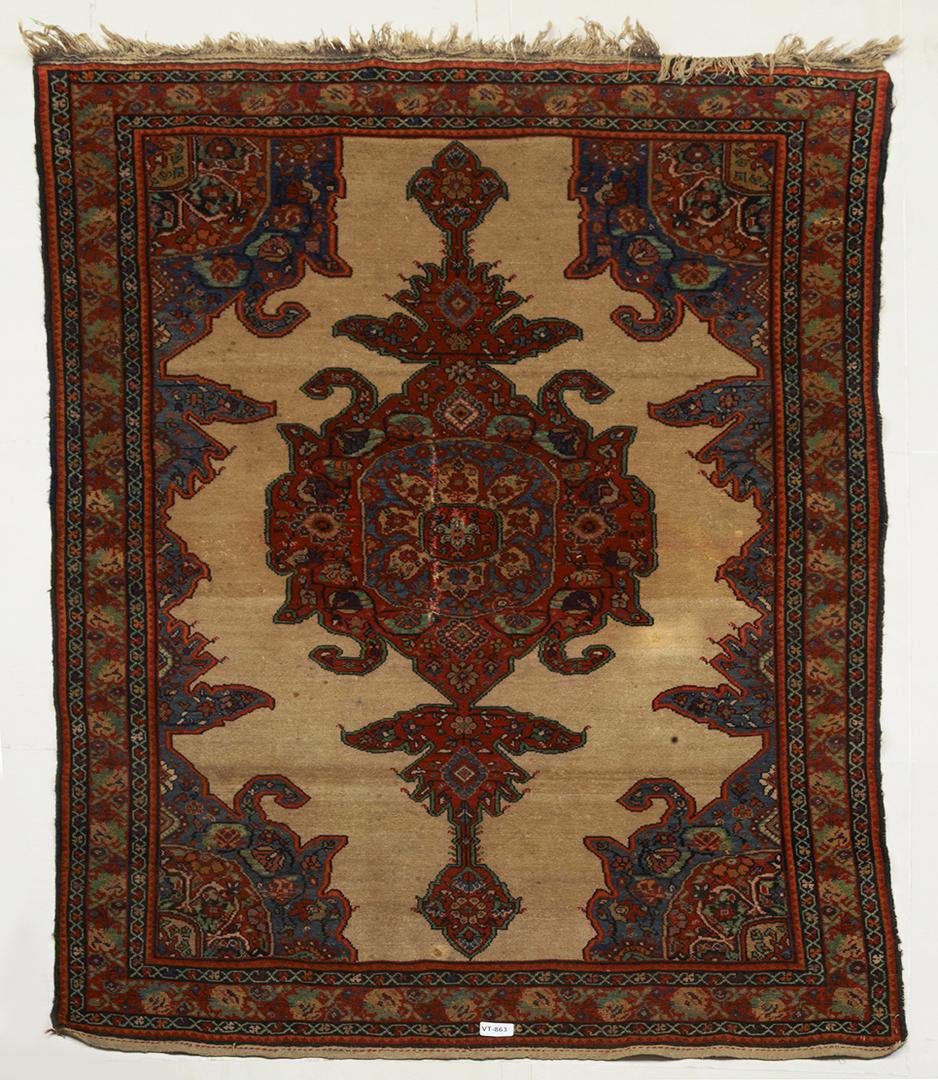
Carpet. The State Hermitage Museum.
The carpet comes from the collection of A. K. Rudanovsky and is not currently on permanent display.
At 190 by 135 centimetres it is a small carpet — the size of a hearth rug or a covering for a low divan rather than a great carpet for a state room. Its design, however, is monumental: a single medallion dominates the field, and the border is broad enough to hold its own against it.
The Object
The field is a warm sandy beige, undecorated except for the great medallion that occupies its centre and the dark blue spandrels that fill the corners.
The medallion is built in layers. A central rosette sits inside a lobed cartouche, which is itself enclosed by a larger, scalloped form with pendant elements extending above and below. The palette is restricted and effective: deep red, dark blue, ivory, a little green and a dusty rose.
The border is equally deliberate. A wide main border of red carries a repeating design of rosettes and palmettes linked by vines, and it is separated from the field by narrow guard stripes of alternating colour. The outer edge of the carpet is finished with a selvage, and at the top the warp threads extend into a short fringe.
The Medallion and the Corners
The composition is one of the classic designs of Persian carpet weaving, known as the medallion and corner layout — lachak-toranj in Persian, from lachak, the corner piece, and toranj, the medallion.
Its logic is architectural. The medallion establishes a centre, the corners acknowledge the rectangular shape of the carpet, and the border frames the whole like the edge of a page. The design is symmetrical in both axes, and that symmetry is not decorative but structural: it allows a weaver to work from a drawing, and it allows a carpet to be read from any direction.
The scheme goes back to the court carpets of the Safavid period, when the great workshops of Isfahan and Kashan produced silk and wool carpets for the shah and for export. Nineteenth-century weavers inherited the vocabulary and adapted it to new markets, new sizes and new tastes.
Persia and the Carpet
Carpet weaving in Iran was never a single industry. It existed at several levels at once.
At the top were the urban workshops, which worked from paper cartoons and produced carpets of great technical refinement. Below them were the village workshops, which wove from memory and tradition, and the nomadic tribes, whose carpets were smaller, looser and often more inventive.
The nineteenth century saw the balance shift. Demand from Europe and Russia grew steadily, and carpet weaving became an important export industry. Workshops multiplied, designs were adapted to foreign interiors, and the carpet moved from the floor of the Iranian house to the parlours of St Petersburg, London and Paris.
Wool, Knots and Dyes
A knotted pile carpet is made by tying short lengths of wool around the warp threads and fixing them with wefts.
The density of the knots determines the fineness of the design. A carpet of this size, with a drawing as detailed as the medallion and border here, requires a considerable number of knots per square centimetre, and the quality of the wool matters as much as the density: soft, long-stapled wool takes the dye deeply and wears slowly.
The colours are the other half of the design. Traditional Persian dyeing used madder for red, indigo for blue, weld and other plants for yellow, and cochineal for crimson. These dyes age in a characteristic way — they soften and shift, and the reds of an old carpet often fade to a warm rose.
From the second half of the nineteenth century, synthetic aniline dyes became available and spread quickly through the industry. Their colours were brighter and cheaper, but they were also harsher and less stable, and the contrast between the two dye traditions is one of the ways in which carpets of this period can be dated.
The Nineteenth Century
The nineteenth century was the great age of the Persian carpet as an export commodity.
The Qajar court continued the tradition of royal patronage, but the expansion of trade changed the scale of production. Carpet merchants, many of them based in Tabriz, organised weaving in the villages, supplied the wool and the designs, and sold the finished carpets in the bazaars of Istanbul, the Caucasus and Russia.
Russian interest in Persian carpets was particularly strong. The trade routes through the Caucasus and the Caspian made Iranian carpets relatively accessible, and they appear in Russian interiors of every quality, from the palaces of the nobility to the houses of merchants and officials.
A carpet like this one belongs to that world: a well-made, moderately sized carpet with a classical design, produced for a market that wanted the Persian look in a format that would fit an ordinary room.
The Drawing
Behind every urban carpet lies a drawing. The design was prepared on paper, often in a workshop that specialised in cartoons, and then transferred to the loom by the weaver, who followed the outline knot by knot.
The medallion-and-corner scheme is particularly demanding because it must remain symmetrical across a surface that is built up row by row. A small error in a corner spandrel will be visible from across the room; the design has no place to hide.
This is why the classical Persian carpet is often described as an architectural drawing translated into wool. The proportions of the field, the width of the border and the size of the medallion are decisions made before the first knot is tied, and the finished carpet is the execution of a plan.
Wear and Survival
Carpets are among the most used objects in a house. They are walked on, moved, beaten, exposed to sunlight and to soot. A nineteenth-century carpet that survives in good condition has usually been protected by something — a smaller room, a table, a period in storage.
Wear is also a record. The pile thins first where feet pass, the colours fade where light falls, the selvages break where the carpet is dragged. Conservators read these traces as evidence of how an object was used, and they belong to its history quite as much as its design.
Provenance
The carpet carries the inventory number VT-863 and comes from the collection of A. K. Rudanovsky.
Its presence in the collection reflects the taste of the period. Persian carpets were not yet museum objects in the nineteenth century; they were furnishings, and a collector who owned Italian paintings and Chinese porcelain might also own a carpet from Isfahan or Tabriz without seeing any contradiction.
In the Hermitage
The carpet is preserved in the State Hermitage Museum in Saint Petersburg and is not on permanent display.
Textiles of this kind are difficult museum objects. They are heavy, sensitive to light and vulnerable to moths and to the stresses of hanging. Many of the carpets in museum collections have spent decades in storage, studied by specialists rather than seen by the public.
Yet the carpet is also one of the most complete works of art in the collection. It has no back, no frame and no hidden side: the whole surface is the image, and the image is made of wool, knot by knot, over months of work.