Artist: Nathaniel Mills (mentioned in 1830), master
Origin: Great Britain, Birmingham
Date: 1840–1841
Material: silver
Technique: stamping, guilloching, notching, partial gilding
Dimensions: 4 × 2 × 0.5 cm
Current Collection: The State Hermitage Museum
Inventory Number: E-13582
Hermitage ID: 170699
Rudanovsky Connection: Entered the Hermitage in 1919 from the collection of A. K. Rudanovsky.
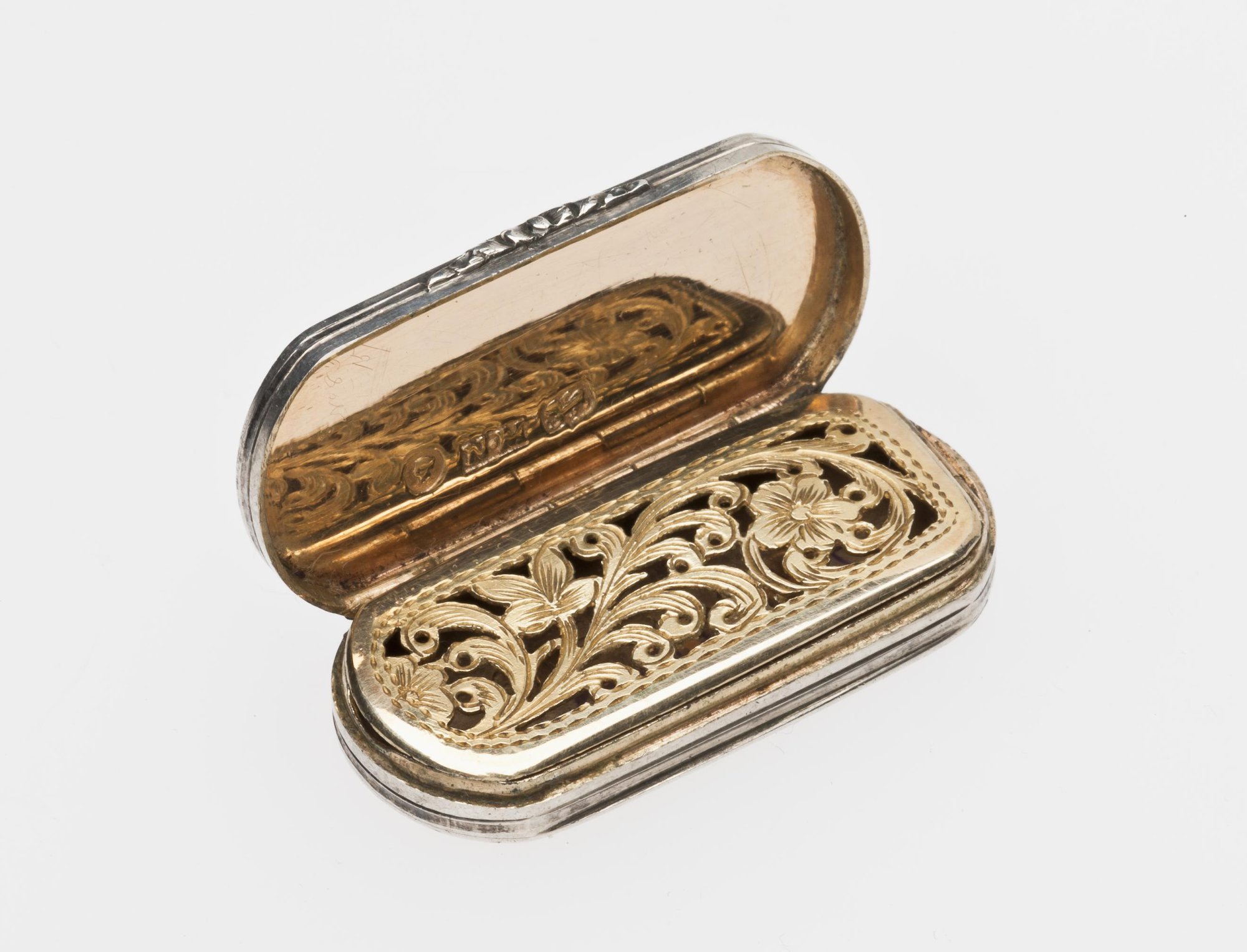
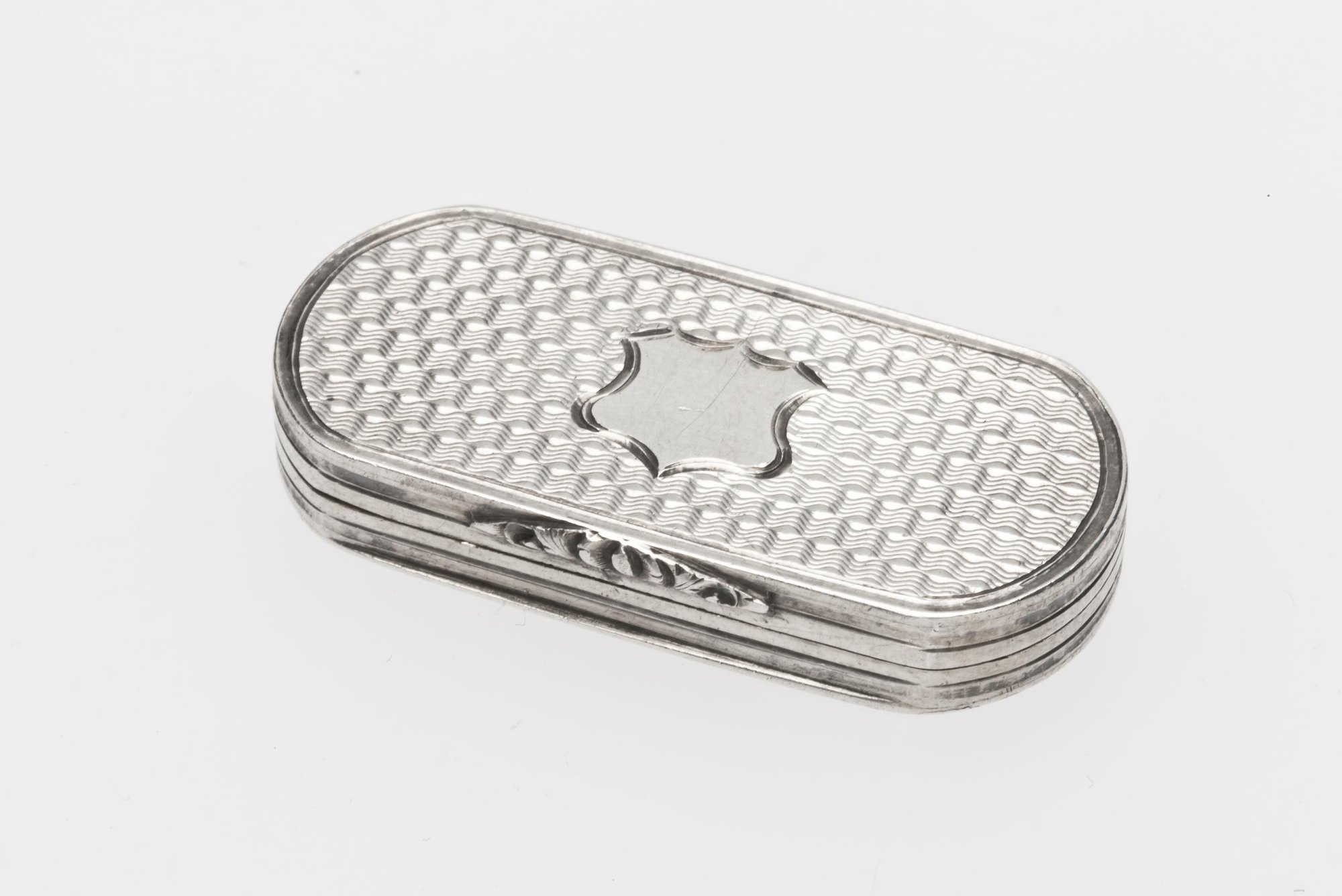
A small silver scent case, four centimetres long, made in Birmingham in 1840–41 by the workshop of Nathaniel Mills, with an engine-turned lid and a pierced grille inside.
Potpourri Vase. The State Hermitage Museum.
The box comes from the collection of A. K. Rudanovsky and is not currently on permanent display.
It is one of the smallest objects in the collection and one of the most concentrated. Everything that the nineteenth century knew about making silver on an industrial scale is present here in a space no larger than a matchbox: the stamped body, the engine-turned lid, the pierced grille, the gilded interior, the hinge that still works after a hundred and eighty years.
The Object
The case is a flattened oval in plan, with rounded ends and a gently domed lid. The lid is covered with an engine-turned pattern of interlacing waves, cut so that the light breaks across the surface in a fine, rippling texture. In the centre sits an empty cartouche, framed by a scalloped outline, waiting for initials or a crest that were never engraved.
Inside, the lid is gilded and carries a pierced grille of thin, scrolling foliage, cut and chased in a flat gold colour. The base is plain and polished. Along the side runs a narrow moulding, notched like a rope, and the two halves meet at a hinge that is almost invisible when the box is closed.
The museum’s title calls the object a potpourri vase. In scale and construction, however, it belongs to the family of small scent cases that were carried in a pocket or a reticule: a container for something fragrant, opened under the nose when required.
A Birmingham Silversmith
Nathaniel Mills was one of the best-known silversmiths of Birmingham in the second quarter of the nineteenth century.
Birmingham was the centre of what the trade called «toys» — small silver and gilt articles: boxes, buckles, buttons, card cases, vinaigrettes, pencil cases, thimbles. The town did not compete with London in the making of great plate; it competed in the making of many small things, quickly and well.
Mills specialised in exactly this market. His boxes are distinguished by crisp engine-turning, careful hinges and a sense of proportion that survives the tiny scale. The firm’s production was large, and its work was exported widely, including to the Russian market.
The date 1840–41 belongs to the last years of the master’s career; the business continued after his death under the same name, which is why the record describes him as «mentioned in 1830» rather than giving precise dates.
The Guilloché Surface
The lid is the object’s face, and the engine-turning is its principal ornament.
Guilloché is a technique of cutting geometric patterns into metal with a lathe. The work is done with a rose engine or a straight-line engine, machines that guide the cutter along a controlled path while the workpiece rotates or slides. The result is a surface of extraordinary regularity: waves, lines and basketwork patterns that no hand can produce.
The point of the technique is not only decoration but light. A flat silver surface reflects the room as a single blur; an engine-turned surface breaks the reflection into hundreds of tiny facets, so that the box seems to move as it is turned in the hand.
Scent and the Small Object
The nineteenth century was a great age of portable scent.
Vinaigrettes held a sponge soaked in aromatic vinegar; smelling salts were kept in small bottles; potpourri and perfumed pastilles travelled in boxes. The purpose was partly pleasure and partly necessity. In crowded rooms, in carriages, in streets where the drains were open, a strong scent was a form of protection as well as a luxury.
Such objects were also social. A small silver box taken from a pocket and opened in company was a gesture of refinement, and the quality of the box spoke for its owner as clearly as the quality of a watch.
Making by Machine
The techniques listed in the museum record — stamping, guilloching, notching, partial gilding — describe a production process that was already industrial.
The body was struck from sheet silver in a press, not raised by hand from an ingot. The ornament was cut by machine. The mouldings were formed by dies. Only the assembly, the fitting of the hinge and the finishing were done by hand, and even those operations were divided among specialists.
This does not make the box less accomplished. It makes it a document of its moment: the point at which the luxury trades of Birmingham learned to combine the precision of the machine with the finish of the goldsmith.
The Empty Cartouche
The centre of the lid is left blank, framed by a scalloped reserve. This is the most eloquent detail of the object.
A cartouche of this kind was made to receive an engraved monogram, a crest or a date. The owner would have chosen the inscription, and the silversmith would have cut it after the box was finished. That this one remains empty suggests a box bought from stock and never personalised, or a gift whose meaning was never fixed.
An empty cartouche is also a small lesson in how luxury objects work. The value of the box lies partly in what it leaves open: the possibility of ownership, the space reserved for a name.
Silver in the Age of Industry
Birmingham silver of the 1830s and 1840s belongs to the first age of industrial luxury.
The town’s manufacturers had learned to combine machine production with hand finishing, and they sold their work across Europe and America. English silver of this period is often technically excellent and stylistically conservative: the patterns are inherited from the eighteenth century, but the methods of making them are modern.
Mills’s boxes show this clearly. The design is traditional — a rounded box with engine-turned ornament — but the production is industrial: stamped bodies, machine-cut patterns, standardised hinges. The object sits exactly at the point where craft becomes manufacture.
Provenance
The box comes from the collection of A. K. Rudanovsky and carries the inventory number E-13582.
Its presence in that collection is a reminder of how broad nineteenth-century collecting could be. A collector who owned paintings and sculpture might also own a hundred small objects — boxes, seals, buttons, snuff bottles — kept in a cabinet and shown to visitors one by one.
In the Hermitage
The box is preserved in the State Hermitage Museum in Saint Petersburg and is not on permanent display.
Objects of this size are easy to overlook in a museum. They sit in storerooms, in drawers, in numbered trays. But they carry a disproportionate amount of information: about materials, about manufacturing, about the daily habits of the people who used them.
Held between two fingers, the box is almost weightless. Opened, it reveals a gold interior and a grille of pierced foliage — a small, perfect machine for holding a scent.