Artist: Chaerles de Hooch (1577–1638), as recorded
Origin: Holland
Date: 17th century
Material: panel
Technique: oil
Dimensions: 49.5 × 40 cm
Current Collection: The State Hermitage Museum
Inventory Number: GE-5453
Hermitage ID: 25975
Rudanovsky Connection: Entered the Hermitage in 1919 from the collection of A. K. Rudanovsky.
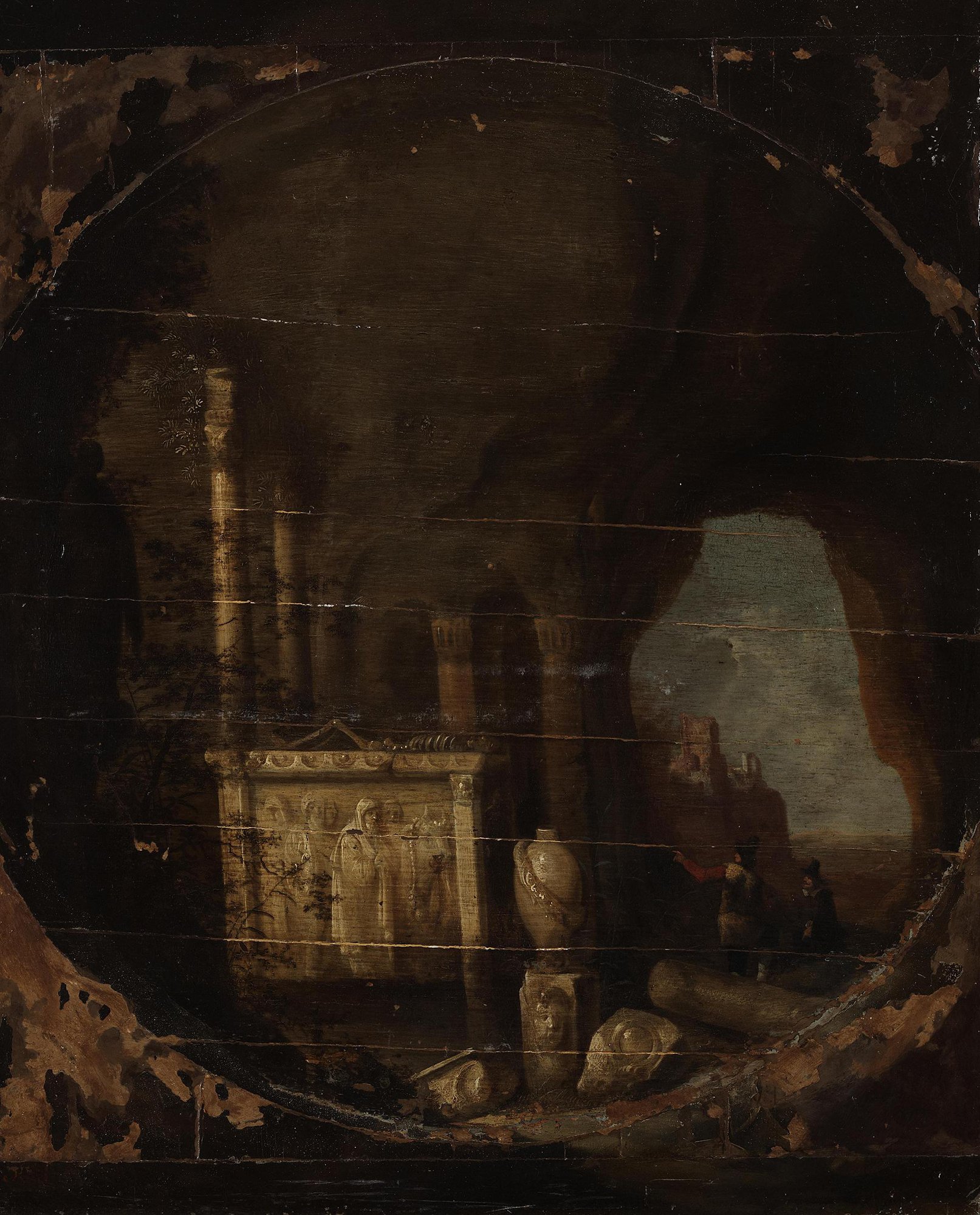
A Dutch painting of the seventeenth century showing a dark cave filled with ancient ruins, an urn and a carved relief.
Cave with Ancient Ruins. The State Hermitage Museum.
The painting entered the Hermitage in 1919 from the collection of A. K. Rudanovsky. It is not currently on permanent display.
It is a small panel — 49.5 by 40 centimetres — painted almost entirely in browns and blacks, with a round opening at the right letting in a pale grey light.
The Object
The painting shows the interior of a cave or grotto.
The walls are dark and rough, and the space is filled with ancient fragments: a carved relief, a broken column, an urn on a pedestal, a fallen capital and a piece of sculpture on the ground.
At the right, a large irregular opening reveals a landscape with a hill, a tower and two small figures standing near the water.
The Cave
The cave is the painting’s subject and its frame.
It is a natural space, dark and enclosed, and it is painted with a rough, uneven surface. The cave walls are brown and black, with patches of lighter stone, and they surround the antiquities like a vault.
Caves were a favourite motif of seventeenth-century art: they were places of mystery, of hidden treasure and of the passage from the world to the underworld.
The Ruins
The ruins are the cave’s contents.
A carved relief leans against the wall at the left; a broken column stands beside it; an urn sits on a pedestal; a fallen capital and a fragment of sculpture lie on the ground. The ruins are Roman, or imagined as Roman.
They are painted in warm browns and ochres, and they emerge from the darkness as if lit by a hidden source.
The Relief
The carved relief is the most legible of the antiquities.
It is a rectangular panel with a pediment, and it shows several standing figures in classical dress, carved in low relief. It may represent a sacrifice, a procession or a myth.
The relief is the painting’s human element: in a cave of stones, it is the only place where people appear.
The Landscape
The landscape is visible through the opening at the right.
It is pale and cool: a grey-green hill, a tower, a sky, and two small figures standing near the water. It is a glimpse of the world outside the cave, and it contrasts with the darkness within.
The opening is the painting’s light source, and it is what makes the cave legible.
The Artist
The painting is recorded as the work of Chaerles de Hooch (1577–1638).
The name is unusual, and it may be a variant or a corruption of another name — Carel de Hooch, or a member of the de Hooch family. Little is known about this artist, and the attribution rests on the style and the record.
The painting belongs to the Dutch tradition of ruins and grottoes, which flourished in the seventeenth century.
The Panel
The painting is on panel.
Panel was a common support for small Dutch paintings: it is smooth, rigid and takes fine detail. The panel is thin, and it shows signs of age: cracks, losses and a darkening of the paint.
The surface has suffered, and parts of the image are obscured — a reminder that old paintings are also objects with a history of damage and repair.
The Frame
The painting has a painted arched top.
The arch is part of the composition, not a separate frame: it is painted on the panel, with spandrels at the corners, so that the image appears to be set in a niche or a window.
This device was common in Dutch painting, and it gives the cave the look of a view through an opening.
The Seventeenth Century
The seventeenth century was the great age of Dutch painting.
Dutch artists painted landscapes, interiors, still lifes, portraits and ruins, and they sold their works to a large market of collectors and burghers. Ruin scenes were popular: they combined architecture, landscape and a moral reflection on time.
This panel belongs to that market: a small, dark, carefully painted image for a private collector.
The Urn
The urn is the painting’s most prominent object.
It stands on a pedestal at the centre-right, and it is painted in warm ochre with dark shadows. Its shape — a rounded body with a narrow neck and two handles — is classical, and it suggests a funeral urn or a vessel for ashes.
Urns were a favourite motif of ruin painting, and they carried a moral message: the vessel of the dead, standing among the ruins of their world.
The Darkness
The darkness is the painting’s atmosphere.
The cave is almost black, and the objects emerge from it slowly, as the eye adjusts. The darkness is not empty: it is full of texture, of stone, of shadow, of things half-seen.
This use of darkness is characteristic of Dutch ruin painting, where the cave or the grotto becomes a place of meditation and melancholy.
Ruins and Vanitas
Ruins were a moral subject in the seventeenth century.
They showed the passing of time, the vanity of human ambition and the survival of art. A broken column or a fallen capital was a memento mori: a reminder that empires fall, and that only stone remains.
This painting belongs to that tradition, and its cave is a small theatre of time.
The Collector
The panel came to the Hermitage with the Rudanovsky collection.
Rudanovsky collected Dutch and Flemish paintings alongside porcelain, drawings, glass and miniatures, and his collection included several small panels of this kind.
The painting is therefore a double document: of Dutch ruin painting in the seventeenth century and of a Russian collector’s taste in the nineteenth.
The Broken Column
A broken column stands at the left.
Its shaft is cut off at mid-height, and its capital is missing; a piece of it lies on the ground nearby. The break is the painting’s most eloquent detail: it marks the passage of time, and it turns a piece of architecture into a ruin.
The column is painted in warm brown, with light falling on its flutes, and it is one of the few vertical elements in a composition of curves and shadows.
Provenance
The painting carries the inventory number GE-5453 and entered the Hermitage in 1919 from the collection of A. K. Rudanovsky.
In the Hermitage
The painting is preserved in the State Hermitage Museum in Saint Petersburg and is not on permanent display.
It is a small, dark, mysterious image, and it preserves a world of stones and shadows: a cave, a relief, an urn, and a glimpse of light at the end.
It is also a meditation on time: everything in the cave has outlived the world that made it, and the darkness has kept it company, quietly, for centuries, without a word, and it is still waiting, patiently, for the next visitor.