Artist: Lorenzo di Bicci (c. 1350)
School: Florentine
Origin: Italy
Date: second half of the 14th century
Material: panel
Technique: tempera
Dimensions: 108 × 46 cm
Current Collection: The State Hermitage Museum
Inventory Number: GE-5504
Hermitage ID: 29486
Rudanovsky Connection: Entered the Hermitage in 1919 from the collection of A. K. Rudanovsky.
A Florentine panel of the second half of the fourteenth century showing St Christopher carrying the Christ Child across a river.
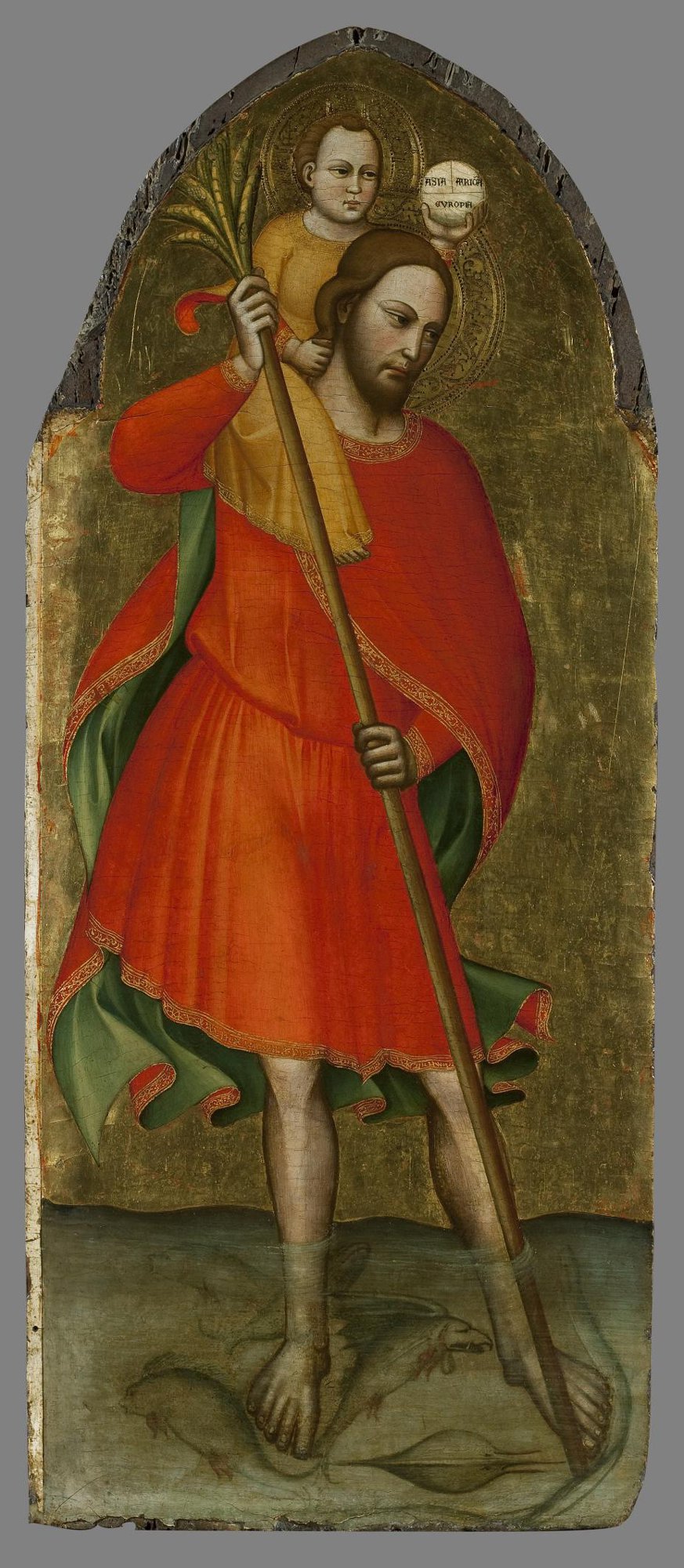
St Christopher. The State Hermitage Museum.
The painting entered the Hermitage in 1919 from the collection of A. K. Rudanovsky. It is not currently on permanent display.
It is a tall, narrow panel — 108 by 46 centimetres — with an arched top, painted in tempera on a gold ground.
The Object
The panel shows a giant figure wading through water, carrying a small child on his shoulder.
Christopher wears a red tunic with a green mantle, and he holds a long staff in one hand and a palm branch in the other. The child sits on his shoulder, dressed in yellow, and holds a sphere inscribed with letters.
The background is gold, and the water is a green-grey band at the bottom, with a fish swimming beneath the saint’s feet.
The Saint
St Christopher is the patron saint of travellers.
According to the legend, he was a giant who devoted himself to serving the strongest master, and he carried travellers across a river. One night he carried a child who grew heavier and heavier, until Christopher could barely stand — the child was Christ, and the weight was the weight of the world.
The legend made Christopher a favourite saint of the late Middle Ages, and his image was painted on church walls and panels across Europe.
The Child
The Christ Child sits on Christopher’s shoulder.
He is small, with a round face and short hair, and he wears a yellow tunic with a gold halo. In his hands he holds a sphere — the orb of the world — inscribed with letters.
The child is both the burden and the reward: he is the reason for the saint’s journey, and the sign of his sanctity.
The Water
The water fills the bottom of the panel.
It is painted in green-grey, with a few lines suggesting the current, and a fish swims beneath the saint’s feet. The water is the river of the legend, and it is also the boundary between the earthly and the divine.
Christopher’s feet are bare, and his legs are submerged: he is in the middle of the crossing, and the journey is not yet over.
The Staff
The staff is the saint’s attribute.
It is a long wooden pole, held diagonally across the body, and it is planted in the water. The staff is the tool of the ferryman, and it is also a symbol of support and pilgrimage.
In his other hand, Christopher holds a palm branch — the sign of martyrdom, and a reminder that the saint’s journey ends in death.
The Gold Ground
The background is gold.
Gold leaf was applied to the panel before painting, and it gives the image a luminous, sacred surface. The figures stand out against it, and the gold suggests the heavenly world beyond the scene.
Gold grounds are characteristic of Italian painting of the fourteenth century, and they are one of the marks of its devotional function.
Lorenzo di Bicci
Lorenzo di Bicci (c. 1350 – c. 1427) was a Florentine painter.
He was a prolific artist, and his workshop produced frescoes, panels and altarpieces for churches and confraternities in and around Florence. His style is characterised by clear outlines, strong colours and simple, monumental forms.
This panel belongs to the tradition of Florentine devotional painting of the late fourteenth century.
Tempera
The painting is in tempera.
Tempera is a paint made with pigments bound in egg yolk, applied to a prepared panel. It dries quickly, and it produces a clear, matt surface with strong colours.
Tempera was the standard medium of Italian panel painting before the adoption of oil, and it gives the image its crisp lines and its luminous colours.
The Panel
The panel is tall and narrow, with an arched top.
It was probably part of a larger altarpiece or a polyptych, or it was made as an independent devotional image for a church or a private chapel. Its shape suggests a niche or a pilaster.
The gold ground and the arched top are characteristic of such panels, and they give the image a monumental, architectural character.
The Fish
A fish swims beneath the saint’s feet.
It is painted in green-grey, close to the colour of the water, and it is one of the few living things in the panel besides the two figures. In Christian symbolism, the fish is a sign of Christ — the letters of the Greek word for fish spell out «Jesus Christ, Son of God, Saviour».
The fish is a small detail, but it reinforces the panel’s meaning: the saint is wading through a river that is also a symbol.
The Red
The saint’s tunic is a strong, saturated red.
It is the panel’s dominant colour, and it stands out against the gold ground and the green mantle. Red is the colour of martyrdom and of love, and it gives the figure its energy.
The tunic is painted with a few broad folds, and its colour has survived the centuries remarkably well.
Devotion
The panel is a devotional image.
It was made to be prayed before, not simply admired, and its gold ground, its clear forms and its legible story all serve that purpose. A worshipper could read the legend in the image: the giant, the child, the river.
Devotional images of this kind were common in fourteenth-century Italy, and they were placed in churches, chapels and private houses.
The Legend’s Weight
The legend of St Christopher is about weight.
The child grows heavier with every step, and the saint discovers that he is carrying the world. The story is a parable of service: the smallest burden can be the heaviest, and the humblest task can be divine.
The panel shows the moment in the middle of the river, when the weight is greatest and the far bank is still out of reach.
The Halo
Christopher wears a halo.
It is a gold disc, punched with a pattern and outlined in dark paint, and it marks him as a saint. The child wears one too, smaller and finer.
Halos are the visual grammar of sacred art: they distinguish the holy from the ordinary, and they were painted with gold leaf to catch the light of candles.
Provenance
The painting carries the inventory number GE-5504 and entered the Hermitage in 1919 from the collection of A. K. Rudanovsky.
In the Hermitage
The painting is preserved in the State Hermitage Museum in Saint Petersburg and is not on permanent display.
It is a fine example of Florentine devotional painting, and it preserves one of the oldest legends of the Christian West: the giant, the child and the river, in tempera and gold, on a panel that has lasted more than six hundred years, and still counting, on a wall in Saint Petersburg.