Artist: Unknown French painter
Origin: France
Date: 17th century
Material: canvas
Technique: oil
Dimensions: 64 × 81 cm
Current Collection: The State Hermitage Museum
Inventory Number: GE-5710
Hermitage ID: 36906
Rudanovsky Connection: Entered the Hermitage in 1919 from the collection of A. K. Rudanovsky.
A seventeenth-century French painting of Christ and the Samaritan woman at the well, on display in the Winter Palace.
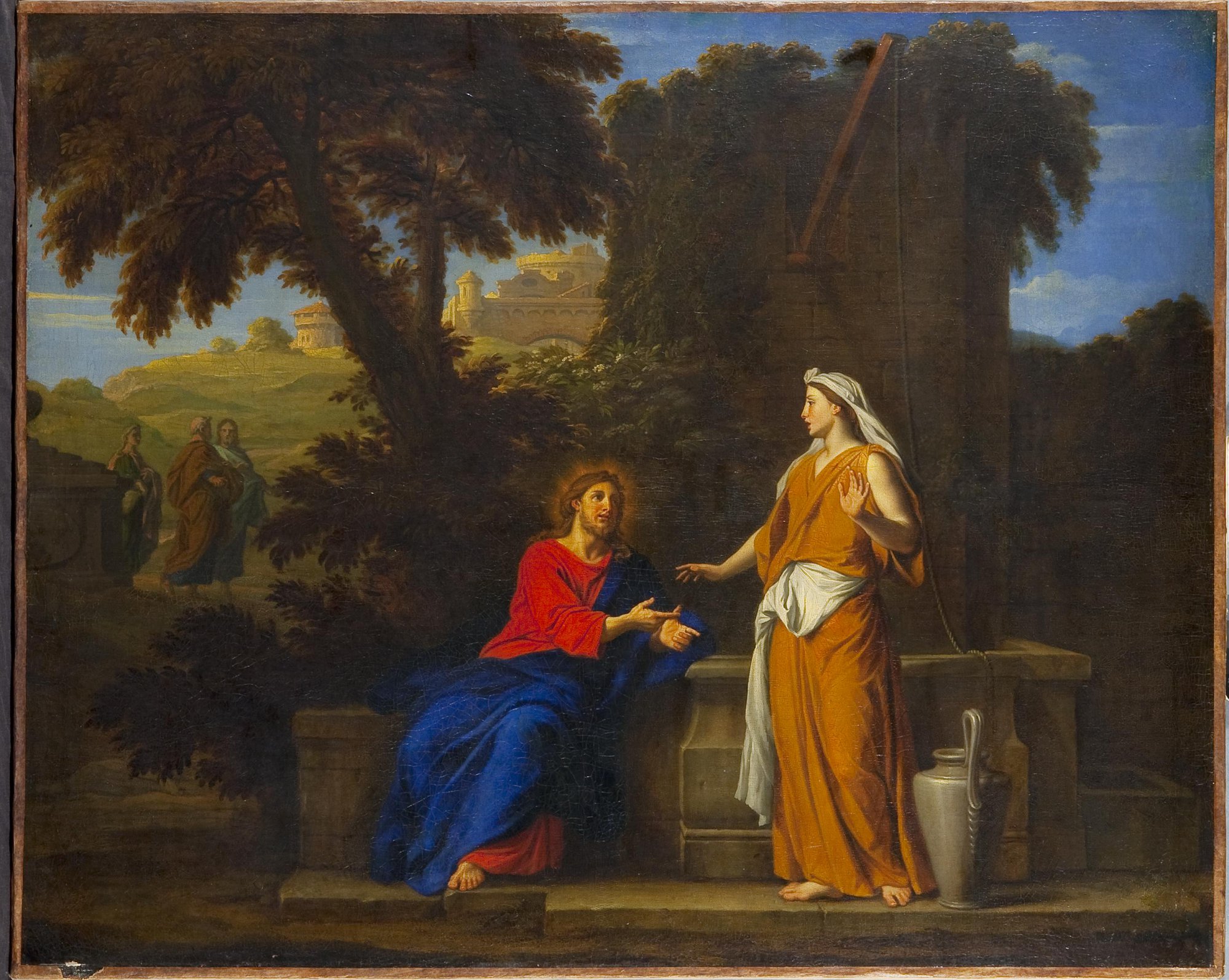
Christ and the Samaritan Woman. The State Hermitage Museum.
The painting entered the Hermitage in 1919 from the collection of A. K. Rudanovsky. It is on display in the Winter Palace, in room 281.
It shows Christ seated on a stone well, speaking to a woman who stands before him with a water jar at her feet, against a landscape of trees, hills and classical buildings.
The Object
The painting is a horizontal canvas, 64 by 81 centimetres.
Christ sits on the left, dressed in a red tunic and a blue mantle, his hand extended in a gesture of speech. The woman stands on the right, in an orange-yellow dress and a white headscarf, her hand raised.
Between them is the well, a stone structure with a wooden beam. In the background, a landscape with trees, a hill town and a blue sky; at the left, the disciples approach.
The Subject
The subject is taken from the Gospel of John.
Christ, travelling through Samaria, rests at Jacob’s well while his disciples go to buy food. A Samaritan woman comes to draw water, and Christ speaks to her of «living water» — the water of eternal life.
The conversation is one of the longest dialogues in the Gospels, and it was a favourite subject of seventeenth-century painters.
The Composition
The composition is classical: two figures, a central object, a landscape behind.
Christ and the woman are arranged on a diagonal, with the well between them. The gestures of the hands connect the two figures, and the landscape opens behind them like a stage set.
The balance of the composition — seated figure on the left, standing figure on the right — is a formula of French classical painting, derived from Poussin and his circle.
The Figures
The figures are painted with restraint.
Christ is shown with a beard and long hair, his face turned toward the woman, his hand raised in a gesture of teaching. The woman stands with her body turned slightly, her head inclined, her expression attentive.
Their draperies are painted in broad, simple folds: red and blue for Christ, orange and white for the woman. The colours are strong but harmonious.
The Landscape
The landscape is as important as the figures.
A large tree frames the left side; a hill with buildings rises in the distance; a blue sky with light clouds fills the upper part. The landscape is idealised, composed of classical elements rather than observed from nature.
This kind of landscape — the «classical landscape» — was developed in seventeenth-century Rome, and it became one of the hallmarks of French painting of the period.
French Classicism
The painting belongs to French classicism of the seventeenth century.
Classicism valued clarity, order, balance and restraint. Its subjects were drawn from the Bible, from mythology and from ancient history, and its compositions were built on geometry and perspective.
This painting shows those values: a clear subject, a balanced composition, restrained gestures and a landscape that frames the action.
Poussin’s Circle
The style of the painting is close to the circle of Nicolas Poussin.
Poussin worked in Rome, and his classical landscapes and history paintings influenced a generation of French artists. The composition, the draperies and the landscape of this painting all recall his manner.
The attribution is «unknown French painter», but the painting belongs to the Poussinist tradition, and it may have been made by a follower or a pupil.
Oil on Canvas
The painting is in oil on canvas.
Oil allows the painter to model forms in layers, to glaze shadows and to build up light. The surface of this painting is slightly darkened by age, and the varnish has yellowed, giving it a warm, mellow tone.
The brushwork is visible in the draperies and the landscape, but the faces are painted with a smoother, more careful touch.
The Well
The well is the centre of the composition.
It is a stone structure with a wooden beam, and it serves as a seat for Christ and as a stage for the conversation. In the Gospel, the well is Jacob’s well, a place of memory and prophecy.
The painter gives the well a simple, architectural form, and it anchors the two figures in the landscape.
The Disciples
The disciples appear in the background, on the left.
They are small figures, walking toward the well with food from the town. Their presence is essential to the story: in the Gospel, they return and are surprised to find Christ speaking with a Samaritan woman.
The painter places them at a distance, so that they do not disturb the central dialogue. They are a narrative detail, a reminder of the world beyond the well.
The Water Jar
The woman’s water jar stands at her feet.
It is a large, pale vessel with a handle, painted in grey and white. It is the attribute of the Samaritan woman: she came to draw water, and she leaves her jar behind when she goes to tell the town about Christ.
The jar is a small object, but it carries the story: without it, the scene would be a conversation; with it, it is a moment in a narrative.
The Tree
A large tree frames the left side of the painting.
Its trunk and branches are painted in dark brown, and its foliage fills the upper left corner. The tree balances the composition, frames the figures and gives the landscape depth.
Trees of this kind are a standard element of classical landscape: they provide a repoussoir, a dark foreground that pushes the scene back into space.
The Sky
The sky is blue, with light clouds.
It occupies the upper part of the canvas and gives the scene its light. The blue is clear and slightly cool, and it contrasts with the warm tones of the figures and the earth.
The sky is not a realistic observation but an idealised backdrop: a serene, luminous space that frames the sacred conversation.
The Gesture
Christ’s hand is the painting’s centre of gravity.
It is extended toward the woman, palm open, in a gesture of speech and offering. The gesture connects the two figures and gives the conversation its direction.
In classical painting, hands are as expressive as faces: they carry the meaning of the scene, and they guide the viewer’s eye from one figure to the other.
Provenance
The painting carries the inventory number GE-5710 and entered the Hermitage in 1919 from the collection of A. K. Rudanovsky.
In the Hermitage
The painting is on display in the Winter Palace, in room 281, among the French paintings of the seventeenth century.
It is a quiet, classical image, and it shows how a biblical story could be turned into a landscape of order and light — the ideal of French painting in the age of Poussin, and a room in the Winter Palace in the twenty-first century.