Artist: Unknown master from Zug
Origin: Switzerland
Date: 1639
Material: coloured and clear glass, lead
Technique: silver stain, overglaze painting
Dimensions: 34 × 22.5 cm
Current Collection: The State Hermitage Museum
Inventory Number: V-203
Hermitage ID: 134664
Rudanovsky Connection: Entered the Hermitage in 1919 from the collection of A. K. Rudanovsky.
A Swiss stained-glass panel of 1639, made for Oswaldt Weber and painted with a knight on horseback beneath a canopy of architecture.
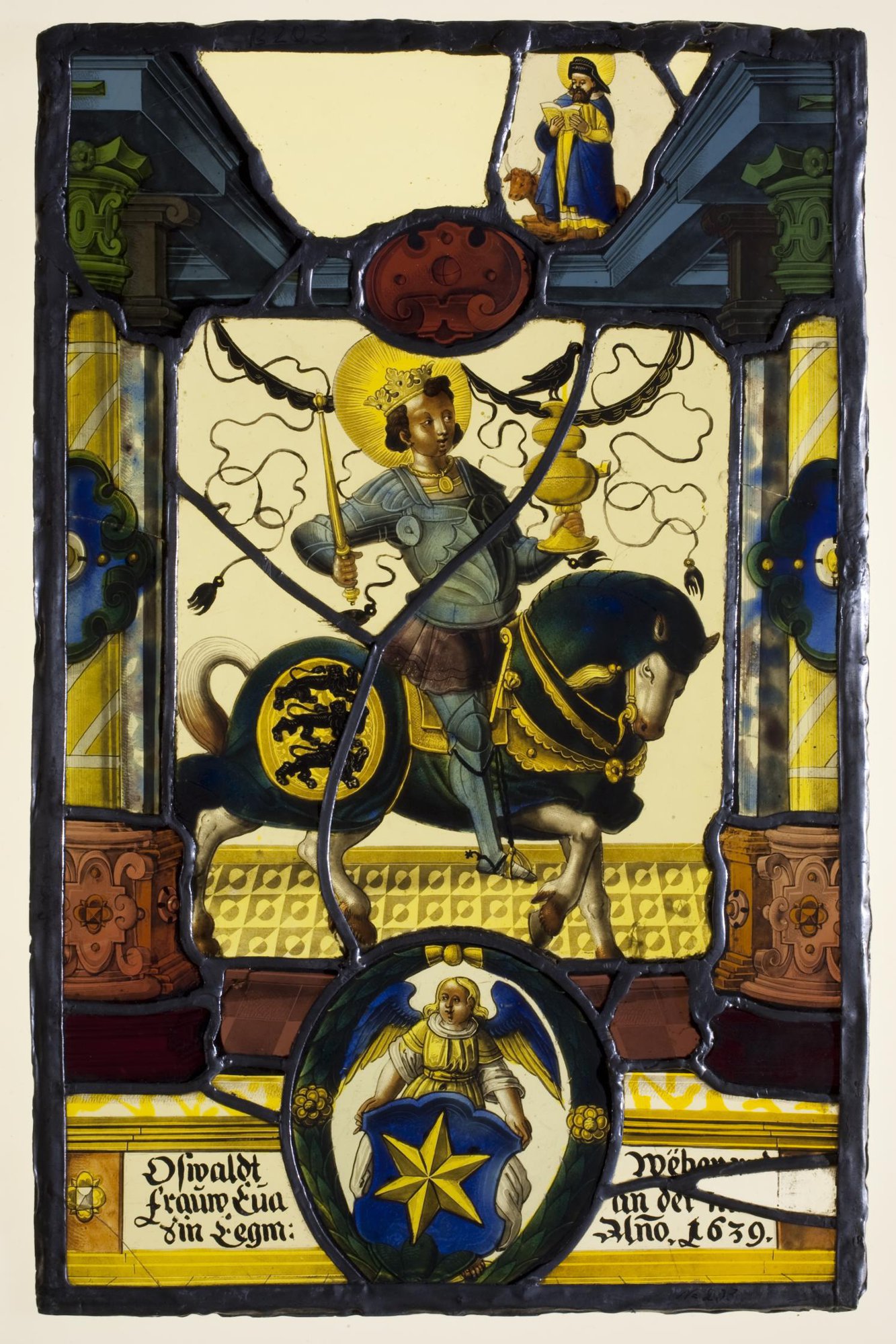
Stained Glass of Oswaldt Weber. The State Hermitage Museum.
The panel entered the Hermitage in 1919 from the collection of A. K. Rudanovsky. It is not currently on permanent display.
It is a small rectangle of glass, lead and paint — a window panel made to be set into a larger window, and a coat of arms made to be read.
The Object
The panel is framed by painted architecture: columns, cornices and a segmental arch, all in grey and gold.
In the centre, a knight in armour rides a dark horse, a sword in one hand and a golden chalice in the other. He has a halo, and above him a scroll curls through the air. At the bottom, an angel holds a blue shield with a gold star.
Below, on a yellow band, an inscription in black lettering names the donor and the date: Oswaldt Weber … Anno 1639.
The Wappenscheibe
The panel is a Wappenscheibe — a coat-of-arms window.
In Switzerland, such panels were commissioned by individuals, families, guilds and towns, and donated to churches, town halls and monasteries. They recorded the donor’s name and arms, and they were set into windows as marks of generosity and status.
The tradition flourished from the fifteenth to the eighteenth century, and it produced thousands of panels, of which many survive in museums and private collections.
The Knight
The knight is the central figure.
He wears plate armour, a plumed helmet and a golden collar, and he rides a dark horse with a decorated harness. In one hand he holds a sword, in the other a chalice.
The figure may be a saint — St George, St Maurice or a patron — or an idealized knight representing the donor’s family. The halo suggests a saint, but the arms on the shield are those of the Weber family.
The Chalice
The chalice is a curious attribute.
A knight with a chalice is unusual: the object suggests the Grail, or a reliquary, or a eucharistic vessel. It may identify the figure as a saint associated with a particular devotion, or it may be a family emblem.
Whatever its meaning, the chalice gives the panel its golden accent and its note of mystery.
The Architecture
The architecture frames the scene.
Painted columns, cornices and a tiled floor create a shallow stage, in the manner of the Renaissance and Baroque window panels. The architecture is not realistic: it is a frame, drawn in perspective, that gives the figures a setting.
The grey and gold of the stone contrast with the bright colours of the knight, the horse and the shield.
The Shield
The shield at the bottom is held by an angel.
It is blue, with a gold star, and it belongs to the Weber family. The angel stands in a roundel, surrounded by a wreath, and presents the arms to the viewer.
This arrangement is typical of Swiss panels: the arms are the point of the object, and everything else — the knight, the architecture, the inscription — supports them.
The Inscription
The inscription is painted on a yellow band at the bottom.
It is written in German black letter, and it names the donor, his wife and the date. The text is partly legible: Oswaldt Weber, Frau Eva, Anno 1639.
Inscriptions of this kind are the panels’ archives: they record who commissioned the window and when, and they allow the object to be dated and placed.
Silver Stain
The panel is painted with silver stain and overglaze painting.
Silver stain is a compound of silver applied to the glass and fired, producing a range of yellows and golds. Overglaze painting uses vitreous enamel to draw the details — faces, armour, foliage — on the surface of the glass.
The combination allowed the glass painters to achieve rich colours and fine detail, and it is one of the great techniques of European stained glass.
Lead
The glass is held together by lead cames.
The lead lines are visible throughout the panel: they outline the figures, separate the colours and hold the pieces in place. In a window, the lead is structural; in a museum panel, it is also part of the drawing.
The lead has oxidized over time, and its dark lines contrast with the bright glass.
Zug
The panel is attributed to an unknown master from Zug.
Zug is a small city on the lake of the same name, in central Switzerland, and it was one of the centres of Swiss glass painting. Its workshops produced panels for churches, town halls and private houses across the region.
The attribution is based on style rather than on a signature: the architecture, the figure types and the palette are characteristic of Zug glass painting of the 1630s.
The Frame
The painted architecture is the panel’s frame.
It is drawn in perspective, with columns, cornices and a tiled floor, and it creates a shallow stage for the figures. The architecture is not real: it is a painted setting, a device to give depth and dignity to the scene.
Frames of this kind are a hallmark of Renaissance and Baroque glass painting, and they connect the panel to the traditions of theatre and perspective.
Glass Painting
Glass painting is a difficult art.
The painter works on pieces of coloured glass, applying vitreous enamel and silver stain, and then fires them in a kiln. The colours fuse with the glass, and the result is a luminous surface that changes with the light.
Each piece must be cut to shape, painted, fired and assembled with lead. The process is slow, and mistakes are irreversible.
The Panel in a Window
The panel was made for a window.
It was set into a larger window, alongside other panels, and it was seen in the light of day, from inside a church or a hall. The lead cames held it in place, and the stone tracery framed it.
In a museum, the panel is lit from behind or from the front, and its original context is lost. But the glass still glows, and the colours still work as they were meant to.
Provenance
The panel carries the inventory number V-203 and entered the Hermitage in 1919 from the collection of A. K. Rudanovsky.
In the Hermitage
The panel is preserved in the State Hermitage Museum in Saint Petersburg and is not on permanent display.
It is a fine example of Swiss stained glass of the seventeenth century, and it preserves, in glass and lead, the memory of a family, a devotion and a date.
For a window, that is a great deal of memory — and it is still legible, three centuries later, in a museum store in Saint Petersburg. It no longer opens onto a street in Zug, but it still holds the light of day.