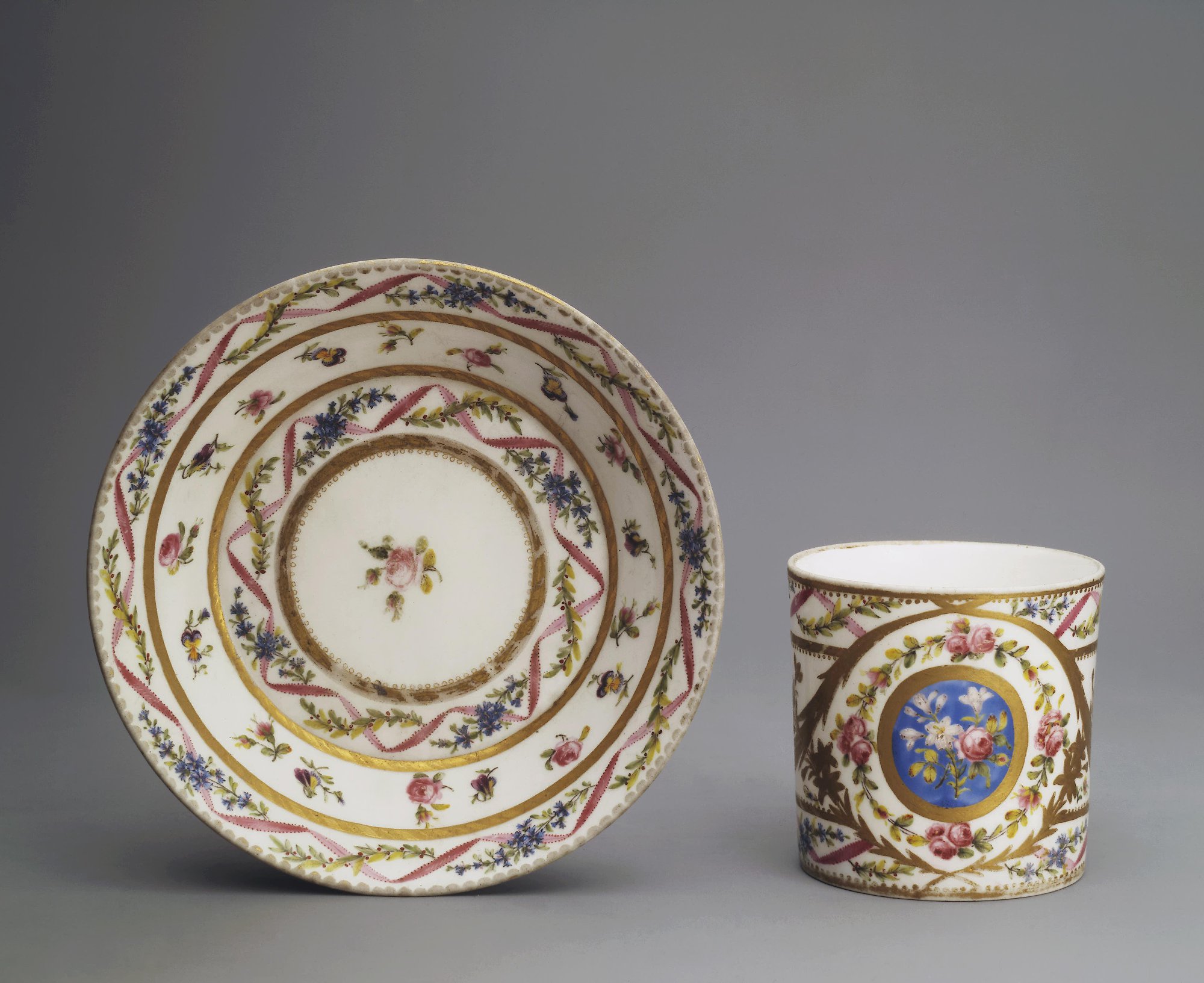
Organization: Meissen Porcelain Manufactory
Origin: Germany (Saxony), Meissen
Date: 1766–1768
Complex: Hunting Service
Material: porcelain
Technique: polychrome overglaze painting, gilding
Dimensions: height 3.1 cm; length 24 cm; width 15.7 cm
Current Collection: The State Hermitage Museum
Inventory Number: ZF-18720
Hermitage ID: 427168
Rudanovsky Connection: Entered the Hermitage in 1919; previously in the A.S. Dolgorukov collection
A second leaf-shaped Meissen tray of 1766–1768 from the «Hunting Service», painted with a deer hunt.
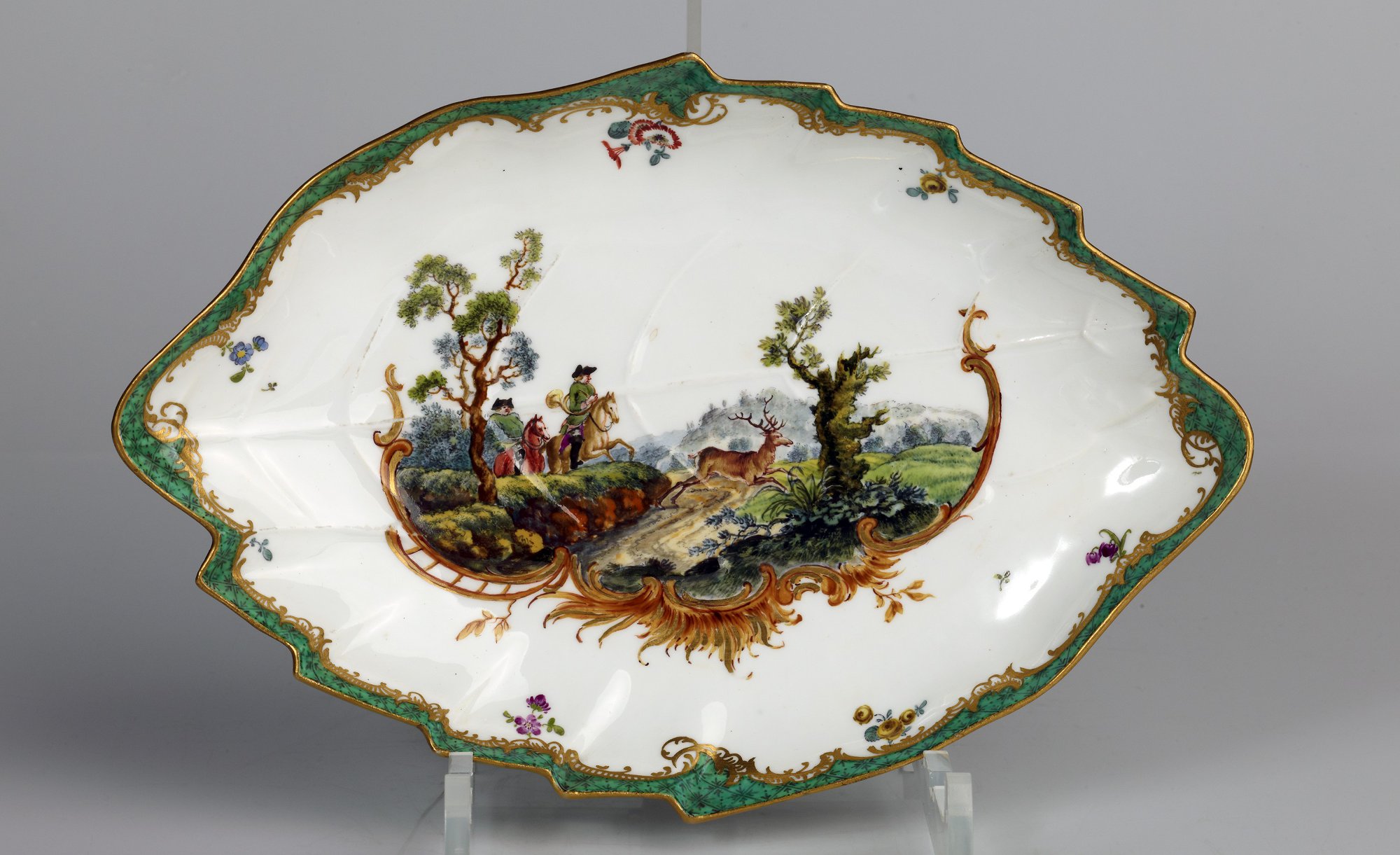
Tray in the Form of a Leaf Depicting a Deer Hunt. The State Hermitage Museum.
The tray entered the Hermitage in 1919, transferred from the Office for the Preservation of Monuments of Art and Antiquity. The record notes that it was previously in the A. S. Dolgorukov collection.
It is a shallow leaf-shaped tray — 24 centimetres long — with a green border and two horsemen chasing a stag.
The Object
The tray is leaf-shaped, with a lobed outline and a shallow well.
Its border is green, painted with a diaper pattern, and it is edged with gold scrolls and small flowers. In the centre, a gold cartouche frames a hunt: two riders on horseback and a stag in flight.
The painting is delicate, and the colours are soft: greens, browns, reds and whites.
The Hunt
The hunt is the tray’s subject.
Two horsemen ride from the left, and a stag runs to the right, pursued. The riders wear green and red coats, and their horses are brown and white.
The scene is a moment of action: the chase is under way, and the outcome is not yet decided.
The Riders
The riders are the scene’s actors.
They sit on their horses, their bodies leaning forward, and they hold their reins and their hats. Their faces are small but expressive.
Hunting on horseback was the great pastime of the eighteenth-century nobility, and the riders are its image: elegant, energetic and privileged.
The Stag
The stag is the quarry.
It runs across the ground, its antlers raised, its body stretched. It is painted in warm browns, with highlights on its coat.
The stag gives the scene its movement, and its flight turns the tray into a picture of the chase.
The Cartouche
The cartouche is a gold frame.
It is painted with scrolls and leaves, and it surrounds the hunt like a window. Its shape is irregular, and it follows the landscape.
Cartouches of this kind are a feature of the service: they frame each scene and separate it from the white ground.
The Border
The border is green.
It is painted with a diaper pattern of small stars, and it is edged with gold scrolls and flower sprays. Its colour contrasts with the white ground and the brown horses.
The border is one of the signs of the service, and it unites its many pieces.
The Service
The tray belongs to the Meissen «Hunting Service».
The service was made in 1766–1768, and it was decorated with hunting scenes after paintings and prints. It was one of the most ambitious services of the eighteenth century.
Its pieces include plates, dishes, tureens, candlesticks and leaf-shaped trays, all painted with scenes of the chase.
The Provenance Note
The tray’s record is unusual.
Unlike most of the works in this group, it does not mention the Rudanovsky collection: it names the Dolgorukov collection instead.
This is worth stating plainly: not every object in this group came through the same hands, and the labels are not always the same.
The Ground
The ground is rough and grassy.
It is painted in greens and browns, with rocks and bushes, and it gives the horses their footing. A path runs across it, and a stream or a ravine separates the riders from the stag.
The ground is the scene’s stage: it gives the figures a place to move, and it suggests the countryside.
The Trees
The trees are painted in soft greens.
Two large trees frame the scene, one at each side, and their foliage rises above the riders. Their trunks are painted with a few strokes, and their branches spread across the sky.
Trees of this kind are a convention of landscape painting: they frame the scene and give it depth.
The Sky
The sky is pale and soft.
It is painted in light greys and blues, with a few clouds, and it fills the upper part of the cartouche. It gives the scene its light, and it opens the composition.
A pale sky is a feature of the service’s landscapes: it keeps the scene airy and legible.
The Gold
The gold is applied in scrolls and lines.
It edges the border, frames the cartouche and covers the small rococo ornaments. It was applied over the glaze, fired and burnished.
The gold gives the tray its richness, and it frames the hunt.
The Table
The tray was made for a table.
It held sweetmeats, fruit or small dishes, and it was part of the dessert service. Its leaf shape made it a decorative object as much as a useful one.
That table is gone, but the tray still carries its logic: a leaf of porcelain, holding something sweet.
The Path
A path runs across the scene.
It is painted in pale ochre, and it leads from the riders to the stag, and then into the distance. It gives the chase its direction, and it connects the figures.
Paths of this kind are a device of landscape painting: they lead the eye and give the scene a narrative.
The Rocks
Rocks are painted at the left.
They are brown and grey, and they frame the riders. Their rough surfaces contrast with the smooth horses and the soft grass.
Rocks of this kind are a convention of the landscape: they give the scene its texture, and they suggest wild nature.
The Piece’s Number
The tray carries an inventory number, ZF-18720.
Numbers of this kind were given by the museum, and they identify the object in the collection. They are the modern equivalent of the old owners’ marks.
The number is a small trace of the object’s life after the table: it is a museum object now.
The Horses
The horses are painted with care.
One is brown, one is white, and both are shown in motion: their legs are raised, their heads are turned, their tails flow. The riders sit close to their backs.
Horses were a favourite subject of porcelain painters, and their movement is one of the scene’s pleasures.
Provenance
The tray carries the inventory number ZF-18720. It entered the Hermitage in 1919, transferred from the Office for the Preservation of Monuments of Art and Antiquity, and it was previously in the A. S. Dolgorukov collection.
In the Hermitage
The tray is preserved in the State Hermitage Museum in Saint Petersburg and is not on permanent display.
It is a fine example of Meissen porcelain, and it preserves a moment of the chase: two riders, a stag and a green leaf of porcelain.
It is a leaf, and it is a hunt, and it has kept its two riders and its stag for more than two centuries.
It is a small thing, and it is complete: a leaf, a hunt, a stag. And the stag is still running. And the leaf is still green. And it is still a small monument to a green afternoon.