Artist: Christian Friedrich Herold (1700–1779), painter
Organization: Meissen Porcelain Manufactory, the Herold period
Origin: Germany
Date: circa 1735–1740
Material: porcelain and bronze
Technique: overglaze painting with gilding
Dimensions: height 16.4 cm; diameter 11 cm
Current Collection: The State Hermitage Museum
Inventory Number: ZF-16332
Hermitage ID: 352412
Rudanovsky Connection: Entered the Hermitage in 1919 from the collection of A. K. Rudanovsky.
A Meissen chocolate pot of about 1735–1740, painted with a scene of Chinese musicians and mounted in gilt bronze with a wooden handle.
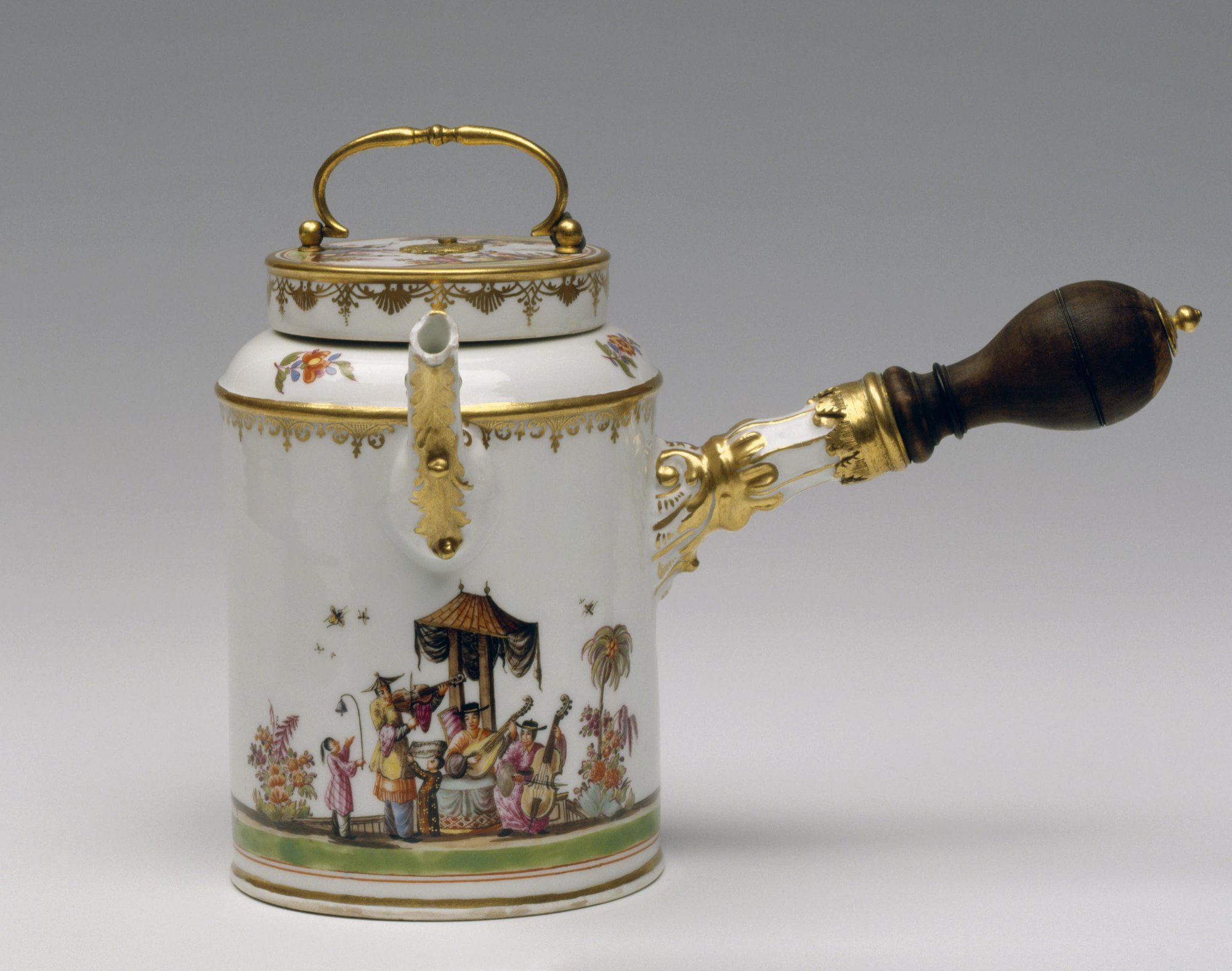
Covered Chocolate Pot. The State Hermitage Museum.
The pot entered the Hermitage in 1919 from the collection of A. K. Rudanovsky. It is on display in the Winter Palace, in room 305.
It is a cylindrical vessel with a domed lid, a short spout and a long wooden handle, painted in colours with a landscape and a group of figures.
The Object
The pot is white, with a slightly tapering body and a domed lid.
A scene is painted around the body: a group of Chinese musicians in a garden, with a pavilion, palms and flowering plants. The lid is decorated with flowers and a gold border.
The mounts are gilt bronze: a handle on the lid, a rim at the neck, a spout mount and a long wooden handle attached to the side with a gilt bronze fitting.
Chocolate
Chocolate was a luxury drink of the eighteenth century.
It was made from cocoa, sugar and spices, whisked to a froth and served hot. The chocolate pot was designed for the drink: a tall body, a lid to keep it hot, a spout for pouring and a handle set at a right angle to the spout.
Pots of this kind were made in silver, porcelain and faience, and they were among the most elegant objects of the table.
The Chinoiserie
The scene is a chinoiserie.
Chinoiserie was a European fantasy of China: pagodas, palms, mandarins, musicians and gardens, painted in pastel colours. It was one of the dominant decorative styles of the 1730s and 1740s, and Meissen was its most important centre.
The scene on the pot is not a record of China but an invention: a European dream of the East, painted on porcelain.
The Musicians
The group of musicians is the centre of the scene.
Several figures play stringed instruments under a canopy, while a child and a servant stand nearby. The musicians wear robes and caps, and their faces are painted with the simplified features of chinoiserie.
Music was a favourite subject of chinoiserie: it allowed the painter to combine figures, instruments and a garden in a single, charming composition.
Herold
The pot is attributed to Christian Friedrich Herold (1700–1779), a painter at Meissen.
Herold was one of the factory’s leading painters of chinoiserie, and his scenes are known for their delicate figures, their pale colours and their sense of fantasy. The «Herold period» of Meissen takes its name from him.
His work is one of the glories of eighteenth-century porcelain, and this pot is a good example of his manner.
The Mounts
The mounts are gilt bronze.
They were added to the porcelain to provide a handle, a spout and a rim, and they turn the pot into a complete object. The gilt bronze is chased and gilded, and it contrasts with the white porcelain and the coloured scene.
Mounts of this kind were often made by specialist bronziers, and they could be added in Europe after the porcelain left the factory.
The Spout
The spout is short and set at the front.
It is mounted in gilt bronze and covered with a small flap or lid. The spout allowed the chocolate to be poured, and its position — opposite the handle — made the pot easy to use.
A chocolate pot without a spout would be a jar; with it, it becomes a vessel for serving.
Meissen
Meissen was the first European factory to produce true porcelain.
It was founded in 1710, near Dresden, and it quickly became the most important porcelain manufactory in Europe. Its painters, modellers and gilders set the standard for the industry, and its wares were collected by princes and nobles.
This pot belongs to the factory’s golden age, when chinoiserie was at its height.
The Lid
The lid is domed and gilded.
It fits into the rim of the pot and keeps the chocolate hot. Its handle is a gilt bronze loop, and its surface is painted with flowers and a gold border.
The lid is a small painting in its own right, and it completes the object: a pot without a lid would be a jug.
The Handle
The handle is long and made of wood.
It is attached to the body with a gilt bronze fitting, shaped like a shell and leaves, and it extends far enough to keep the hand away from the hot porcelain. The wood is dark and polished, and it contrasts with the white body.
A handle of this kind is a practical solution and a decorative one: it gives the pot its distinctive profile.
The Colours
The colours of the scene are soft and pale.
Pinks, greens, browns, a little blue and gold: the palette of chinoiserie, applied in thin washes over the glaze. The figures are painted with a fine brush, and their robes and instruments are described in a few strokes.
The restraint of the palette is what makes the scene legible on a curved surface.
The Cabinet
The pot was made for a cabinet as much as for a table.
Chinoiserie porcelain was collected and displayed, and a pot like this one would have stood on a shelf among other precious objects. Its mounts and its painting made it a piece to be looked at, not only used.
In a museum case, it is still an object of display, and it still invites close looking.
The Body
The body is cylindrical, with a slight taper.
Its flat surface is ideal for a painted scene: it gives the painter a continuous band to work with, and it allows the figures to be arranged in a landscape. The body is also easy to hold, and its volume is large enough for several cups of chocolate.
A cylinder is a simple shape, and its simplicity is what makes the painting legible.
The Rim
The rim of the pot is mounted in gilt bronze.
The mount covers the join between the body and the lid, protects the edge from chipping and adds a line of gold to the profile. It is chased with a small pattern, and it matches the other mounts.
Mounts of this kind were often added after the porcelain was made, and they could be changed or repaired.
Provenance
The pot carries the inventory number ZF-16332 and entered the Hermitage in 1919 from the collection of A. K. Rudanovsky.
In the Hermitage
The pot is on display in the Winter Palace, in room 305, among the European porcelain of the eighteenth century.
It is a small, precious object, and it preserves, in porcelain and gilt bronze, the European dream of China: musicians in a garden, painted on a pot for chocolate, made to be admired as much as used, and perhaps a little more.