Artist: Carl Christian Vogel von Vogelstein (1788–1868)
Origin: Germany
Date: 1811
Collection: The State Hermitage Museum
Provenance: A. K. Rudanovsky Collection; entered the Hermitage in 1922
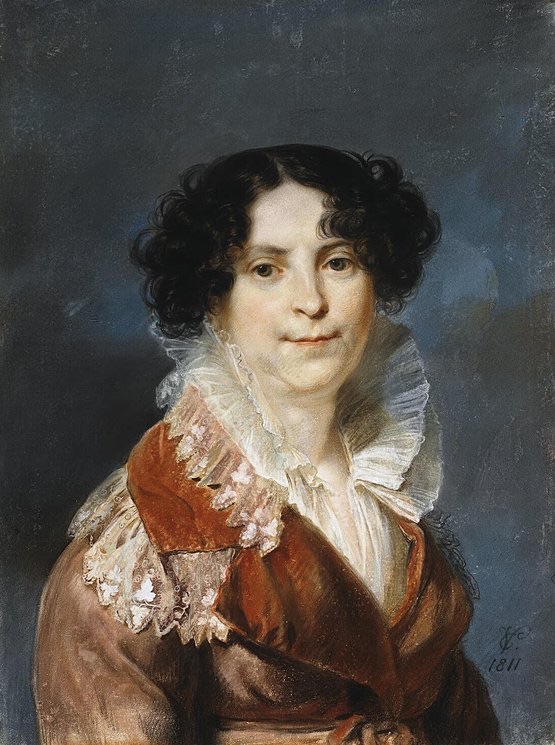
Portrait of a Lady, painted in 1811 by the German artist Carl Christian Vogel von Vogelstein, belongs to the tradition of European portraiture that flourished during the opening decades of the nineteenth century.
The painting later formed part of the A. K. Rudanovsky Collection and entered the State Hermitage Museum in Saint Petersburg in 1922.
Carl Christian Vogel von Vogelstein
Carl Christian Vogel von Vogelstein (1788–1868) was a German painter best known for his portraits and historical compositions.
Born in Wildenfels in Saxony, Vogel received his earliest artistic education from his father, the portrait painter Christian Leberecht Vogel. Growing up within an artistic household gave him an early familiarity with portraiture — a genre that would remain central to his career.
As a young artist, Vogel travelled beyond Germany and encountered the international artistic culture of early nineteenth-century Europe. His career eventually took him to major cultural centres including Dresden and Rome.
He became particularly recognised as a portraitist, producing likenesses of members of European aristocratic, intellectual and artistic society.
A Portrait from 1811
Portrait of a Lady was created at an early stage of Vogel’s career, in 1811.
The identity of the sitter is not specified in the surviving Rudanovsky record, and it would therefore be inappropriate to assign a name to her without further documentary evidence.
What survives is the work itself and its attribution to Vogel, placing the portrait within the broader development of European painting at a moment of considerable cultural and political change.
Portraiture at the beginning of the nineteenth century occupied an important position between the formal traditions of the eighteenth century and the increasingly personal approach that would characterise much nineteenth-century art.
A portrait could communicate social standing, elegance and refinement while also attempting to convey the individuality of its sitter.
European Portraiture
The year 1811 places the painting within the Napoleonic era, when Europe was undergoing profound political and social transformation.
Artistic life nevertheless continued across the continent, and portraiture remained particularly important among aristocratic and educated society.
German artists of Vogel’s generation worked within an increasingly international environment. Dresden, Vienna, Paris, Rome and other European centres provided opportunities for artists to study older masters, encounter contemporary movements and establish relationships with patrons from different countries.
Vogel’s own career reflected this international character.
His reputation as a portrait painter would eventually bring him into contact with numerous prominent figures of his time, while his travels and years in Italy broadened the artistic influences visible across his work.
Vogel von Vogelstein and Italy
Italy played an especially important role in Vogel’s artistic development.
Rome remained one of the essential destinations for European artists during the nineteenth century. Its ancient monuments, Renaissance masterpieces and international community of painters, sculptors, writers and patrons made the city an extraordinary centre of artistic exchange.
Vogel spent a substantial period of his career in Rome and became closely associated with its artistic environment.
Although Portrait of a Lady predates much of this later development, the painting belongs to the formative period of an artist who would go on to build a long career spanning portraiture, religious subjects and historical painting.
The Rudanovsky Collection
At some point in its later history, Portrait of a Lady became part of the A. K. Rudanovsky Collection.
The surviving record does not provide details of when or where the painting was acquired by Rudanovsky, so its earlier provenance should remain open unless further archival documentation is discovered.
Its presence in the collection nevertheless provides another indication of the range of European schools represented in the Rudanovsky holdings.
Alongside Italian, French, Flemish and German Renaissance works, the collection also contained paintings belonging to the artistic culture of the eighteenth and nineteenth centuries.
Vogel’s portrait represents this later European tradition.
From a Private Collection to the Hermitage
According to the surviving collection record, Portrait of a Lady entered the State Hermitage Museum in 1922 from the collection of A. K. Rudanovsky.
This transition from private ownership to a major public museum forms part of the wider history of the Rudanovsky collection during the early twentieth century.
Today, the painting serves not only as an example of Vogel von Vogelstein’s portraiture but also as a surviving link between a nineteenth-century European artist, the history of private collecting in Russia and the former A. K. Rudanovsky Collection.