Organization: Imperial Porcelain Factory
Origin: Russia, St Petersburg
Date: 1780–1796
Material: porcelain
Technique: overglaze polychrome painting, gilding
Dimensions: cup 5.5 × 8.3 × 6.1 cm; lid 3.2 × 6.5 cm; saucer 2.8 × 12.7 cm
Current Collection: The State Hermitage Museum
Inventory Number: ERF-398
Hermitage ID: 909232
Rudanovsky Connection: Entered the Hermitage in 1919 from the collection of A. K. Rudanovsky.
A Russian porcelain cup and saucer of the 1780s–1790s, painted to imitate wood and decorated with flowers.
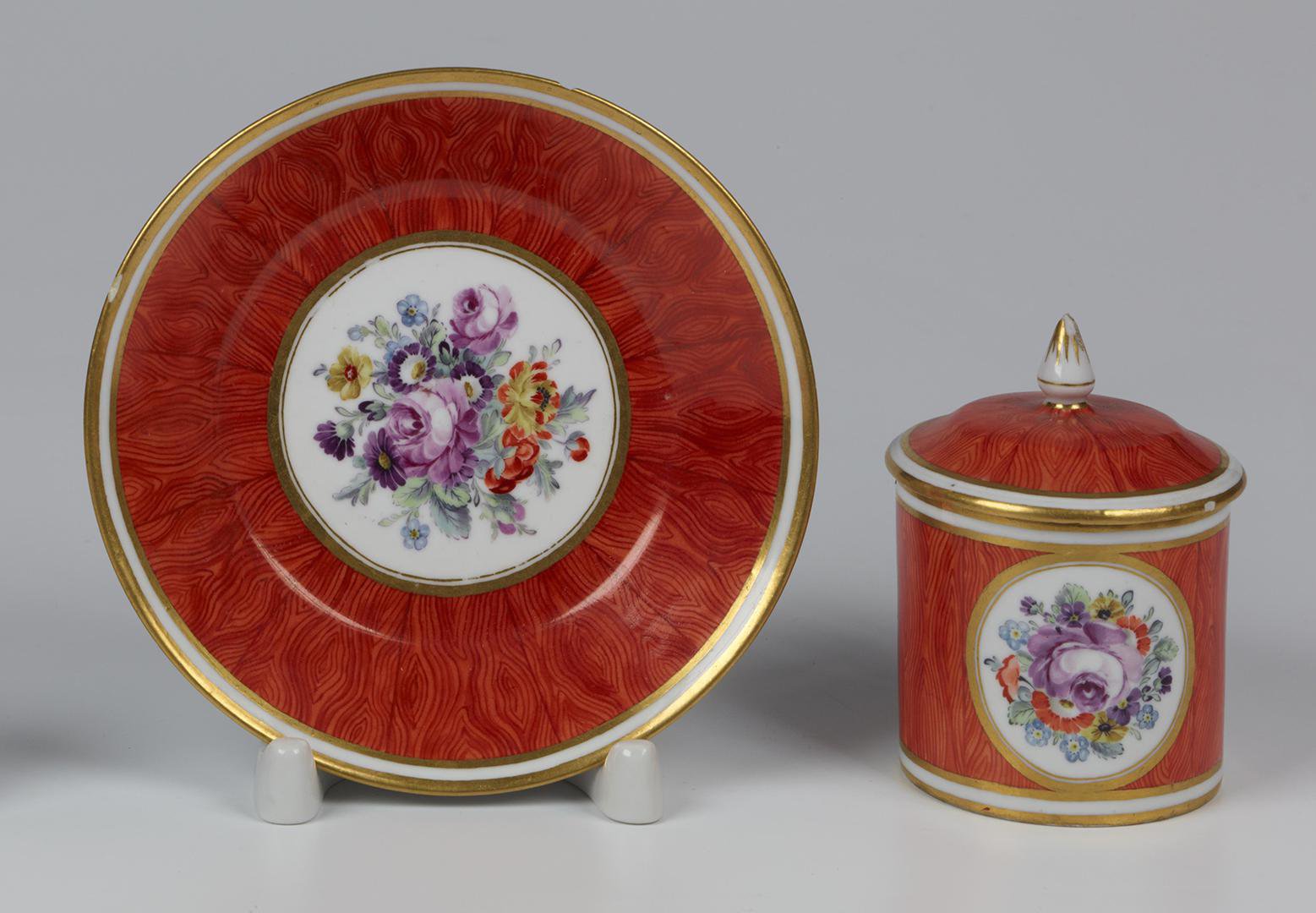
Covered Cup and Saucer with the Painting Imitating the Wood. The State Hermitage Museum.
The cup entered the Hermitage in 1919, transferred from the Office for the Preservation of Monuments of Art and Antiquity, and it was previously in the collection of A. K. Rudanovsky. It is not currently on permanent display.
It is a small tea service — cup, lid and saucer — painted in a red-brown ground that imitates wood, with white reserves of flowers.
The Object
The cup is cylindrical, with a small handle and a domed lid ending in a pointed finial.
The ground is a warm red-brown, painted with a wavy pattern that imitates the grain of wood. In the centre of the cup and of the saucer, a white oval reserve contains a bouquet of flowers.
The edges are banded with gold, and the lid carries the same decoration as the cup.
The Wood Imitation
The ground imitates wood.
It is painted with a wavy, flowing pattern, in reds and browns, and it reproduces the grain of a polished wooden surface. The imitation is convincing: the eye reads it as wood, not as porcelain.
Trompe-l’œil was a popular device in eighteenth-century porcelain: it allowed the painter to imitate marble, wood, stone or fabric, and it turned a piece of ceramic into a visual joke.
The Flowers
The flowers are the cup’s decoration.
They are painted in the white reserves, and they include roses, pansies, convolvulus and other blossoms, in pinks, purples, yellows and blues. They are delicate and naturalistic.
Flower painting was one of the specialities of the Imperial Porcelain Factory, and bouquets of this kind were a favourite decoration for tea services.
The Gold
The gold is applied in bands and lines.
It frames the reserves, edges the rims and covers the finial of the lid. It is fired and burnished, and it shines against the brown ground.
Gilding was the final stage of decoration, and it gave the object its richness and its finish.
The Imperial Factory
The cup was made at the Imperial Porcelain Factory in St Petersburg.
The factory was founded in 1744, and it became the principal porcelain manufactory of the Russian empire. It produced services for the court, the nobility and the diplomatic service, and its painters were among the most skilled in Europe.
The factory’s wares are characterised by careful painting, rich gilding and a taste for imitation and invention.
The Shape
The cup is small and cylindrical.
It is a tea cup, and its shape is simple: a straight body, a small handle and a domed lid. The lid is unusual for a cup, and it suggests that the vessel was used for a hot drink that needed to be kept warm.
The saucer is shallow and wide, and it carries the same decoration as the cup.
The 1780s
The cup was made between 1780 and 1796.
It was a period of great activity at the Imperial Factory, when the court of Catherine II commissioned large services and the factory developed its own style. The taste of the period favoured classical forms and rich decoration.
The cup belongs to that moment: a small, refined object, made for a table of the elite.
The Cup
The cup is small and cylindrical.
It has a straight body, a small loop handle and a rim that meets the lid. Its size — 5.5 centimetres high — makes it a cup for a strong drink, perhaps tea or coffee.
The shape is simple, and it is the vehicle for the decoration: the wood ground and the flower reserve cover the body, and the gold bands frame them.
The Lid
The lid is domed, with a pointed finial.
It fits into the cup and keeps the drink warm, and it carries the same decoration: a wood ground, a flower reserve and gold bands. The finial is a small cone, painted with gold.
A covered cup is a luxurious object: it protects the drink, and it turns a simple vessel into a small ceremony.
The Saucer
The saucer is shallow and wide.
It is 12.7 centimetres across, and it carries a large white reserve with a bouquet of flowers, surrounded by the wood ground and gold bands.
The saucer is the cup’s companion, and it repeats its decoration at a larger scale, so that the two objects read as a single set.
Tea
The cup was used for tea.
Tea was a fashionable drink in eighteenth-century Russia, and it was served from porcelain services. The cup, the saucer and the lid were part of the tea table, along with the teapot, the sugar bowl and the tray.
A tea service was a sign of status, and its decoration was chosen with care.
The Collector
The cup came to the Hermitage with the Rudanovsky collection.
Rudanovsky collected Russian and European porcelain, and his collection included services, figures and decorative objects of many kinds.
The cup is therefore a double document: of the Imperial Porcelain Factory in the 1780s and of a Russian collector’s taste.
The Palette
The palette is warm and soft.
The red-brown of the wood ground, the white of the reserves, the pinks and purples of the flowers and the gold of the bands: the colours are harmonious, and they give the cup its richness.
The palette is typical of the Imperial Porcelain Factory in the 1780s: warm grounds, delicate flowers and generous gilding.
The Handle
The cup has a small loop handle.
It is painted with gold, and it curves out from the body in a simple, elegant shape. The handle is practical and decorative: it allows the cup to be lifted, and it gives the object a finished silhouette.
Handles of this kind were standard on Russian porcelain cups of the period.
Provenance
The cup carries the inventory number ERF-398. It entered the Hermitage in 1919, transferred from the Office for the Preservation of Monuments of Art and Antiquity, and it was previously in the collection of A. K. Rudanovsky.
In the Hermitage
The cup is preserved in the State Hermitage Museum in Saint Petersburg and is not on permanent display.
It is a small, charming object, and it shows how Russian porcelain could imitate wood, paint flowers and gild its edges — all in a cup that fits in the palm of a hand, and that once held tea for someone at a Russian court, in a room full of porcelain, two hundred years ago.
The wood grain is a trick, the flowers are a pleasure, and the gold is a promise of wealth: three small effects, combined in a cup that was made to be admired as much as used. It is a lesson in how porcelain can imitate the world and improve on it.
To look at it closely is to see the painter’s hand in every wave of the false wood and every petal of the flowers.