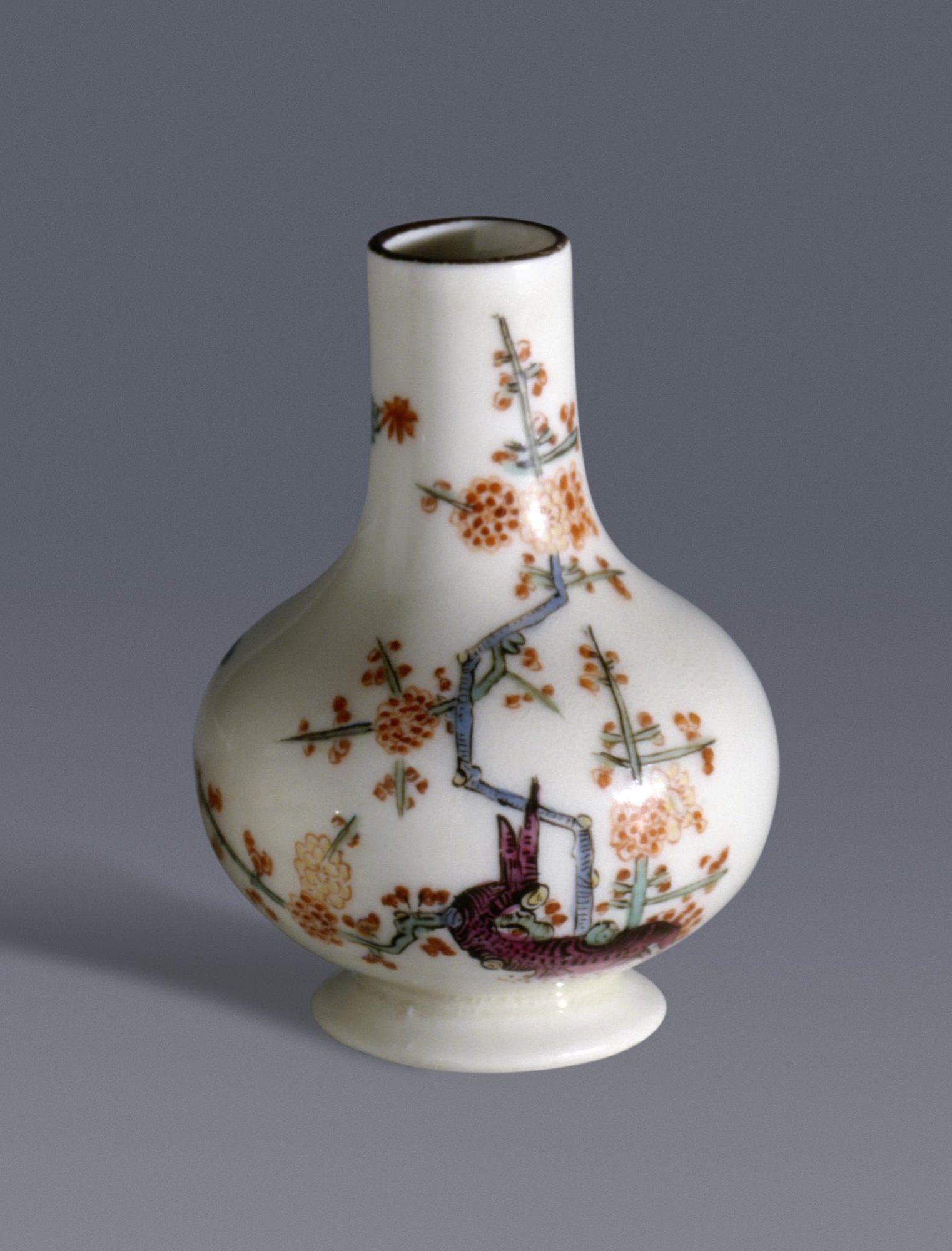
Artists: Johann Gottlob Kirchner (after 1737) and Johann Joachim Kändler (1706–1775), authors of the model
Organization: Meissen Porcelain Manufactory
Origin: Germany, Meissen
Date: circa 1727–1735
Complex: Service with a Yellow Lion
Material: porcelain
Technique: overglaze painting with gilding
Dimensions: height 27 cm; length 30.6 cm; width 17.5 cm
Current Collection: The State Hermitage Museum
Inventory Number: ZF-16758
Hermitage ID: 354347
Rudanovsky Connection: Entered the Hermitage in 1919 from the collection of A. K. Rudanovsky.
A large Meissen covered tureen of about 1727–1735 from the «Yellow Lion» service, after models by Johann Gottlob Kirchner and Johann Joachim Kändler.
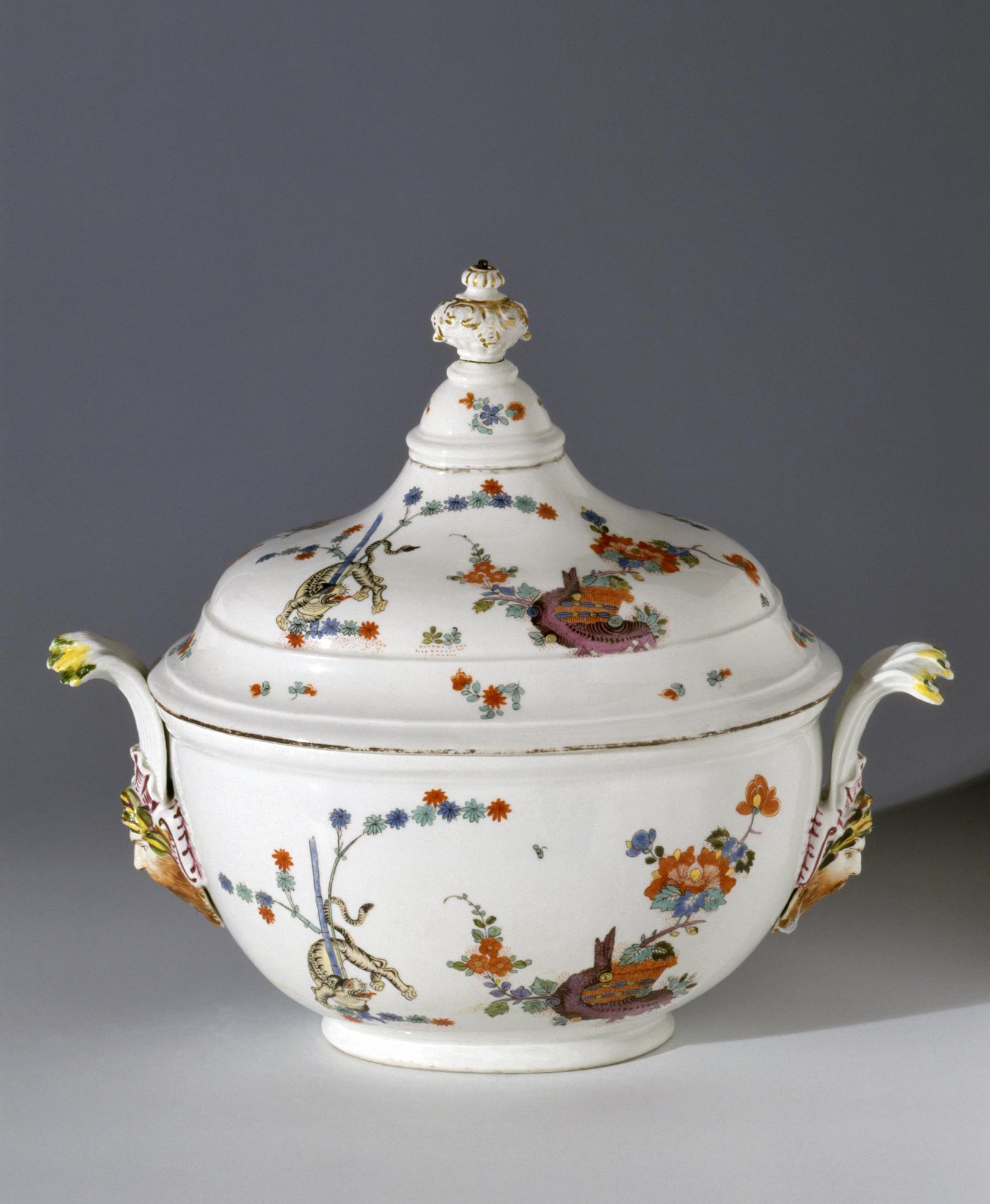
Covered Tureen. The State Hermitage Museum.
The tureen entered the Hermitage from the collections of Prince Dolgorukov, Fersen, A. K. Rudanovsky, Oliv and Gorchakov, Shuvalova, Baron Alexander Stieglitz, and the Leningrad Art Treasures Department. It is on display in the Winter Palace, in room 305.
It is the largest piece of the service — 27 centimetres high, 30.6 long — with a domed lid, two scroll handles and a painted tiger and bird.
The Object
The tureen has a broad, rounded body and a high domed lid.
It stands on a low foot, and it has two scroll handles with yellow and green tips. The lid is crowned by a modelled knob, painted with gold.
The body and the lid are white, painted with a tiger, a purple bird, flowering branches and small flowers.
The Tureen
A tureen is a serving dish.
It is one of the great pieces of a dinner service: it holds soup or stew, and it stands at the centre of the table. Its lid keeps the food hot, and its size makes it a centrepiece.
Tureens were among the most expensive pieces of a service, and they were modelled and painted with special care.
The Lid
The lid is domed and high.
It is decorated with the same pattern as the body: a tiger, a bird and flowers, arranged around the dome. Its knob is a modelled finial, painted with gold and white.
The lid turns the tureen into a closed vessel, and it gives the object its monumental profile.
The Bird
A purple bird is painted on the tureen.
It sits on a branch, its plumage painted in purple and white, and it looks toward the tiger. It may be a pheasant, a ho-ho bird or a fanciful creature of Kakiemon design.
The bird balances the tiger, and it gives the composition its second subject.
The Handles
The tureen has two scroll handles.
They curve out from the body, and their tips are painted in yellow and green, like leaves. The handles are practical — they allow the heavy tureen to be lifted — and decorative.
Handles of this kind are a feature of Meissen tureens of the period, and they give the object its baroque energy.
Kirchner and Kändler
The tureen is after models by two sculptors.
Johann Gottlob Kirchner worked at Meissen from 1727, and Johann Joachim Kändler from 1731; both were responsible for the factory’s figure and animal models. The tureen’s shape and handles are attributed to them.
The attribution places the object among the finest productions of the Meissen workshop.
The Service
The tureen belongs to the «Yellow Lion» service.
The service was produced at Meissen in the 1720s and 1730s, and it included plates, dishes, tureens and flasks, all decorated with the tiger and dragon pattern. It was one of the factory’s most successful services.
The tureen is its largest piece, and it carries the service’s name.
The Date
The tureen is dated to about 1727–1735.
The date places it in the early phase of the service, when the factory was developing its Kakiemon designs. The tureen is therefore an early and ambitious work.
The Foot
The tureen stands on a low foot.
It is a circular ring, white and plain, and it raises the body from the table. The foot gives the tureen stability, and it is the part that is hidden in use.
Foot rings of this kind are a feature of Meissen tureens of the period, and their wear is a sign of use.
The Knob
The lid is crowned by a modelled knob.
It is a small, fluted finial, painted with gold and white, and it is the point where the lid is lifted. Its shape is elegant and complex, and it gives the tureen its top.
Knobs of this kind were modelled separately and applied before firing.
The White
The white ground is the tureen’s space.
It is the colour of the porcelain, glazed and smooth, and it gives the painting its emptiness. The white of the tureen is warm, and it makes the tiger and the bird stand out.
In the Kakiemon style, white is a material: it is the sky, the air and the paper of the picture.
The Hall
The tureen is displayed in the Winter Palace, in room 305.
It stands in a case among other porcelain, and its size makes it the centrepiece of the display. Its white ground and its animals are visible from several angles.
The room and the tureen belong together: a nineteenth-century interior and an eighteenth-century service.
The Restitution
The tureen’s record lists several collections.
The names — Dolgorukov, Fersen, Rudanovsky, Oliv, Gorchakov, Shuvalova, Stieglitz — record the tureen’s passage through the great collections of imperial Russia, and its later transfer to the Hermitage.
The list is a document of Russian collecting, and it gives the tureen a history beyond its making.
The Glaze
The tureen is glazed.
The glaze is clear and glossy, and it covers the whole surface. It protects the painting, and it gives the porcelain its depth.
The glaze has a slight crazing in places, and it catches the light.
The Handles’ Tips
The handles are tipped in yellow and green.
The tips are modelled as leaves or scrolls, and they are painted in bright colours. They give the handles their finish, and they add a note of nature to the object.
Tips of this kind are a feature of Meissen tureens of the period, and they show the factory’s taste for invention.
The Bird’s Wings
The bird’s wings are spread.
They are painted in purple and white, with a pattern of feathers, and they give the bird its volume. The wings are one of the most detailed passages on the tureen.
Feathers are a test of a porcelain painter’s skill: they must be soft and patterned at once, and they must suggest the bird’s movement.
Provenance
The tureen carries the inventory number ZF-16758. It entered the Hermitage from the collections of Prince Dolgorukov, Fersen, A. K. Rudanovsky, Oliv and Gorchakov, Shuvalova, Baron Alexander Stieglitz, and the Leningrad Art Treasures Department.
The long list of owners records the tureen’s passage through several of the great collections of imperial Russia.
In the Hermitage
The tureen is on display in the Winter Palace, in room 305.
It is a magnificent object, and it preserves a scene: a tiger, a purple bird and a flowering branch, painted on the largest piece of the service.
It is the largest piece of the service, and it holds the table’s centre as it once held the soup. It has done so, quietly, for almost three hundred years.