Organization: Meissen Porcelain Manufactory
School: Meissen
Origin: Germany, Meissen
Date: circa 1735–1738
Complex: Service with a Yellow Lion
Material: porcelain
Technique: overglaze painting with gilding
Dimensions: height 6 cm; diameter 4.3 cm
Current Collection: The State Hermitage Museum
Inventory Number: ZF-16760
Hermitage ID: 354349
Rudanovsky Connection: Entered the Hermitage in 1919 from the collection of A. K. Rudanovsky.
A second small Meissen flask of about 1735–1738 from the «Yellow Lion» service, painted with a dragon.
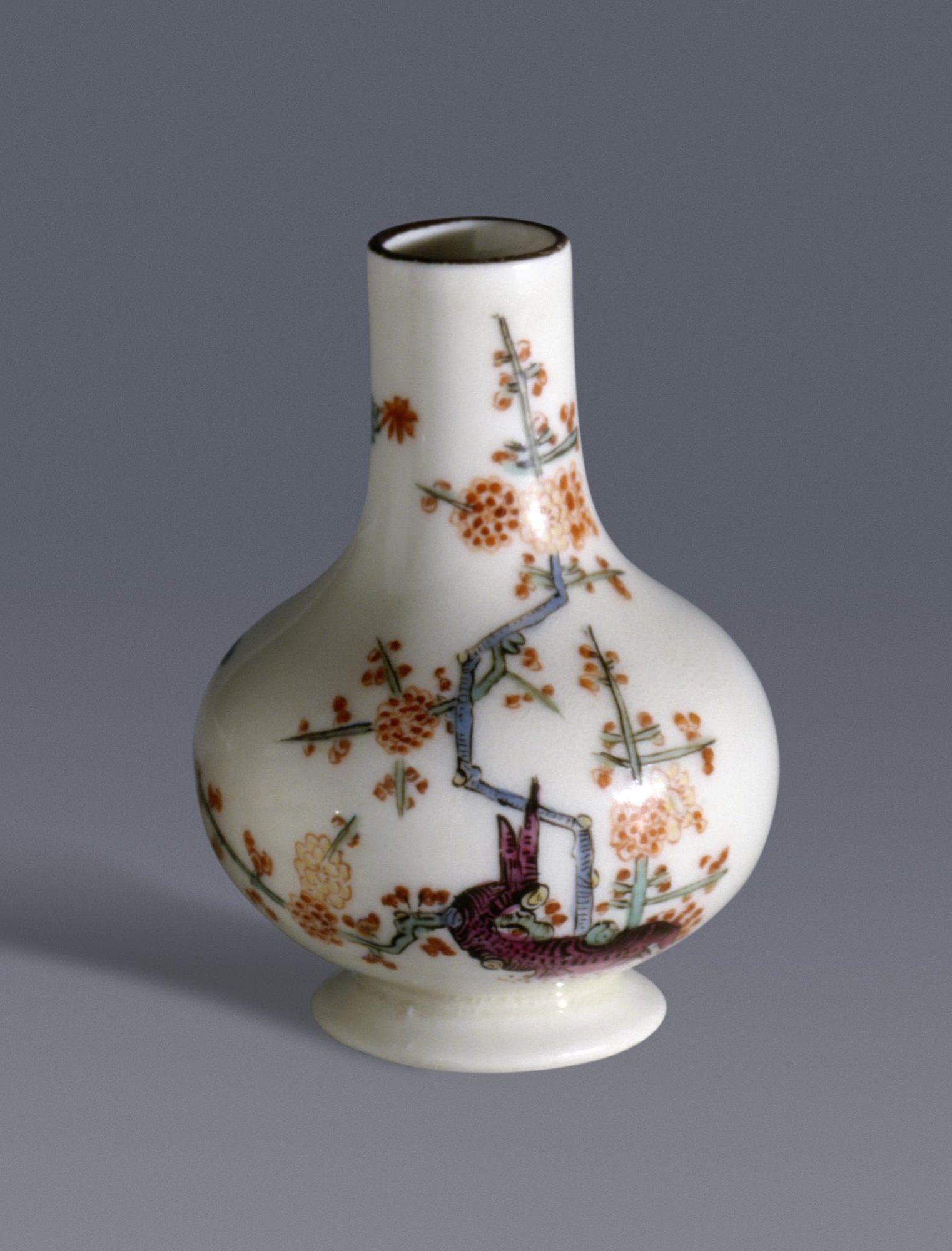
Flask (ZF-16760). The State Hermitage Museum.
The flask entered the Hermitage from the collections of Prince Dolgorukov, Fersen, A. K. Rudanovsky, Oliv and Gorchakov, Shuvalova, Baron Alexander Stieglitz, and the Leningrad Art Treasures Department. It is on display in the Winter Palace, in room 305.
It is a small flask — six centimetres high — with a white ground, a narrow neck and a scene of a dragon among flowering branches.
The Object
The flask has a bulbous body, a narrow neck and a flared foot.
Its surface is white, and it is painted with a dragon, branches and small flowers. The neck is bare, with a brown band at the rim, and the body is covered with the scene.
The flask is small and round, and it fits in the palm of a hand.
The Companion
The flask is the companion of another in the collection, ZF-16759.
The two are the same size and shape, and both belong to the «Yellow Lion» service. They differ in their decoration: one shows a tiger, the other a dragon.
Together, they form a pair, and their subjects echo the two animals of the service.
The Dragon
The dragon is the flask’s subject.
It is painted in purple and blue, with a long body, a horned head and clawed feet, and it is coiled among the branches. Its body is sinuous, and its tail curls.
The dragon is a Chinese and Japanese motif, and it was popular in European chinoiserie.
The Branches
The branches are painted in blue and green.
They rise from the foot of the flask and spread across the body, and they carry orange flowers. The branches give the composition its structure, and they frame the dragon.
Branches of this kind are a Kakiemon convention: they fill the empty spaces and give the scene its rhythm.
The Neck
The neck is bare.
It is white, with a brown band at the rim, and it is the only part of the flask without decoration. The bare neck gives the eye a rest, and it emphasises the painted body.
A bare neck is characteristic of Kakiemon-style flasks: it frames the scene and keeps the composition sparse.
The Service
The flask belongs to the «Yellow Lion» service.
The service was produced at Meissen in the 1720s and 1730s, and it included plates, dishes, tureens and flasks, all decorated with the tiger and dragon pattern. It was one of the factory’s most successful services.
The flask is one of its smallest pieces, and it carries the service’s name.
The Date
The flask is dated to about 1735–1738.
The date places it in the later phase of the service, when the factory was producing large quantities of the pattern for the courts of Europe. The painting is confident and refined.
The flask is therefore a mature work of the Meissen workshop.
The Condition
The flask is in fair condition.
Its foot is chipped, and the brown band at the rim is worn. The painting is still clear, and the surface is glossy.
The damage is part of the object’s history: a small flask, used and carried, and it has survived almost three hundred years.
The Shape
The flask is pear-shaped.
Its body is round and low, its neck is narrow, and its foot is flared. The shape is classical, and it is designed for pouring.
Flasks of this kind were common in the eighteenth century, and they were used for water, wine and liqueur.
The Foot
The flask stands on a flared foot.
It is white, with a brown edge, and it is chipped in places. The foot gives the flask stability, and it is the part that touches the table.
Foot rings of this kind are a feature of Meissen flasks of the period, and their wear is a sign of use.
The White
The white ground is the flask’s space.
It is the colour of the porcelain, glazed and smooth, and it gives the painting its emptiness. The white of the flask is warm, and it makes the dragon and the flowers stand out.
In the Kakiemon style, white is a material: it is the sky, the air and the paper of the picture.
The Hall
The flask is displayed in the Winter Palace, in room 305.
It stands in a case among other porcelain, and it is seen in a controlled light. Its small size makes it an object for close looking.
The room and the flask belong together: a nineteenth-century interior and an eighteenth-century flask.
The Restitution
The flask’s record lists several collections.
The names — Dolgorukov, Fersen, Rudanovsky, Oliv, Gorchakov, Shuvalova, Stieglitz — record the flask’s passage through the great collections of imperial Russia, and its later transfer to the Hermitage.
The list is a document of Russian collecting, and it gives the flask a history beyond its making.
The Glaze
The flask is glazed.
The glaze is clear and glossy, and it covers the whole surface. It protects the painting, and it gives the porcelain its depth.
The glaze has a slight crazing in places, and it catches the light.
The Branches’ Colour
The branches are painted in blue and green.
The blue is a pale, slightly grey blue, and the green is a soft sage. Together, they give the branches their distance and their delicacy, and they contrast with the dragon’s purple.
The colours are applied as enamels, and they have survived with little fading.
The Dragon’s Head
The dragon’s head is small and fierce.
It has horns, whiskers and a long snout, and it is painted in purple and blue. Its eyes are dark, and its mouth is open.
The head gives the dragon its character, and it is one of the finest passages on the flask.
Provenance
The flask carries the inventory number ZF-16760. It entered the Hermitage from the collections of Prince Dolgorukov, Fersen, A. K. Rudanovsky, Oliv and Gorchakov, Shuvalova, Baron Alexander Stieglitz, and the Leningrad Art Treasures Department.
In the Hermitage
The flask is on display in the Winter Palace, in room 305.
It is a small, fine object, and it preserves a scene: a dragon, a branch and a few flowers, painted on a white flask.
It is a small flask, and it has carried its dragon through almost three hundred years, and the dragon has not lost its temper.
It is a small object, and it has outlasted every table it stood on.
It is a small thing, but it is complete: a flask, a dragon, a branch, a few flowers, and three hundred years.
It is a small object, and it is also a small argument for the durability of delicate things.
It is, after all, only a flask, and it has done better than most of us.