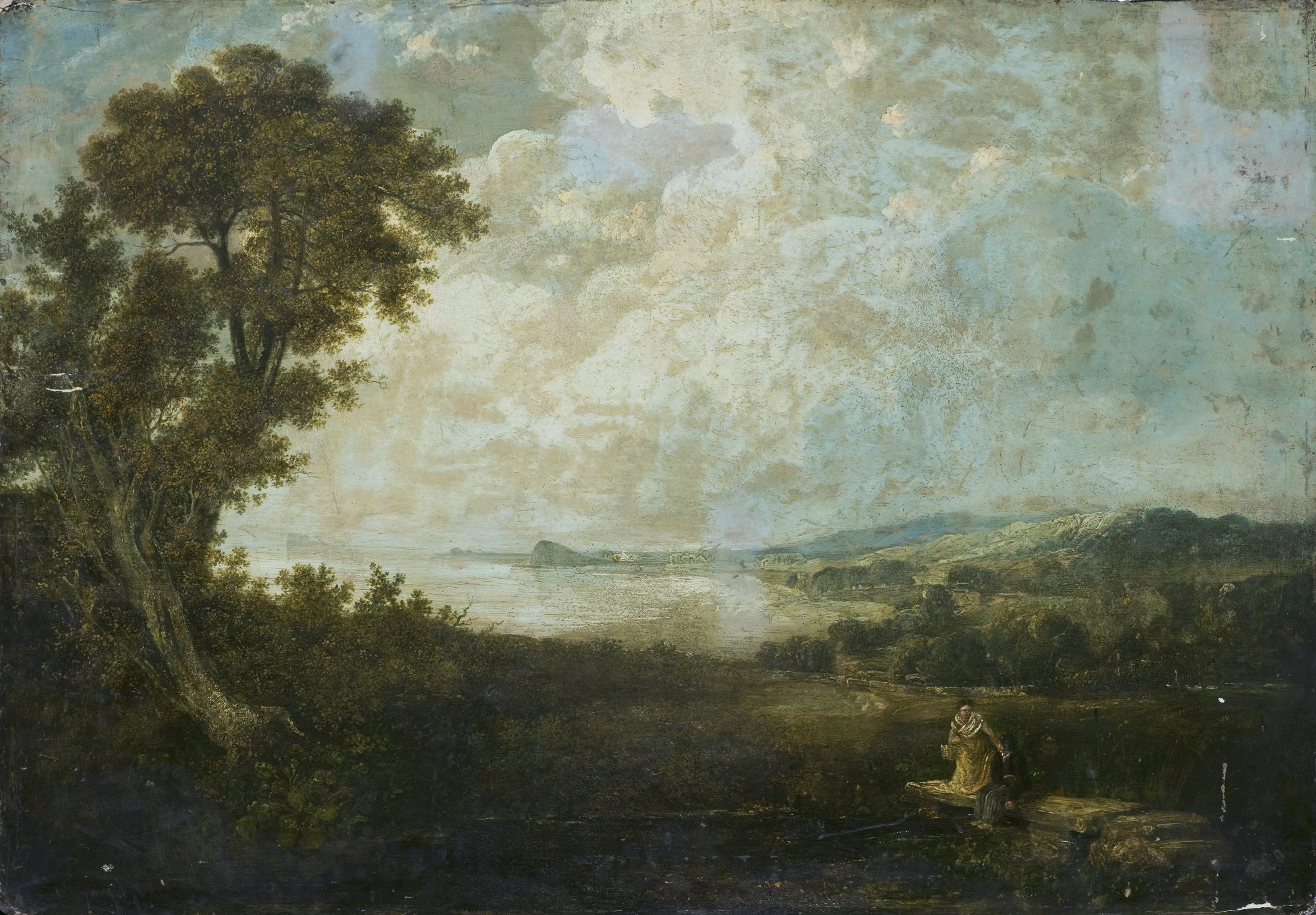
Artist: Unknown artist of the German school, 16th century
Origin: Germany
Date: first third of the 16th century
Material: panel
Technique: oil
Dimensions: 53 × 82 cm
Current Collection: The State Hermitage Museum
Inventory Number: GE-5580
Hermitage ID: 38671
Rudanovsky Connection: Entered the Hermitage in 1920 from the collection of A. K. Rudanovsky.
A German panel painting of the first third of the sixteenth century showing the Crucifixion with saints and a kneeling donor.
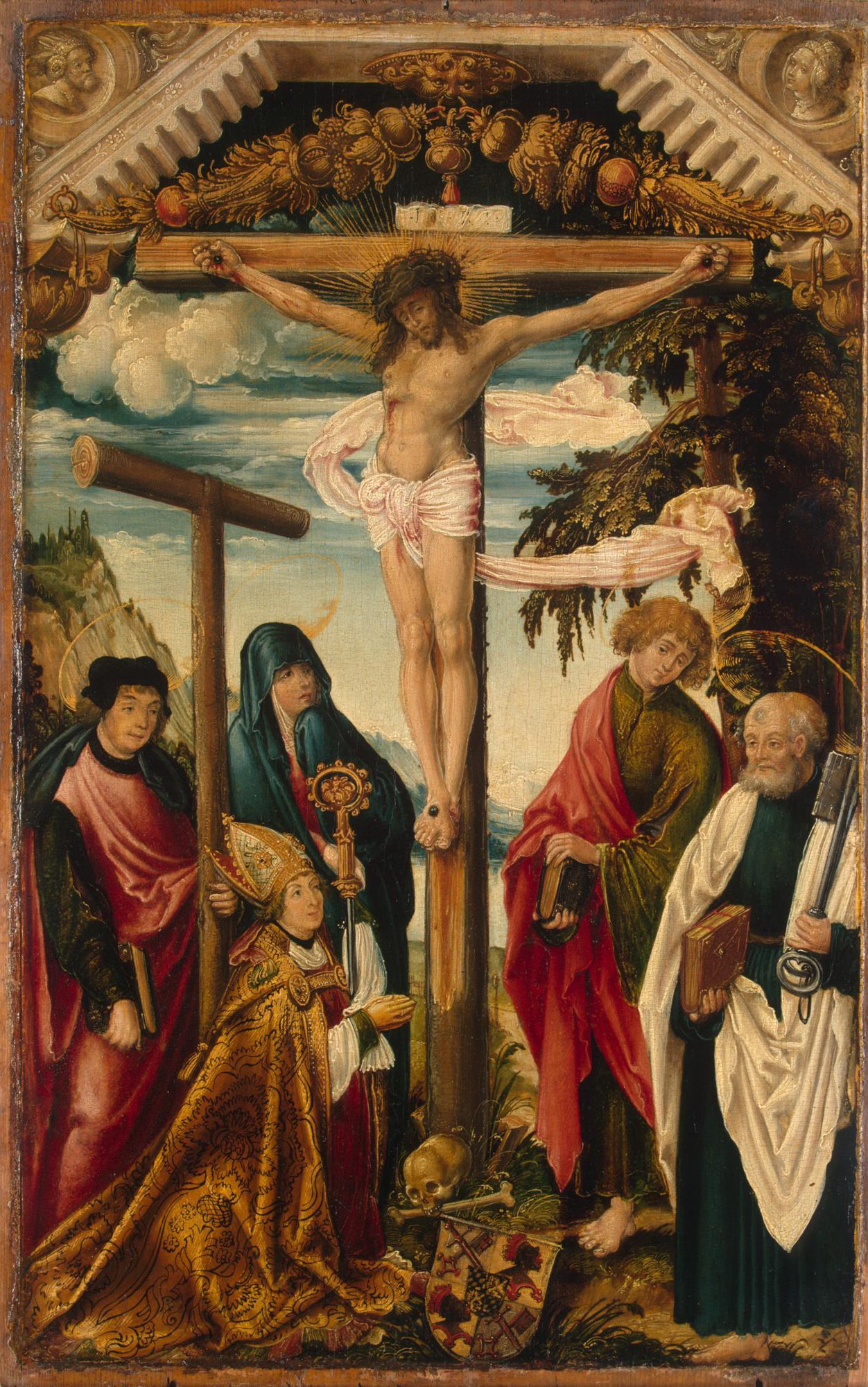
Crucifixion with Attendant Saints and Donor (Calvary). The State Hermitage Museum.
The painting entered the Hermitage in 1920, handed over by the State Museum Fund, and it was originally in the collection of A. K. Rudanovsky. It is on display in the Small Hermitage, in room 255.
It is a small panel — 53 by 82 centimetres — showing the Crucifixion, with four saints, a donor and a coat of arms.
The Object
The composition is vertical, and it is built around the cross.
Christ hangs on the cross at the centre, his body pale against a blue sky, and the cross is framed by a carved wooden arch at the top. At the foot of the cross, a skull and bones lie on the ground.
Around the cross stand four figures: a man in a dark cloak at the left, a woman in a blue mantle beside him, a young man in a red cloak at the right, and an old man with keys and a sword at the far right.
The Crucifixion
The Crucifixion is the painting’s subject.
Christ is shown on the cross, his arms outstretched, his head crowned with thorns and bowed. His body is thin, and his wounds are visible.
The cross is set against a landscape: a blue sky, clouds, a hill, a tree. The scene is both historical and symbolic, and it is the centre of the Christian faith.
The Saints
Four saints stand around the cross.
At the left, a man in a dark cloak with a book — perhaps St John the Evangelist or a patron saint. Beside him, a woman in a blue mantle, her hands clasped: the Virgin Mary.
At the right, a young man in a red cloak with a book: St John the Evangelist. At the far right, an old man with keys and a sword: St Peter.
The Donor
A donor kneels at the foot of the cross.
He is a bishop, dressed in a golden cope and a mitre, and he holds a crosier. He kneels in profile, his hands joined, and he is much smaller than the saints.
The donor is the painting’s patron, and his presence is a signature: he commissioned the panel, and he wanted to be remembered in it.
The Frame
The panel has a painted architectural frame.
At the top, a carved arch spans the composition, with a decorative frieze of fruit and flowers. In the upper corners, two roundels contain portraits: a man and a woman, perhaps the donors’ relatives.
The frame is part of the painting’s design, and it turns the panel into a small altarpiece.
The German School
The panel belongs to the German school of the early sixteenth century.
German painting of the period was characterised by expressive faces, strong colour and a taste for detail. It was the age of Dürer, Cranach and Holbein, and it was one of the great moments of Northern art.
This panel is by an unknown artist, but it shares the qualities of the period: clarity, colour and a devotional intensity.
The Coat of Arms
A coat of arms is painted at the bottom.
It is a shield with a quartered design, and it sits on the ground among the grass and the bones. It identifies the donor’s family, and it is the panel’s documentary element.
Coats of arms are common in donor paintings: they record the patron’s identity, and they allow the panel to be connected to a family and a place.
The Landscape
The landscape is narrow and bright.
A blue sky, with clouds, fills the upper part, and a hill, a river and a tree are visible behind the figures. The landscape is small, but it gives the scene depth and air.
Landscapes in German devotional painting are often simplified: they provide a setting, not a portrait of a place.
The Skull
A skull lies at the foot of the cross.
It is painted in pale bone, with dark eye sockets, and a bone crosses it. The skull is the skull of Adam, and it is a symbol of death and of the redemption: Christ’s death on the same spot redeems the first man’s fall.
The skull is a small, macabre detail, and it is one of the painting’s most eloquent images.
The Roundels
Two roundels at the top contain portraits.
They are small, circular paintings of a man and a woman, set into the corners of the frame. They may be the donors’ parents, or the donors themselves, and they add a personal note to the sacred scene.
Portraits in a devotional painting are a way of including the living in the sacred history.
The Panel
The painting is on panel.
Panel was the standard support for German painting of the period: it is smooth, rigid and takes fine detail. The panel is thin, and it shows signs of age: cracks, losses and a darkened surface.
The paint is oil, applied in layers, with glazes for the flesh and the sky.
The Altarpiece
The panel was probably part of an altarpiece.
It is small, and it may have been the central panel of a small retable, or a portable devotional image. Its frame, its donor and its coat of arms all point to a private or family commission.
The panel was made for a chapel, a house or a family, and it was meant to be prayed before.
The Colours
The colours are strong and clear.
Blue, red, gold, green and pale flesh: the palette of German painting of the period. The blue of the sky and of the Virgin’s mantle dominates, and the red of St John’s cloak and the gold of the donor’s cope provide the accents.
The colours are painted in oil, with glazes and highlights, and they have survived with some darkening and loss.
The Tree
A tree stands at the right.
It is dark green, with bare branches at the top, and it fills the right side of the composition. The tree is a landscape element, and it also has a symbolic meaning: the tree of life, or the tree of the cross.
Trees in Crucifixion scenes often refer to the Garden of Eden and to the wood of the cross, and they give the scene a cosmic dimension.
Provenance
The painting carries the inventory number GE-5580. It entered the Hermitage in 1920, handed over by the State Museum Fund, and it was originally in the collection of A. K. Rudanovsky.
In the Hermitage
The painting is on display in the Small Hermitage, in room 255.
It is a fine example of German devotional painting, and it preserves a moment of piety: a cross, four saints, a kneeling bishop and a coat of arms, painted on a small panel five hundred years ago, in a German workshop, for a bishop who wanted to be remembered.