Artist: Hans Wertinger
Origin: Germany
Date: First third of the 16th century
Style: Renaissance
Collection: The State Hermitage Museum
Provenance: A. K. Rudanovsky Collection, 1919
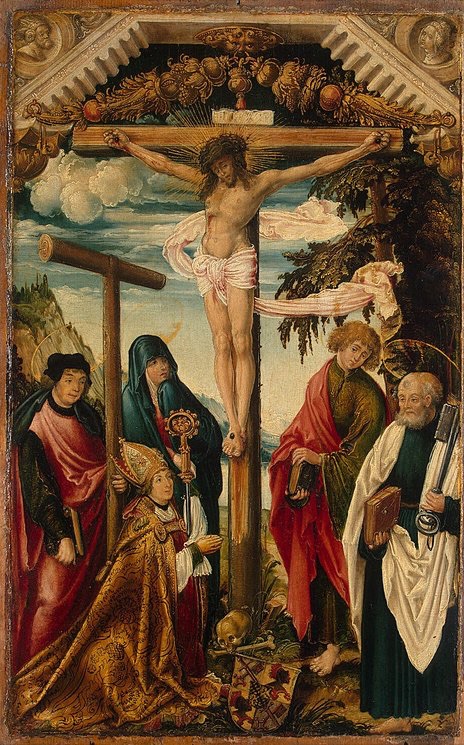
Crucifixion with Attendant Saints and Donor is a German Renaissance work by Hans Wertinger, dating from the first third of the sixteenth century. The painting combines the sacred subject of the Crucifixion with portraiture, landscape and the tradition of depicting a donor within a religious composition.
The work is now held by the State Hermitage Museum in Saint Petersburg and, according to the historical collection record, came from the A. K. Rudanovsky Collection in 1919.
The Crucifixion and the Donor
At the centre of the composition is the Crucifixion, surrounded by figures whose identities give the work a more personal and historical dimension.
Kneeling in richly decorated, gold-embroidered robes is Philipp of the Palatinate (Philipp Wittelsbach), a member of the House of Wittelsbach and an important ecclesiastical figure during the period of the Reformation. He was a son of the Elector Palatine and served as Bishop of Freising and Administrator of Naumburg.
Philipp appears not simply as an observer but as the donor incorporated into the sacred scene — a convention with a long history in European religious art.
Behind the kneeling donor stands his patron saint, Saint Philip, represented with a cross. On the opposite side appears Saint Peter, immediately recognisable through the large keys traditionally associated with the Apostle.
The presence of these saints creates a connection between the biblical subject and the individual for whom the painting was associated or commissioned.
Sacred Subject, Human Presence
Although the Crucifixion is one of the most solemn subjects in Christian art, the painting is distinguished by a comparatively light and vivid colouring.
Rather than creating an overwhelmingly dark or tragic atmosphere, Wertinger gives the scene an unusual sense of openness. The colour, landscape and carefully observed details introduce an almost secular quality into parts of the composition.
The donor’s elaborate clothing is particularly important in this respect. His richly embroidered robes establish his social and ecclesiastical status while simultaneously bringing the contemporary world of sixteenth-century Germany into the sacred narrative.
The result is characteristic of a period in which religious painting was increasingly influenced by a growing interest in the individual, the visible world and the observation of nature.
Hans Wertinger and the German Renaissance
Hans Wertinger was a German painter active during the early sixteenth century and is associated with the artistic culture of Bavaria.
His work belongs to the broader environment of the German Renaissance, a period in which established religious traditions existed alongside new approaches to portraiture, landscape and the representation of the natural world.
An especially notable feature of this painting is its attention to landscape.
The clear interest in nature reflects the influence of artists associated with the Danube School, an important development in early sixteenth-century German and Austrian art. Artists connected with this movement gave landscape an increasingly independent role rather than treating it merely as a background for human figures.
Forests, distant terrain, dramatic skies and the natural environment became active elements of the composition.
In Crucifixion with Attendant Saints and Donor, this sensitivity to the surrounding world helps distinguish the painting from more conventional representations of the same religious subject.
Philipp of the Palatinate
The identity of the donor gives the painting additional historical significance.
Philipp of the Palatinate belonged to the powerful Wittelsbach dynasty and lived during one of the most transformative periods in European religious history.
The early sixteenth century witnessed the beginning and rapid expansion of the Protestant Reformation, which fundamentally altered the political and religious landscape of the Holy Roman Empire.
Philipp himself remained an important Catholic church figure. His appearance in the painting therefore connects the work not only with Renaissance art but also with the religious and political world in which it was created.
His portrait places an identifiable historical individual directly within a timeless Christian narrative — joining personal devotion, dynastic identity and religious imagery in a single composition.
The Rudanovsky Collection
The painting later became part of the A. K. Rudanovsky Collection.
The Rudanovsky collection encompassed works from different periods and European schools, including Italian Renaissance art, French painting, Flemish works and German art.
Crucifixion with Attendant Saints and Donor represents an important German Renaissance component within that broader collecting history.
According to the surviving historical record, the work entered the State Hermitage Museum in 1919 from the collection of A. K. Rudanovsky.
Its transition from a private collection into one of the world’s major public museums places the painting within the wider history of the Rudanovsky collection and the dispersal of private art collections in Russia during the early twentieth century.
Today, the work remains a connection between three different histories: the religious and political world of sixteenth-century Germany, the development of Renaissance painting north of the Alps, and the history of the Rudanovsky Collection.