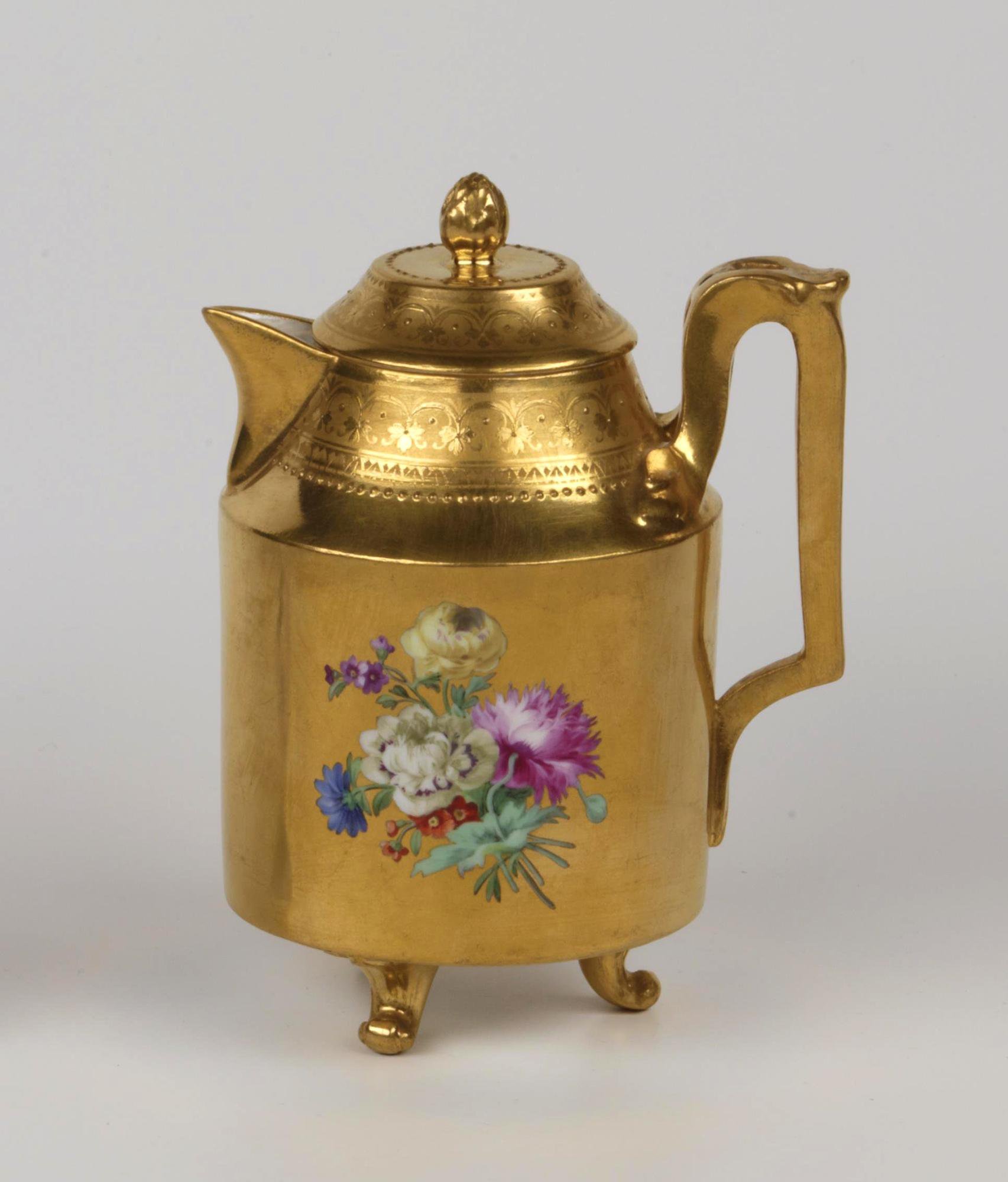
Organization: Imperial Porcelain Manufactory, Vienna
Origin: Austria, Vienna
Date: late 18th – early 19th century
Complex: Breakfast Service (Déjeuner)
Material: porcelain
Technique: gilding, polychrome painting
Dimensions: cup 5.6 cm high; saucer 13 cm in diameter
Current Collection: The State Hermitage Museum
Inventory Number: ZF-17055
Hermitage ID: 352438
Rudanovsky Connection: Entered the Hermitage in 1919 from the collection of A. K. Rudanovsky.
A Viennese porcelain cup and saucer of the late eighteenth or early nineteenth century, from a breakfast service.
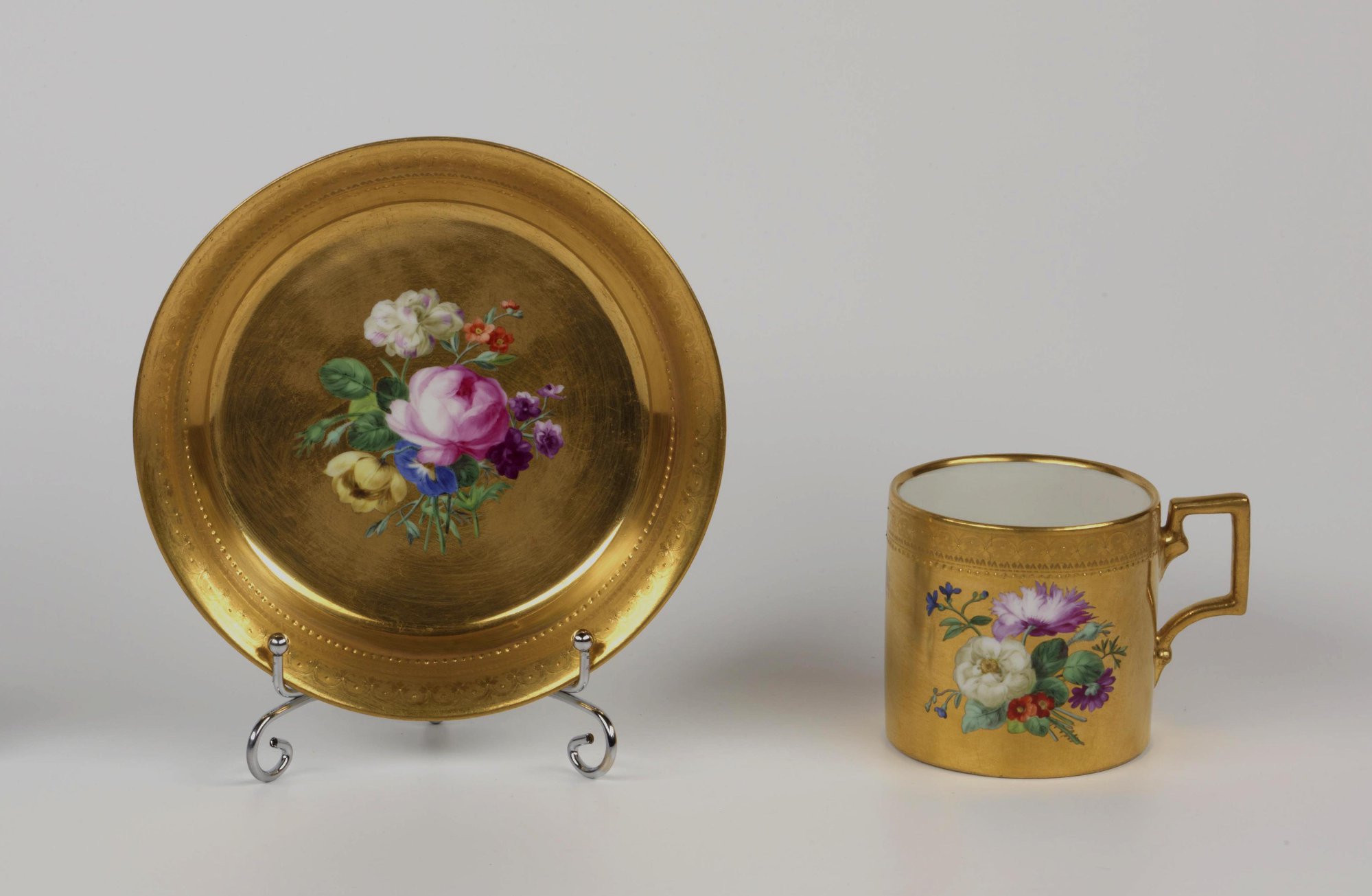
Cup and Saucer, Breakfast Service (ZF-17055). The State Hermitage Museum.
The cup entered the Hermitage in 1919, transferred through the Branch for the Protection of Monuments of Art and Antiquities from the collection of A. K. Rudanovsky. It is not currently on permanent display.
It is a small cup and saucer, completely gilded, with a bouquet of flowers painted on the cup and the saucer.
The Object
The cup is cylindrical, with a square handle and a gold ground.
On the front, a bouquet of flowers: a pink rose, a white flower, blue and purple blossoms, with green leaves. The saucer is round, with a gold ground, and it carries a similar bouquet in its centre.
The gilding covers the whole surface, and the flowers are painted directly on the gold.
The Gold
The gold is the set’s dominant colour.
It covers the cup and the saucer entirely, and it gives the objects a rich, warm, metallic surface. The gold was applied over the glaze, fired and burnished, and it is the most expensive part of the decoration.
A fully gilded service was a display of wealth: gold was costly, and its use on a whole set was a statement.
The Bouquet
The bouquet is the set’s ornament.
On the cup, it is painted on one side; on the saucer, it is placed at the centre. The flowers are painted in soft colours, and they stand out against the gold.
The bouquet turns a gold surface into a garden, and it gives the eye a place to rest.
The Cup
The cup is small and cylindrical.
It holds 5.6 centimetres of liquid, and it is designed for coffee or tea. Its walls are thin, and its handle is a square loop, painted with gold.
The cup’s shape is simple and modern, and it belongs to the neoclassical taste of the period.
The Saucer
The saucer is round and wide.
It is thirteen centimetres across, and it carries the cup and catches the drips. Its gold ground and central bouquet repeat the cup’s decoration, so that the two objects read as a set.
The saucer is the cup’s stage: it frames the cup and completes the service.
Vienna
The cup was made in Vienna.
The Imperial Porcelain Manufactory of Vienna was one of the earliest in Europe, and it produced services, figures and decorative objects. In the late eighteenth and early nineteenth centuries, it was known for its rich grounds, its flower painting and its gilding.
The cup belongs to that production, and it shows the Viennese taste for gold and flowers.
The Déjeuner
The cup is part of a breakfast service.
The service included a tray, a coffee pot, a cream jug, a sugar bowl and cups and saucers, all decorated with the same gold ground and flower bouquets. The cup is one of its smallest pieces.
A déjeuner was a private service, used for a small meal in a bedroom, a boudoir or a garden pavilion.
The Condition
The set is worn.
The gold is rubbed in places, especially on the handle and the rim, and there are small scratches and chips. The painting is still legible, but the object shows its age.
The wear is a sign of use: the cup was filled, lifted and drunk from, and its condition records that daily life.
The Handle
The cup’s handle is a square loop.
It is gilded, and it is attached to the body with a small scroll. Its shape is geometric and modern, and it contrasts with the round body of the cup.
Handles of this kind are a feature of Viennese cups of the period, and they give the object its neoclassical character.
The Rim
The rim of the cup is gilded and slightly flared.
It is thin, and it catches the light, and it gives the cup its delicate outline. The gilding on the rim is worn in places, where the lips touched it.
Rims of this kind were the most vulnerable part of the object, and their wear is a sign of use.
The Inside
The inside of the cup is white.
It is glazed and plain, without gilding, and it shows the colour of the coffee or tea. The white interior contrasts with the gold exterior, and it gives the cup its function.
A cup is a vessel before it is an ornament, and the white well is where the drink lives.
The Scale
At 5.6 centimetres, the cup is small.
It fits in the palm of a hand, and it holds a single portion. Its smallness is part of its character: it is an object made for one person, one moment and one pleasure.
Small objects demand close attention, and this cup rewards it.
The Collector
The cup came to the Hermitage with the Rudanovsky collection.
Rudanovsky collected European porcelain alongside paintings, drawings, glass and miniatures, and his collection included Viennese services and decorative objects.
The cup is therefore a double document: of Vienna in the late eighteenth century and of a Russian collector’s taste.
The Gilder
The gilding was the work of a specialist.
The gilder applied the gold in a liquid medium, fired it, and then burnished it with a hard stone to bring out its shine. The process was slow, and it required a steady hand.
The gold on this cup is even and bright, and it shows the gilder’s skill.
The Breakfast
The cup belongs to a breakfast.
A déjeuner was served in the morning, in a private room, and it was a small, intimate meal: coffee, cream, sugar, bread and fruit. The cup was the centre of the ritual.
The object is therefore not only a vessel but a piece of a morning: a small ceremony, repeated every day.
The Bouquet’s Flowers
The bouquet is a mixed bunch.
A pink rose, a white flower, a blue bellflower, a purple blossom and small red buds, with green leaves. Each flower is painted with a few strokes, and each has its own colour.
The variety is deliberate: it gives the bouquet the look of a real bunch, gathered in a garden and placed on the cup.
Provenance
The cup carries the inventory number ZF-17055. It entered the Hermitage in 1919, transferred through the Branch for the Protection of Monuments of Art and Antiquities from the collection of A. K. Rudanovsky.
In the Hermitage
The cup is preserved in the State Hermitage Museum in Saint Petersburg and is not on permanent display.
It is a small, rich object, and it preserves a moment of the Viennese table: a gold cup, a bouquet of flowers and a private breakfast.
It is a small gold object, and it has kept its flowers through two centuries of handling.
And it is still a cup, and the gold is still gold.