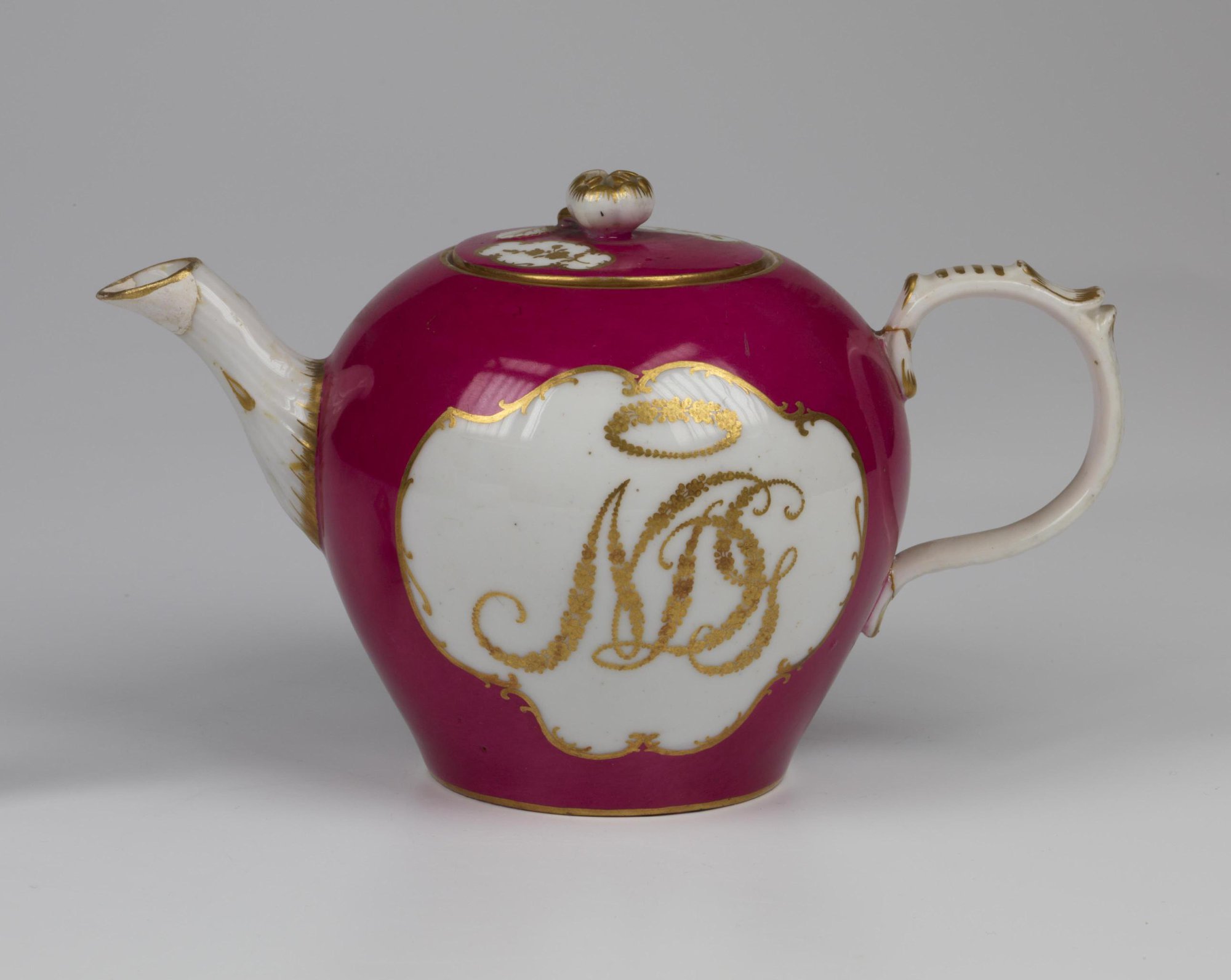
Organization: Francis Gardner Porcelain Factory
Origin: Russia, Moscow province, Dmitriev district, the village of Verbilki
Date: second half of the 18th century
Material: porcelain
Technique: overglaze monochrome coating, painting with gold
Dimensions: cup 4.3 × 7.3 × 9.2 cm; saucer 2.6 × 12.6 cm
Current Collection: The State Hermitage Museum
Inventory Number: ERF-216
Hermitage ID: 909323
Rudanovsky Connection: Entered the Hermitage in 1919 from the collection of A. K. Rudanovsky.
A second Gardner porcelain cup and saucer of the second half of the eighteenth century, with a crimson coating, a gilded monogram and a long history of damage.
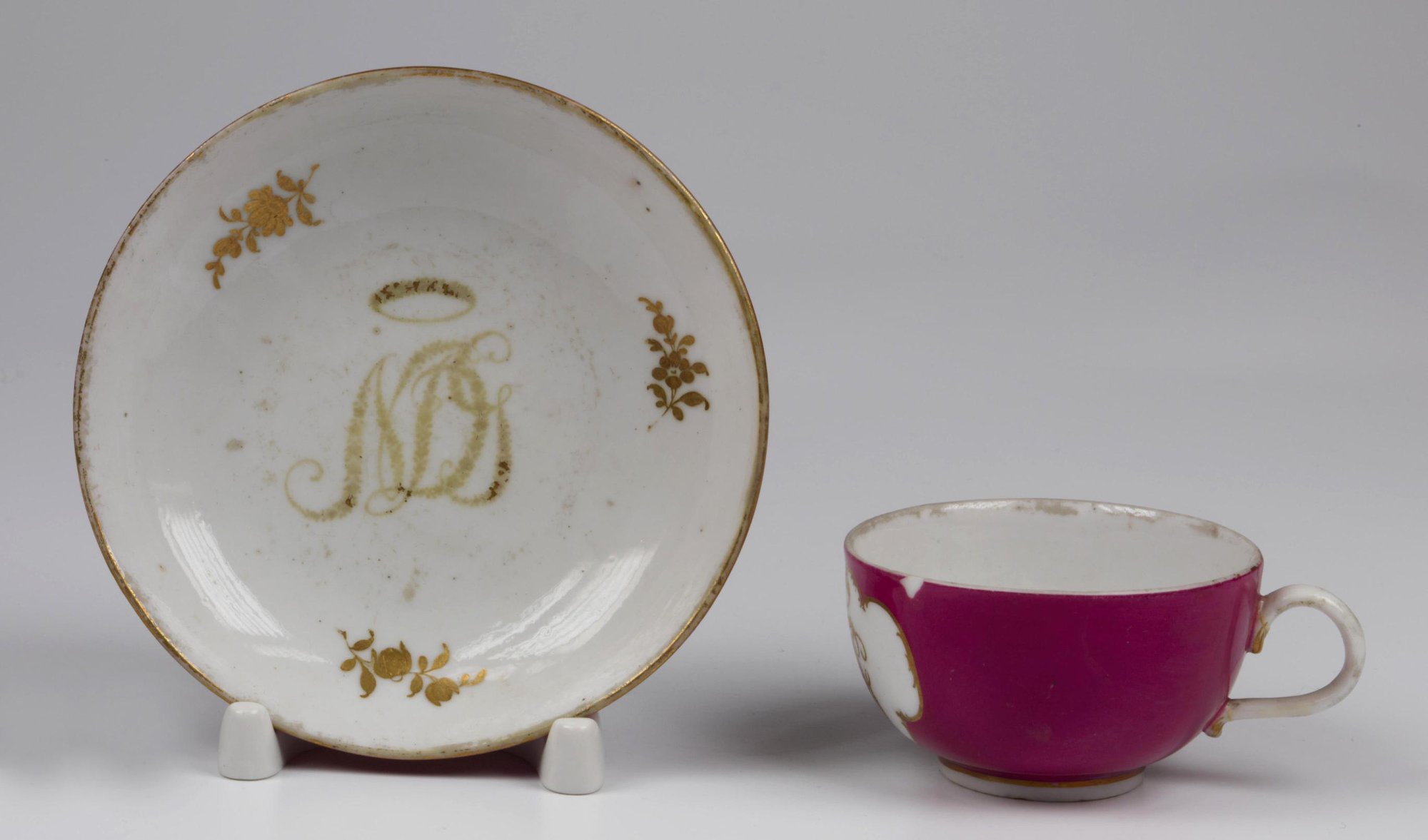
Cup and Saucer with Crimson Coating and Gilded Monogram (ERF-216). The State Hermitage Museum.
The cup entered the Hermitage in 1919, handed over from the collection of A. K. Rudanovsky via the Office for the Preservation of Monuments of Art and Antiquity. It is not currently on permanent display.
It is a small cup and saucer — the cup 4.3 centimetres high — with a crimson ground, a white reserve and a gilded monogram, and its saucer is broken and repaired.
The Object
The cup has a rounded body, a white handle and a white interior.
Its exterior is covered with a crimson coating, and a white reserve contains a gilded monogram. The rim and the base are banded with gold.
The saucer is white, with a large gold monogram in the centre, gold flower sprays and a gold rim — and it is crossed by a network of cracks.
The Twin
The cup is the twin of another in the collection, ERF-434.
The two are of the same type: the same crimson ground, the same white reserve, the same gilded monogram and the same gold sprays. They were probably part of the same service.
They differ in condition: the other cup is worn, but this one is broken.
The Damage
The saucer is badly damaged.
It is broken into several pieces and repaired, and the cracks run across its surface in a network of dark lines. The gold is worn, and the porcelain is stained.
The damage is old: the repairs are visible, and they were made with an adhesive that has darkened with time.
The Repair
The saucer has been repaired.
The pieces were joined, and the cracks were filled, but the repair was not disguised. The lines of the breaks remain, and they record the object’s accident.
Repairs of this kind are common in old porcelain: they show that the object was valued enough to be mended rather than thrown away.
The Monogram
The monogram is the set’s personal mark.
On the saucer, it is painted in gold, under a small crown: an interlaced letter, probably an «M» or an «E». On the cup, it appears in the white reserve.
The monogram survives the damage, and it still identifies the object’s owner.
The Crimson
The crimson is the cup’s colour.
It is a deep, slightly purple red, applied as a monochrome coating over the glaze. The colour is rich and even, but it has chipped in places, revealing the white porcelain beneath.
Crimson grounds were a speciality of Russian porcelain in the eighteenth century.
Gardner
The cup was made at the Gardner factory.
The factory was founded in 1766 by Francis Gardner, an English merchant, in the village of Verbilki near Moscow. It became one of the most important porcelain works in Russia.
Its wares are characterised by strong colours, rich gilding and a taste for personal monograms.
The Condition
The cup is worn and chipped.
The crimson coating has losses, especially near the handle and the rim, and the gilding is rubbed. The cup’s handle is intact, but the surface is stained.
The object is therefore a document of use and of age, and its damage is part of its history.
The Handle
The cup has a white handle.
It is a simple loop, painted with gold at its edges, and it contrasts with the crimson body. The handle is practical — it allows the cup to be lifted — and decorative.
Handles of this kind were standard on Gardner cups of the period, and they give the object its elegant silhouette.
The Cup’s Shape
The cup is rounded, with a small foot.
It is a tea cup, and its shape is designed to be held between the fingers. Its crimson ground makes it look heavier than it is.
The shape is typical of Gardner cups of the period, and it is one of the signs of the factory’s style.
The Gold
The gold on the cup is worn.
It is applied in bands and lines, and it covers the rim, the base and the monogram. But it is rubbed in places, and the crimson shows through.
The loss of gold is a sign of age and of use, and it is part of the object’s character.
The Tea Table
The cup was made for a tea table.
It stood among other cups and saucers, and it was used for tea or coffee. Its crimson and gold would have caught the candlelight, and its monogram would have been read by the guests.
That table is gone, and the cup’s own history has been harder than most.
The Collector
The cup came to the Hermitage with the Rudanovsky collection.
Rudanovsky collected Russian and European porcelain, and his collection included services, figures and small objects of many kinds.
The cup is therefore a double document: of the Gardner factory in the eighteenth century and of a Russian collector’s taste.
The White Reserve
The white reserve is the cup’s focus.
It is a small oval, cut into the crimson ground, and it contains the gilded monogram. The reserve is framed by a gold line, and it is the only white area on the outside of the cup.
The reserve has survived the damage better than the crimson: its white surface is still legible.
The Size
At 4.3 centimetres, the cup is small.
It fits in the palm of a hand, and it holds a single portion. Its smallness is part of its character: it is an object made for one person and one moment.
Small objects are easily broken, and this one has been.
The Foot
The cup stands on a small foot.
It is white, with a gold band, and it raises the body from the saucer. The foot gives the cup stability, and it is the part that is hidden in use.
The foot here is chipped, and the gold is worn — another sign of the cup’s long life.
Provenance
The cup carries the inventory number ERF-216. It entered the Hermitage in 1919, handed over from the collection of A. K. Rudanovsky via the Office for the Preservation of Monuments of Art and Antiquity.
In the Hermitage
The cup is preserved in the State Hermitage Museum in Saint Petersburg and is not on permanent display.
It is a small, damaged object, and it preserves a name: a crimson cup, a gold monogram and a repaired saucer, which together tell a story of use, accident and survival.
It is a broken object, and it has been kept, mended and shown, which is its own kind of dignity. It is a cup that was broken, and kept, and it is still here.