Organization: Gardner Porcelain Factory
Origin: Russia, Moscow Governorate, Dmitrovsky Uyezd, Verbilki Village
Date: second half of the 18th century
Material: porcelain
Technique: monochrome overglaze coating, gold painting
Dimensions: 12 × 19.4 × 11.3 cm overall; teapot 10 × 19.4 × 11.3 cm; lid 2.5 × 6.5 cm
Current Collection: The State Hermitage Museum
Inventory Number: ERF-217
Hermitage ID: 909324
Rudanovsky Connection: Entered the Hermitage in 1919 from the collection of A. K. Rudanovsky.
A Gardner porcelain teapot of the second half of the eighteenth century, with a crimson glaze and a gilded monogram.
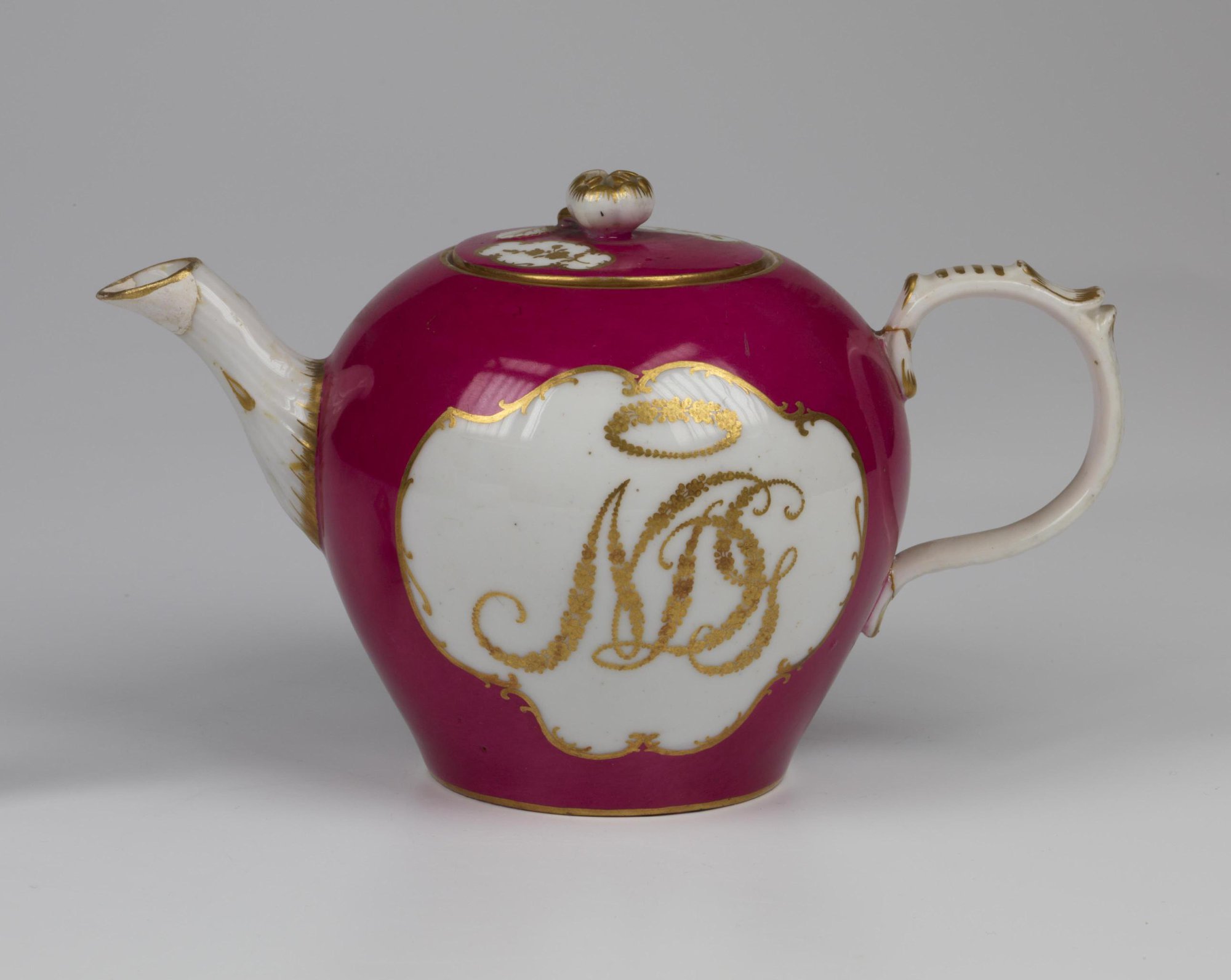
Teapot with a Lid with Crimson Glaze and Gilded Monograms. The State Hermitage Museum.
The teapot entered the Hermitage in 1919, transferred through the Department for the Protection of Monuments of Art and Antiquities from the collection of A. K. Rudanovsky. It is not currently on permanent display.
It is a round teapot — 12 centimetres high with its lid — with a crimson body, a white cartouche and a gilded monogram.
The Object
The teapot has a globular body, a short spout and a loop handle.
Its exterior is covered with a crimson coating, and a large white cartouche, shaped like a cloud, contains a gilded monogram under a small coronet. The rim, the lid and the base are banded with gold.
The spout and the handle are white, with gold lines, and the lid has a small gilded knop.
The Crimson
The crimson is the teapot’s colour.
It is a deep, slightly purple red, applied as a monochrome coating over the glaze. The colour is rich and even, and it covers the whole body.
Crimson grounds were a speciality of Russian porcelain in the eighteenth century, and they were used for the most luxurious services.
The Monogram
The monogram is the teapot’s personal mark.
It is painted in gold in the white cartouche, under a small coronet: an interlaced letter, probably an «M» or an «E», with flourishes. It identifies the owner of the service.
A monogram turns a teapot into a personal object, made for a specific family or person.
The Cartouche
The cartouche is the teapot’s frame.
It is white, with a cloud-like edge, and it is outlined in gold. It separates the monogram from the crimson ground, and it gives the object its focus.
Cartouches of this kind are a common device in Russian porcelain: they frame the decoration and give the object a formal, heraldic character.
The Spout
The spout is short and curved.
It is white, with gold lines, and it rises from the shoulder of the pot. Its tip is cut at an angle, and it is banded with gold.
The spout is practical — it allows the tea to be poured — and it is one of the details that make the teapot legible.
The Handle
The handle is a loop.
It is white, with gold lines, and it curves out from the body. Its shape is simple and functional, and it allows the pot to be lifted.
Handles of this kind are standard on Gardner teapots of the period, and they give the object its elegant silhouette.
Gardner
The teapot was made at the Gardner factory.
The factory was founded in 1766 by Francis Gardner, an English merchant, in the village of Verbilki near Moscow. It became one of the most important porcelain works in Russia, and it supplied the court and the nobility.
Its wares are characterised by strong colours, rich gilding and a taste for personal monograms.
The Eighteenth Century
The teapot was made in the second half of the eighteenth century.
It was the great age of Russian porcelain, when the imperial and private factories produced services for the court, the nobility and the merchant class. Monograms and coats of arms were common.
The teapot belongs to that world: a small, personal object, made for a Russian household.
The Lid
The lid is domed, with a gilded knop.
It fits into the rim of the pot and keeps the tea hot. It is crimson, like the body, and it is banded with gold and decorated with a small white reserve.
The lid turns the pot into a closed vessel, and it gives the object its rounded profile.
The Gilding
The gilding is applied in bands and lines.
It covers the rim, the lid, the base and the monogram, and it is fired and burnished. The gold gives the object its richness, and it contrasts with the crimson and the white.
Gold is the most fragile part of the decoration, and it wears first where the object is handled.
The Tea Table
The teapot was made for a tea table.
It stood beside cups, a sugar bowl and a cream jug, and it was used for tea. Its crimson and gold would have caught the candlelight, and its monogram would have been read by the guests.
That table is gone, but the teapot still carries its message: a name, a rank and a family.
The Shape
The teapot is globular, with a short spout.
Its body is round and full, and its shape is designed to hold heat. The lid, the spout and the handle are balanced around the sphere.
The shape is typical of Gardner teapots of the period, and it is one of the signs of the factory’s style.
The Collector
The teapot came to the Hermitage with the Rudanovsky collection.
Rudanovsky collected Russian and European porcelain, and his collection included services, figures and small objects of many kinds.
The teapot is therefore a double document: of the Gardner factory in the eighteenth century and of a Russian collector’s taste.
The Spout’s Gold
The spout is edged with gold.
The gold runs along its upper side and around its tip, and it frames the white porcelain. It is a small detail, but it gives the spout its finish.
Gold on a spout is practical as well as decorative: it protects the edge from chipping.
The Knop
The lid is crowned by a small knop.
It is gilded, and it is shaped like a knob or a bud. It is the point where the lid is lifted, and it gives the pot its top.
Knops of this kind were modelled separately and applied before firing.
The Base’s Gold
The base of the teapot is banded with gold.
It is a thin gold line, and it runs around the foot. It frames the crimson body and gives the object a finished base.
The gold is worn in places, where the pot touched the table, and the crimson shows through.
Provenance
The teapot carries the inventory number ERF-217. It entered the Hermitage in 1919, transferred through the Department for the Protection of Monuments of Art and Antiquities from the collection of A. K. Rudanovsky.
In the Hermitage
The teapot is preserved in the State Hermitage Museum in Saint Petersburg and is not on permanent display.
It is a small, rich object, and it preserves a name: a crimson pot, a gold monogram and a crown, painted in Russia two centuries ago.
It is a teapot, and it carries a name, and it has held its crimson for more than two centuries.
A pot, a lid, a monogram: it is enough. And it is still a good pot to look at.