Organization: Imperial Porcelain Manufactory, Vienna
Origin: Austria, Vienna
Date: 1805
Material: porcelain
Technique: polychrome painting, gilding
Dimensions: cup 7.2 cm high, 6.8 cm diameter; saucer 13.5 cm diameter, 2.9 cm high
Current Collection: The State Hermitage Museum
Inventory Number: ZF-17074
Hermitage ID: 352442
Rudanovsky Connection: Entered the Hermitage in 1919 from the collection of A. K. Rudanovsky.
A Viennese porcelain cup and saucer of 1805, with a green and gold border and a bouquet of flowers.
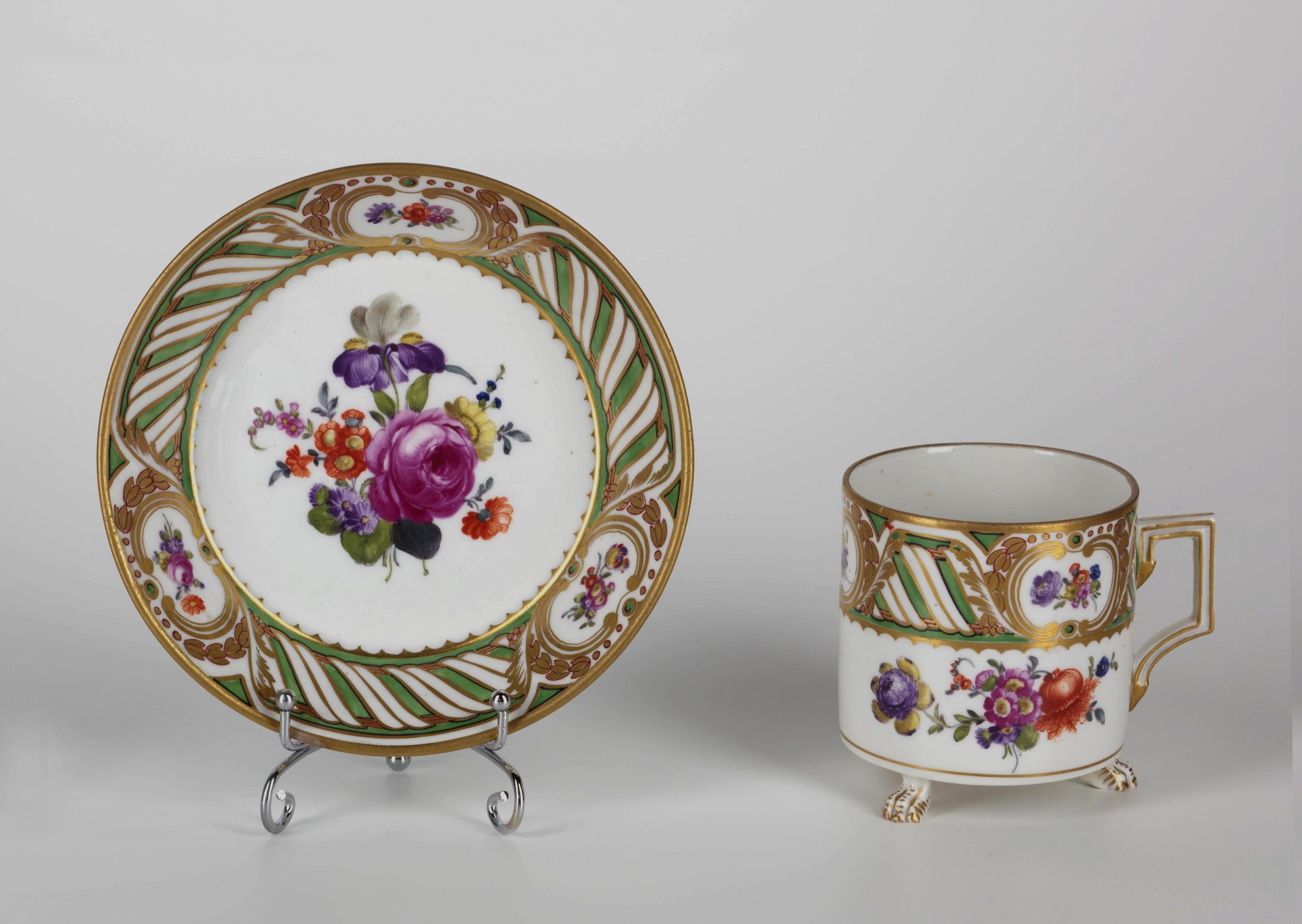
Cup and Saucer (ZF-17074). The State Hermitage Museum.
The cup entered the Hermitage in 1919, transferred through the Branch for the Protection of Monuments of Art and Antiquities from the collection of A. K. Rudanovsky. It is not currently on permanent display.
It is a cup with a scalloped rim, standing on four feet, and a saucer, both decorated with a green and gold border and a bouquet of flowers.
The Object
The cup is straight-sided, with a square handle and four small feet.
Its upper part is decorated with a border of green and gold, shaped like a basket or a ribbon, and its lower part is white, with a bouquet of flowers. The saucer repeats the pattern: a green and gold border around a white centre with a bouquet.
The cup’s rim is scalloped, and the saucer’s edge is gilded.
1805
The cup is dated 1805.
It was made during the Napoleonic wars, in the year of Austerlitz, when Vienna was occupied by the French. The porcelain factory continued to work, and it produced objects for the court and the nobility.
The cup is therefore a small witness of a difficult year: a luxury object, made in a city at war.
The Border
The border is the set’s structure.
It is a band of green and gold, painted with diagonal lines and scrolls, and it runs around the upper part of the cup and the rim of the saucer. The green is a soft, slightly grey colour, and the gold gives it its sparkle.
Borders of this kind are a feature of Viennese porcelain of the period, and they frame the flowers.
The Flowers
The flowers are the set’s charm.
A bouquet of roses, an iris, blue and red blossoms, with green leaves, is painted on the cup and the saucer. The flowers are delicate and naturalistic, and their colours contrast with the green border.
Flower painting was a speciality of the Vienna factory, and the bouquets here are among its finest work.
The Cup
The cup is small and straight-sided.
It holds 7.2 centimetres of liquid, and it is designed for coffee or tea. Its rim is scalloped, and its handle is a square loop, painted with gold.
The cup’s four feet are unusual: they raise it from the saucer, and they give it a delicate, floating appearance.
The Feet
The cup stands on four small feet.
They are white, painted with gold, and they are shaped like little paws or scrolls. The feet raise the cup above the saucer, and they allow the air to circulate.
Feet of this kind are a feature of Viennese cups of the period, and they are one of the signs of the factory’s invention.
The Saucer
The saucer is round and shallow.
It is 13.5 centimetres across, and it carries the same green and gold border and the same bouquet as the cup. Its centre is white, and its edge is gilded.
The saucer is the cup’s stage: it frames the cup and completes the set.
Vienna
The set was made in Vienna.
The Imperial Porcelain Manufactory of Vienna was one of the earliest in Europe, and it produced services, figures and decorative objects. In the early nineteenth century, it was known for its rich borders, its flower painting and its gilding.
The set belongs to that production, and it shows the Viennese taste for colour and detail.
The Handle
The handle is a square loop.
It is white, painted with gold, and it is attached to the body with a small scroll. Its shape is geometric and modern, and it contrasts with the scalloped rim.
Handles of this kind are a feature of Viennese cups of the period, and they give the object its neoclassical character.
The Gold
The gold is applied in bands and lines.
It frames the border, edges the rim and covers the feet. It was applied over the glaze, fired and burnished, and it is the most expensive part of the decoration.
The gold gives the set its sparkle, and it contrasts with the green and the white.
The Basketwork
The border imitates basketwork.
It is painted with diagonal lines and scrolls, in green and gold, and it looks like a woven ribbon or a basket. The pattern is a trompe-l’œil: porcelain imitating wickerwork.
Basketwork borders were popular in the Empire period, and they gave porcelain a rustic, natural look.
The Table
The set was made for a table.
It stood among other cups and saucers, and it was used for coffee or tea. Its green and gold would have caught the candlelight, and its flowers would have repeated across the table.
That table is gone, but the set still carries its logic: a small vessel, made for a festive morning.
The Collector
The set came to the Hermitage with the Rudanovsky collection.
Rudanovsky collected European porcelain alongside paintings, drawings, glass and miniatures, and his collection included Viennese services and decorative objects.
The set is therefore a double document: of Vienna in 1805 and of a Russian collector’s taste.
The Palette
The palette is soft and fresh.
White, green, gold, pink, purple and blue: the colours are light and harmonious, and they give the set a spring-like quality. The green border and the flower bouquet are the dominant notes.
The palette is typical of Viennese porcelain of the early nineteenth century, and it gives the set its charm.
The Wear
The set is worn.
The gold is rubbed on the rim and the handle, and there are small chips on the feet. The painting is still fresh, but the object shows its age.
The wear is a sign of use, and it records the cup’s long life on a table.
Provenance
The set carries the inventory number ZF-17074. It entered the Hermitage in 1919, transferred through the Branch for the Protection of Monuments of Art and Antiquities from the collection of A. K. Rudanovsky.
In the Hermitage
The set is preserved in the State Hermitage Museum in Saint Petersburg and is not on permanent display.
It is a small, refined object, and it preserves a moment of the Viennese table: a green border, a bouquet of flowers and a cup on four feet.
It is a small object, made in a hard year, and it has kept its flowers and its green border through two centuries of history.
It is a small thing, and it is also a record of a year that changed Europe.
The flowers have outlasted the war they were made in, which is what porcelain does best.
A cup, a bouquet, a green border: it is a small object, and it is a small argument for the survival of beautiful things. It has done that for two hundred years, quietly, without a chip on its flowers.