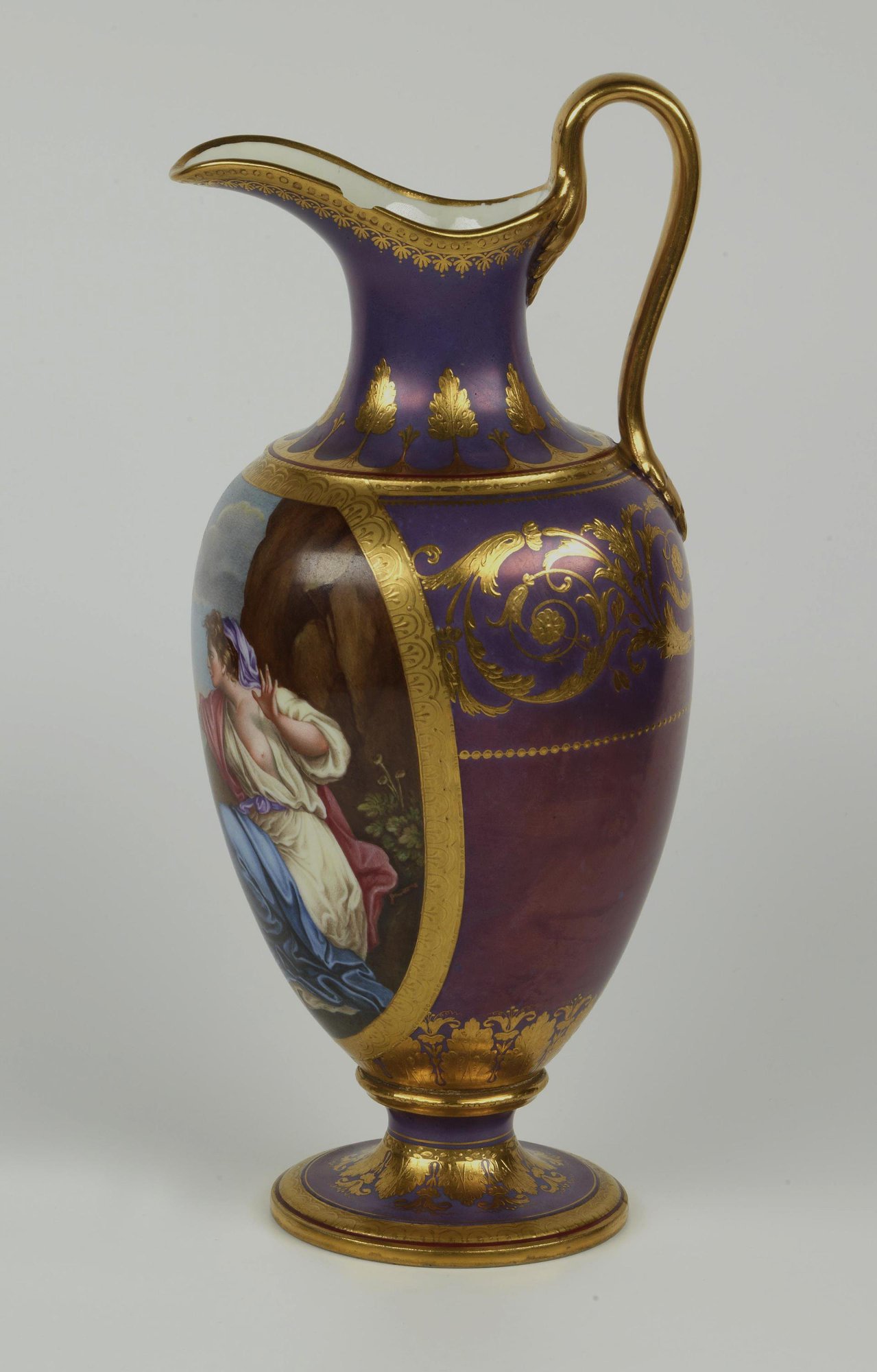
Organization: Imperial Porcelain Manufactory, Vienna
Origin: Austria, Vienna
Date: late 18th – early 19th century
Material: porcelain
Technique: gilding, polychrome painting
Dimensions: height 13.5 cm; length 34 cm; width 18 cm
Current Collection: The State Hermitage Museum
Inventory Number: ZF-17099
Hermitage ID: 352452
Rudanovsky Connection: Entered the Hermitage in 1919 from the collection of A. K. Rudanovsky.
A Viennese porcelain tray for liqueur glasses, made in the late eighteenth or early nineteenth century.
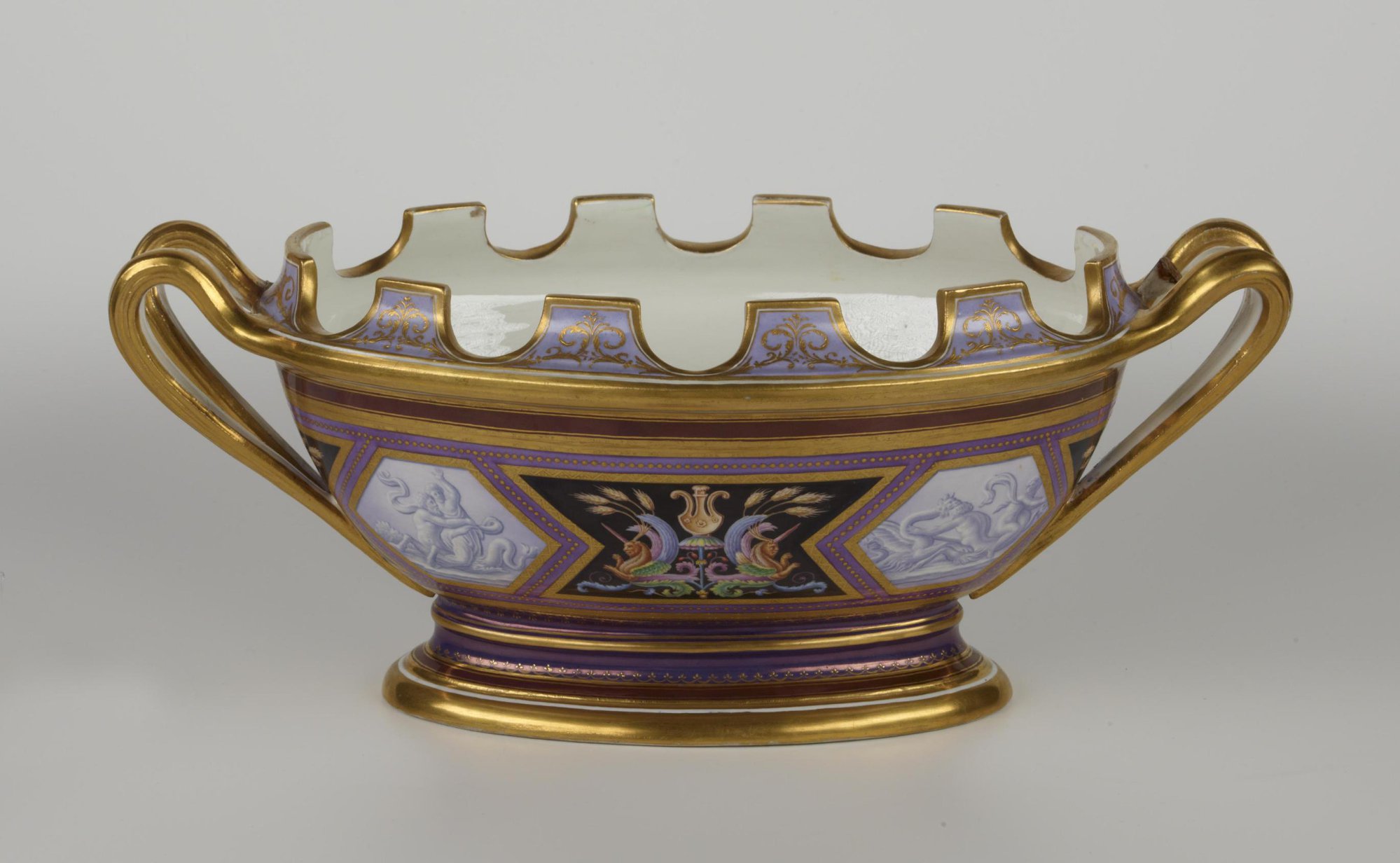
Liqueur Glass Tray. The State Hermitage Museum.
The tray entered the Hermitage in 1919, transferred through the Branch for the Protection of Monuments of Art and Antiquities from the collection of A. K. Rudanovsky. It is not currently on permanent display.
It is a boat-shaped bowl — 34 by 18 centimetres — with a scalloped rim, two handles and painted panels of classical figures.
The Object
The tray is boat-shaped, with a broad body and a wavy, scalloped rim.
It stands on a low foot, and it has two large loop handles at the ends. Its colours are purple, gold and white, and its body is divided into panels by gold bands.
In the panels, classical scenes are painted: putti, a vase with ears of wheat, a herm or a term.
Liqueur
The tray is for liqueur glasses.
After dinner, small glasses of liqueur were served, and they stood on a tray like this one. The scalloped rim held the glasses in place, and the tray carried them around the table.
Liqueur was a strong, sweet drink, and its glasses were small; the tray is therefore a stage for a small, festive moment.
The Shape
The shape is a boat.
It is a classical form, with a broad body, a low foot and two handles, and it is painted and gilded to look like a vessel of antiquity.
Boat shapes were popular in the Empire period: they suggested antiquity, travel and the sea, and they gave porcelain an architectural, almost sculptural form.
The Rim
The rim is scalloped.
It is cut into a series of deep, rounded notches, and each notch is edged with gold. The notches held the stems of the glasses, and the points between them framed the glasses.
A scalloped rim is a functional device, but it is also a decorative one: it gives the tray a crown of gold.
The Panels
The body is divided into panels.
Each panel is framed by a gold band, and each contains a different scene. The central panel, on a black ground, shows putti and a vase with ears of wheat; the side panels, on a pale ground, show classical figures.
Panels of this kind are a feature of Empire porcelain: they allowed the painter to show several scenes on one object.
The Handles
The tray has two large handles.
They are loops, gilded, and they rise from the sides of the body. The handles are practical — they allow the tray to be carried — and they give the object its boat-like silhouette.
Handles of this kind are a feature of Viennese trays of the period.
Vienna
The tray was made in Vienna.
The Imperial Porcelain Manufactory of Vienna was one of the earliest in Europe, and it produced services, figures and decorative objects. In the early nineteenth century, it was known for its rich grounds, its gilding and its painted panels.
The tray belongs to that production, and it shows the Viennese taste for colour and ornament.
The Empire
The tray belongs to the Empire style.
The Empire style was the official style of the Napoleonic period, and it was characterised by classical forms, strong colours, gold and military motifs. It was a style of power and display.
The tray is a good example: a classical form, a purple ground, gold panels and classical scenes.
The Foot
The tray stands on a low foot.
It is a circular base, with a moulded profile, and it raises the bowl from the table. The foot is painted with purple and gold, and it gives the object its stability.
A low foot under a wide bowl is a classical proportion: it makes the tray look lighter than it is.
The Black Panel
One panel is painted on a black ground.
It shows putti, a vase and ears of wheat, in pale colours, and it contrasts with the pale panels on the sides. The black ground makes the figures stand out, and it gives the tray its depth.
Panels on different grounds are a feature of Empire porcelain: they allowed the painter to vary the effect.
The Colour
The tray is purple and gold.
The purple is a deep, slightly blue violet, and the gold covers the bands, the rim and the handles. The combination is rich and imperial, and it gives the object its character.
Purple was a fashionable colour in the Empire period, and it was used for the most luxurious objects.
The Table
The tray was made for a table.
It stood at the end of a dinner, with small glasses of liqueur, and it was passed around the guests. Its purple and gold would have caught the candlelight.
That table is gone, but the tray still carries its logic: a stage for a small, festive ritual.
The Collector
The tray came to the Hermitage with the Rudanovsky collection.
Rudanovsky collected European porcelain alongside paintings, drawings, glass and miniatures, and his collection included Viennese services and decorative objects.
The tray is therefore a double document: of Vienna in the Empire period and of a Russian collector’s taste.
The Putti
The putti are the tray’s figures.
They are small, winged children, painted in pale colours, and they appear in several panels: one plays, one carries a vase, one holds an ear of wheat. Their bodies are soft and rounded.
Putti are a classical motif, and their presence turns the tray into a small mythological scene.
The Handles’ Weight
The handles are large for the bowl.
They are loops of porcelain, gilded, and they rise above the rim. Their size makes the tray easy to carry, and it gives the object a generous, open silhouette.
Large handles were a feature of Empire trays: they made a heavy object look light and inviting.
Provenance
The tray carries the inventory number ZF-17099. It entered the Hermitage in 1919, transferred through the Branch for the Protection of Monuments of Art and Antiquities from the collection of A. K. Rudanovsky.
In the Hermitage
The tray is preserved in the State Hermitage Museum in Saint Petersburg and is not on permanent display.
It is a fine example of Viennese porcelain, and it preserves a small ceremony: a boat-shaped tray, a few liqueur glasses and a purple and gold evening.
It is a tray, and it is also a small stage: a boat of porcelain, a few glasses and an evening that has lasted two hundred years.
It is a fine object, and it has outlasted the dinner, the guests and the empire it was made for.
It is a small boat, and it is still afloat, in a case, in a museum.
It is a small boat of porcelain, and it carries nothing but a memory of a party, which is enough. And it is still a boat, and it is still afloat.