Organization: Meissen Porcelain Manufactory
Origin: Germany, Meissen
Date: 1750s
Complex: Porcelain Tea and Coffee Service
Material: porcelain
Technique: polychrome painting, gilding
Dimensions: cup 4.3 cm high, 7.4 cm diameter; saucer 12.5 cm diameter
Current Collection: The State Hermitage Museum
Inventory Number: ZF-17742
Hermitage ID: 352524
Rudanovsky Connection: Entered the Hermitage in 1919 from the collection of A. K. Rudanovsky.
A second Meissen cup and saucer of the 1750s, with the same purple wave pattern and a different bouquet.
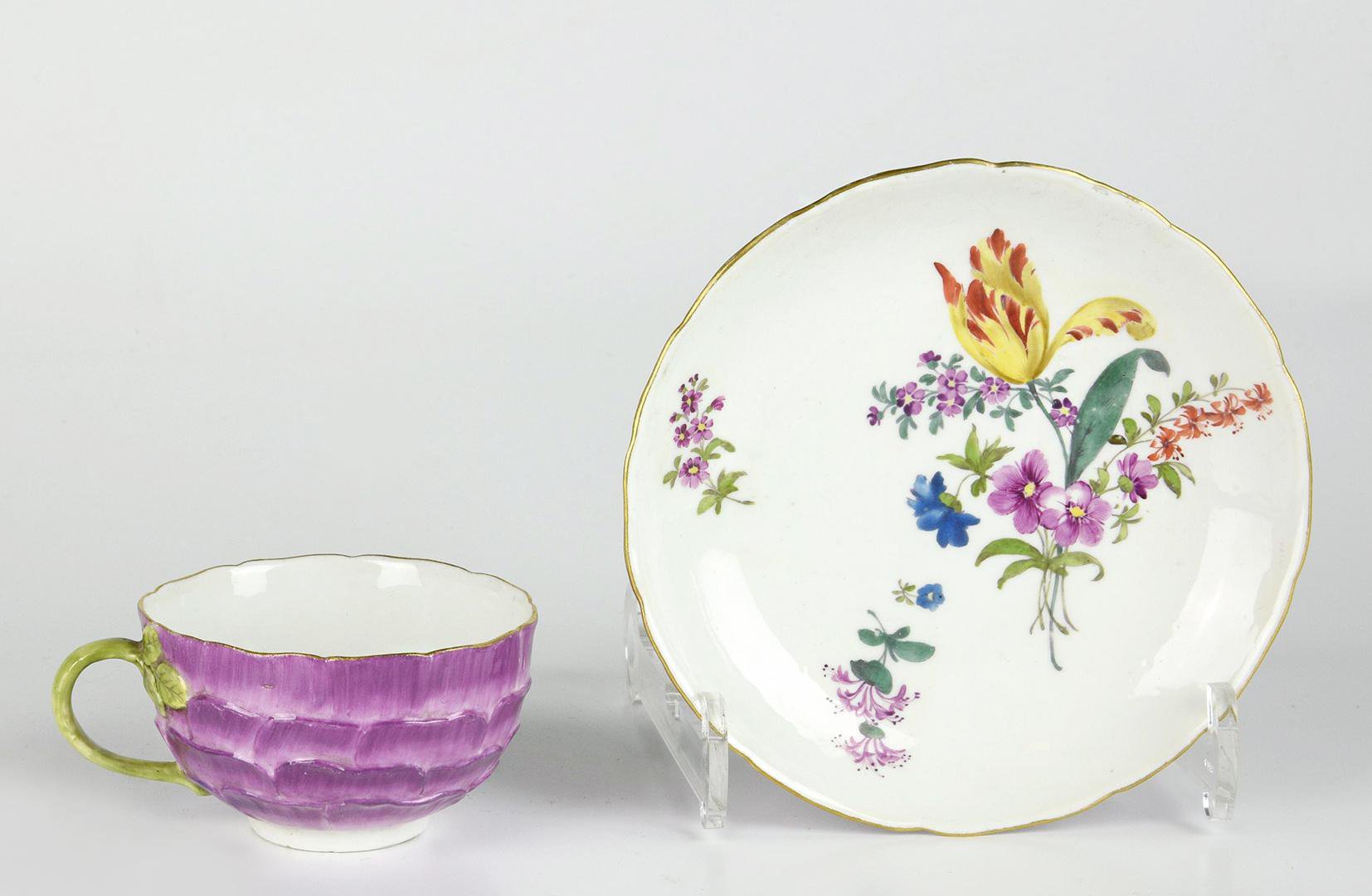
Cup and Saucer (ZF-17742). The State Hermitage Museum.
The cup entered the Hermitage in 1919, transferred through the Branch for the Protection of Monuments of Art and Antiquities from the collection of A. K. Rudanovsky. It is not currently on permanent display.
It is a small cup — 4.3 centimetres high — with the same purple wave pattern as its companion, a green handle and a gilt rim, and a saucer painted with a tulip.
The Object
The cup is rounded, with a scalloped rim and a small foot.
Its body is decorated with purple waves, and its rim is gilded. The handle is green, modelled as a branch, and the saucer is white, with a scalloped gilt edge.
The saucer carries a bouquet of flowers: a yellow and red tulip, purple lilac, blue convolvulus and small blossoms.
The Companion
The cup is the companion of another Meissen cup and saucer in the collection, ZF-17737.
The two share the purple wave pattern, the green handle and the gilt rim, and they were probably part of the same service. They differ in the flowers on their saucers.
Such pairs are common in old services: the cups were made in sets, and the painters varied the bouquets.
The Purple
The purple is the cup’s ground.
It is painted in horizontal waves, with soft edges, and it covers the body from the rim to the foot. The colour is a soft violet, and it is applied in washes.
The purple gives the cup its character: it is a colour of fantasy, and it turns a simple vessel into an object of delight.
The Handle
The handle is green.
It is modelled as a branch, with a small leaf where it meets the body, and it is painted in a natural green. The colour contrasts with the purple, and it adds a note of the garden.
Handles of this kind are a feature of Meissen in the 1750s, and they show the factory’s taste for natural forms.
The Saucer
The saucer carries a bouquet.
It is painted in the centre, with a tulip, lilac, convolvulus and small blossoms, and it is surrounded by scattered flowers. The bouquet is loose and naturalistic, and its colours are warm.
The saucer is the cup’s stage: it frames the cup and gives the painter a larger surface.
The Tulip
The tulip is the bouquet’s centre.
It is a yellow and red tulip, with pointed petals, and it is painted with care: the colours, the edges, the highlights. Its form is simple and elegant.
Tulips were a fashionable flower in the eighteenth century, and they were a favourite subject of porcelain painters.
Meissen
The cup was made at Meissen.
Meissen was the first European factory to produce true porcelain, and it was the most important manufactory of the eighteenth century. Its painters, modellers and gilders set the standard for the industry.
The cup belongs to the factory’s mature period, when its painting was at its finest.
The Service
The cup is part of a tea and coffee service.
The service included cups, saucers, a teapot, a coffee pot, a sugar bowl and a tray, all decorated with flowers and gilt rims. The cup is one of its smallest pieces.
Tea and coffee services were a luxury of the eighteenth-century table, and they were made in great numbers by the European factories.
The Cup’s Shape
The cup is rounded, with a small foot.
It is a tea cup, and its shape is designed to be held between the fingers. The scalloped rim gives it a delicate, flower-like edge.
The shape is typical of Meissen cups of the 1750s, and it is one of the signs of the factory’s elegance.
The Gilt Rim
The rim is gilded.
It is a thin gold line, and it catches the light. The gilding was applied last, and it wears first where the lips touched it.
A gilt rim is a small detail, but it frames the cup and gives it a finished look.
The Colours
The colours are soft and warm.
Purple, green, pink, yellow, blue and gold: the palette is rich but not loud, and it gives the cup its charm. The purple waves and the green handle are the dominant notes.
The colours are applied as enamels, and they have survived with little fading.
The Collector
The cup came to the Hermitage with the Rudanovsky collection.
Rudanovsky collected European porcelain alongside paintings, drawings, glass and miniatures, and his collection included German services and decorative objects.
The cup is therefore a double document: of Meissen in the 1750s and of a Russian collector’s taste.
The Palette
The palette is warm.
White, purple, green, pink, yellow, blue and gold: the colours are soft and harmonious, and they give the cup its charm. The purple waves and the green handle are the dominant notes.
The palette is typical of Meissen in the 1750s, and it gives the cup its refinement.
The Saucer’s Edge
The saucer’s edge is scalloped and gilded.
It is a thin gold line, and it follows the waves of the rim. The edge protects the saucer and gives it a finished look.
Scalloped and gilded edges are a feature of Meissen saucers of the period, and they frame the painted bouquet.
The Size
At 4.3 centimetres, the cup is small.
It fits in the palm of a hand, and it holds a single portion. Its smallness is part of its character: it is an object made for one person and one moment.
Small objects demand close attention, and this cup rewards it.
The Painting
The painting is the set’s charm.
The flowers on the saucer are painted with a fine brush, and each petal has its own shade. The purple waves on the cup are painted in washes, with soft edges.
This combination of precise flowers and soft grounds is characteristic of Meissen in the 1750s, and it is one of the reasons the factory’s wares were so admired.
Provenance
The cup carries the inventory number ZF-17742. It entered the Hermitage in 1919, transferred through the Branch for the Protection of Monuments of Art and Antiquities from the collection of A. K. Rudanovsky.
In the Hermitage
The cup is preserved in the State Hermitage Museum in Saint Petersburg and is not on permanent display.
It is a small, charming object, and it preserves a moment of the Meissen table: a purple wave, a green handle and a tulip on a saucer.
It is a companion piece, and it has its own tulip, its own light and its own small history.
It is small, and it is complete, and it has a saucer that still holds its flowers.
A cup, a saucer, a tulip: it is enough. And it is still a little remarkable.