Organization: Sèvres Porcelain Manufactory
Origin: France
Date: 1785
Material: soft-paste porcelain
Technique: polychrome painting, gilding
Dimensions: height 6 cm; diameter 12 cm
Current Collection: The State Hermitage Museum
Inventory Number: ZF-20547
Hermitage ID: 454003
Rudanovsky Connection: Entered the Hermitage in 1919 from the collection of A. K. Rudanovsky.
A Sèvres cup and saucer of 1785, painted with blue bands, gilt dots and small reserves of roses.
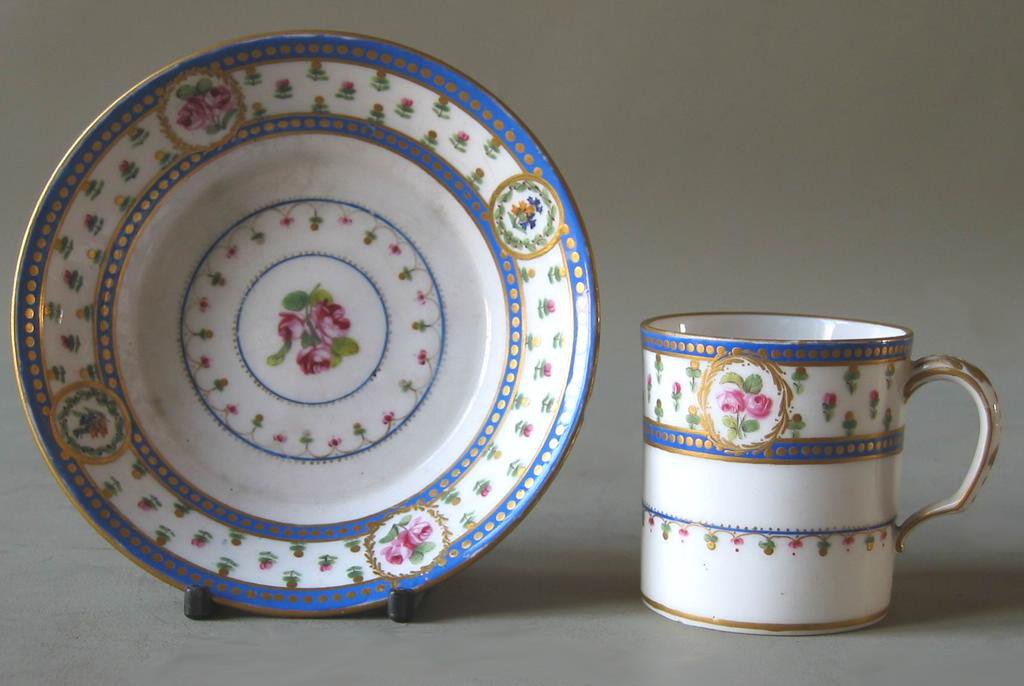
Cup and Saucer (ZF-20547). The State Hermitage Museum.
The cup entered the Hermitage in 1919, transferred through the Department for the Protection of Monuments of Art and Antiquities from the collection of A. K. Rudanovsky. It is not currently on permanent display.
It is a small cup and saucer — the cup six centimetres high, the saucer twelve across — painted with a delicate pattern of bands and flowers.
The Object
The cup is cylindrical, with a small handle and a slightly flared rim.
Its decoration is arranged in horizontal bands: a blue band with gilt dots at the rim, a white band with small sprays of flowers, a blue band at the base. Two oval reserves contain roses.
The saucer repeats the pattern: a blue rim with gilt dots, a white band with flower sprays, and a central rose in a circle of small flowers.
The Cup
The cup is small and delicate.
It is a tea or coffee cup, and its size — six centimetres high — makes it a vessel for a strong, hot drink. Its walls are thin, and its handle is a simple loop.
The cup was made to be held between the fingers, and its decoration is designed to be seen at close range.
The Saucer
The saucer is shallow and wide.
It is twelve centimetres across, and it carries the same decoration as the cup, scaled up: a blue rim, a white band and a central rose.
The saucer and the cup are a set: their patterns match, and their colours are the same.
The Blue Band
The blue band is the set’s structure.
It runs around the rim of the cup and the saucer, and it is decorated with small gilt dots. The blue is deep and even, and the gold catches the light.
Bands of this kind are a feature of Sèvres in the 1780s: they frame the decoration and give the object a clear architecture.
The Flowers
The flowers are the set’s charm.
They are small sprays of roses and other blossoms, painted in pinks, greens and blues, and they are scattered across the white bands. Two reserves contain larger roses.
Flower painting was one of the specialities of Sèvres, and the flowers here are delicate and naturalistic.
Sèvres in 1785
The set was made at Sèvres in 1785.
The factory was a royal manufactory, and it supplied the court and the aristocracy with porcelain of extraordinary quality. Its painters, gilders and modellers worked together to produce objects in which every detail was coordinated.
The set belongs to that production: a small, refined object, painted with care and designed for a table of the elite.
Soft Paste
The set is made of soft-paste porcelain.
Soft paste is a mixture of clay and glass, fired at a lower temperature than hard paste. It is more translucent and more fragile, and it allows a wider range of colours.
Soft paste was the standard material of Sèvres in the eighteenth century, and it gives the cup its warm white and its delicate surface.
The Handle
The cup has a small loop handle.
It is white, with a gold line along its edge, and it curves out from the body in a simple, elegant shape. The handle allows the cup to be lifted, and it completes the object.
Handles of this kind were standard on Sèvres cups of the period, and they were made separately and applied before firing.
The Rim
The rim of the cup is flared and gilded.
It is thin, and it catches the light, and it gives the cup its delicate outline. The gilt line on the rim is a small detail, but it frames the cup and gives it a finished look.
Rims of this kind were painted last, after the decoration, and they were the most vulnerable part of the object.
The Reserves
The cup and saucer have oval reserves.
They are small, framed by gilt scrollwork, and they contain roses painted with care. The reserves are the object’s focus: they concentrate the decoration, and they give the eye a place to rest.
Reserves were a common device in Sèvres porcelain: they framed the flowers and separated them from the bands.
The Table
The set was made for a table.
It stood among cups, plates and other pieces of the same service, and it was used for tea or coffee. Its blue and gold would have caught the candlelight, and its flowers would have repeated across the table.
That table is gone, but the set still carries its logic: a small vessel, made for a festive moment.
The Collector
The set came to the Hermitage with the Rudanovsky collection.
Rudanovsky collected Sèvres porcelain alongside paintings, drawings, glass and miniatures, and his collection included services, cups and decorative objects.
The set is therefore a double document: of the Sèvres factory in 1785 and of a Russian collector’s taste.
The Gold
The gold is applied in lines and dots.
It outlines the bands, edges the rim and forms the small dots that decorate the blue ground. It is fired and burnished, and it shines against the white and blue.
Gold is the most fragile part of the decoration, and it wears first where the object is handled.
The Pattern
The pattern is a system of bands.
A blue band with gold dots, a white band with flower sprays, a blue band again: the decoration runs around the cup and the saucer in a series of rings, and the reserves are set into the white bands.
This banded system is characteristic of Sèvres in the 1780s, and it allows the cup and saucer to match while remaining distinct in size.
The Cup’s Well
The inside of the cup is plain white.
It is glazed and smooth, without decoration, and it shows the colour of the tea or coffee. The plain interior contrasts with the busy exterior, and it gives the cup its function.
A cup is a vessel before it is an ornament, and the white well is where the drink lives.
Provenance
The set carries the inventory number ZF-20547. It entered the Hermitage in 1919, transferred through the Department for the Protection of Monuments of Art and Antiquities from the collection of A. K. Rudanovsky.
In the Hermitage
The set is preserved in the State Hermitage Museum in Saint Petersburg and is not on permanent display.
It is a small, charming object, and it shows how a cup and saucer could be turned into a delicate painting: blue bands, gilt dots and a garden of small roses.
It is a small object, and it holds a whole eighteenth-century table in its pattern: blue, gold and roses.
And it is still a cup, still waiting for a hand to lift it.
A cup, a saucer and a pattern: it is enough.