Organization: Dagoty’s Factory
Origin: France, Paris
Date: 1805–1810
Material: porcelain, bisque porcelain
Technique: black coating, painting with gold, gilding
Dimensions: height 20 cm; diameter 13 cm
Current Collection: The State Hermitage Museum
Inventory Number: ZF-21915
Hermitage ID: 466273
Rudanovsky Connection: Entered the Hermitage in 1919 from the collection of A. K. Rudanovsky.
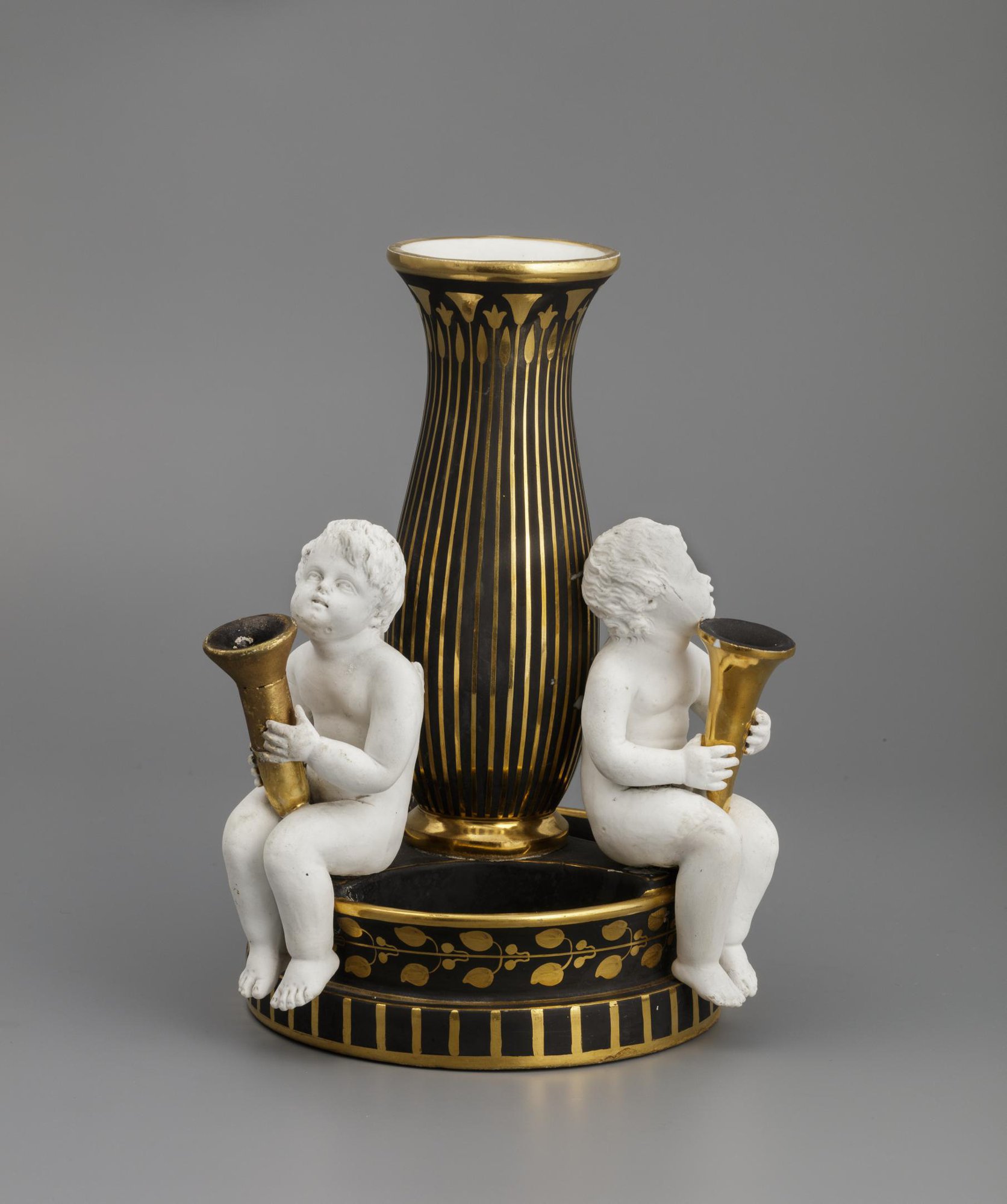
A Paris porcelain vase of 1805–1810 from the Dagoty factory, black and gold, with three white bisque putti around its base.
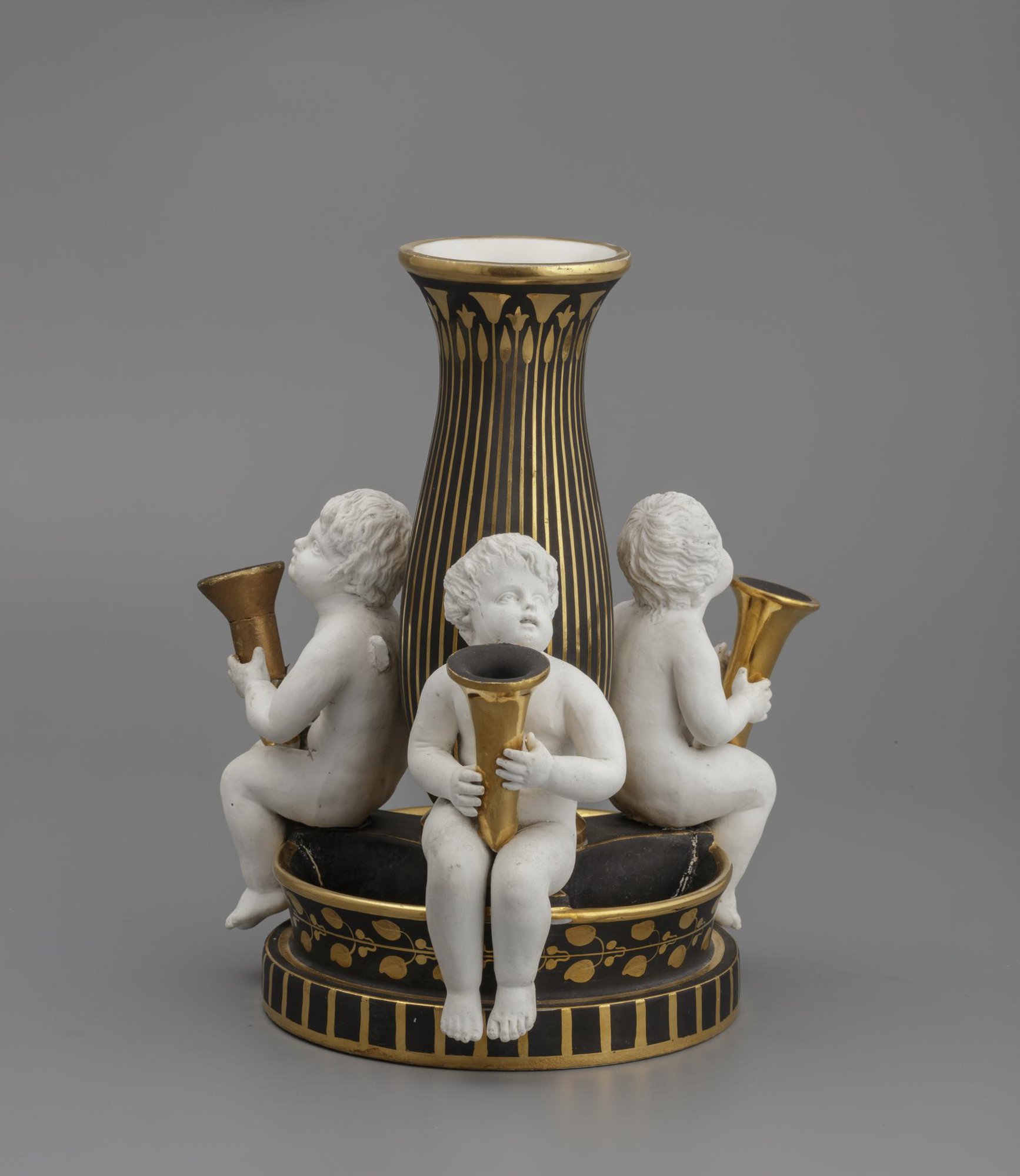
Vase (ZF-21915). The State Hermitage Museum.
The vase entered the Hermitage in 1919, handed over via the Department for the Protection of Monuments of Art and Antiquities from the collection of A. K. Rudanovsky. It is on display in the General Staff Building, in room 318.
It is a vase twenty centimetres high, with a black body, gold ornament and three white figures of children seated around the foot.
The Object
The vase has a flared neck, a slender body and a broad foot.
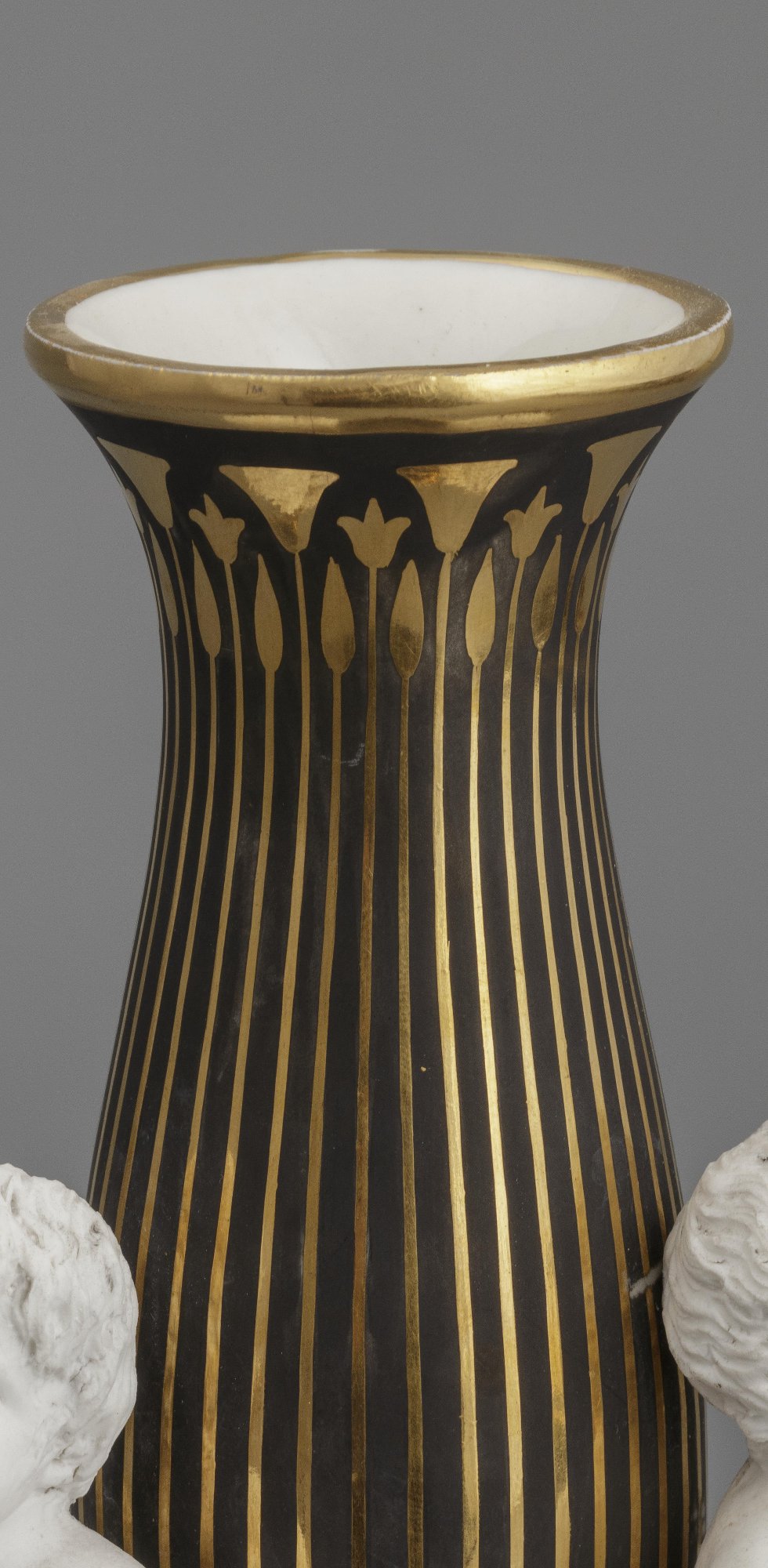
The body is black, decorated with vertical gold stripes and, at the neck, a band of gold lotus flowers. The foot is a black drum with gold lines and a band of leaves.
Around the foot sit three putti, modelled in white bisque, each holding a gilt horn or cornucopia.
The Vase
The vase is a decorative object.
It was made for a table, a shelf or a mantelpiece, and it was meant to be seen from several angles. Its form is classical, and its decoration is Empire.
Vases of this kind were produced in Paris in large numbers during the First Empire, and they were exported across Europe.
The Putti
The putti are the vase’s most distinctive feature.
They are modelled in white bisque, and they sit around the foot, their legs hanging down, their bodies turned. Each holds a gilt horn, and their heads are tilted back.
The putti are classical in form and playful in spirit: they turn a vase into a small sculpture, and they give the object its movement.
The Horns
Each putto holds a horn or a cornucopia.
The horns are gilded, and they are open at the top, like small vases or cups. They may have held flowers, incense or simply been decorative.
Horns and cornucopias are classical symbols of abundance, and they connect the vase to the vocabulary of Empire decoration.
The Black and Gold
The black and gold are the vase’s colours.
The black is a deep, matte ground, applied over the porcelain, and the gold is painted and fired. The contrast is strong and elegant, and it gives the object its Empire character.
Black and gold were fashionable in Paris around 1800: they suggested luxury, antiquity and the new classicism of the Napoleonic court.
Dagoty
Dagoty’s factory was one of the leading porcelain works of Paris.
It was founded by Pierre-Louis Dagoty in the early nineteenth century, and it produced vases, services, clocks and decorative objects for the imperial court and the nobility. Its wares are characterised by rich grounds, gold decoration and bisque figures.
The vase belongs to the factory’s most productive period, when Paris was the centre of luxury porcelain in Europe.
The Empire Style
The vase belongs to the Empire style.
The Empire style was the official style of Napoleon’s court, and it was characterised by classical forms, strong colours, gold and military motifs. It was a style of power and display.
This vase is a good example: a classical form, a black ground, gold ornament and white bisque figures.
The Display
The vase is displayed in the General Staff Building, in room 318.
It stands among other decorative objects, and it is seen in the round. Its black and gold surface and its white figures make it a striking object in a case.
The room and the vase belong together: the Empire interior and the Empire object.
The Neck
The neck of the vase is flared.
It widens toward the rim, and it is decorated with a band of gold lotus flowers, painted in a stylised, almost Egyptian manner. The neck gives the vase its elegance, and it frames the opening.
The lotus is a classical motif, and it was popular in Empire decoration as a symbol of Egypt and of the East.
The Foot
The foot is a black drum.
It is broad and low, and it is decorated with gold lines and a band of leaves. The foot supports the three putti and the vase, and it gives the object its stability.
Feet of this kind are a feature of Empire vases: they raise the body and provide a base for the figures.
The Bisque
The putti are made of bisque.
Bisque is unglazed porcelain, fired once, and it has a matte, slightly granular surface. It was used for figures and groups, and it imitates the appearance of marble.
Bisque was a speciality of Paris factories in the Empire, and it was used for the most expensive decorative objects.
The Empire Interior
The vase was made for an Empire interior.
Such interiors were characterised by strong colours, gold, classical forms and military motifs. Decorative objects like this vase stood on consoles, mantelpieces and tables, and they were part of a carefully composed ensemble.
The vase belongs to that world: a black and gold object, with white figures, made to be seen against a rich background.
The Collector
The vase came to the Hermitage with the Rudanovsky collection.
Rudanovsky collected European porcelain alongside paintings, drawings, glass and miniatures, and his collection included French vases and services.
The vase is therefore a double document: of Paris porcelain in the Empire and of a Russian collector’s taste.
The Gold Stripes
The gold stripes run up the body of the vase.
They are painted in fine lines, evenly spaced, and they narrow toward the neck. They give the black body a vertical rhythm, and they catch the light.
Stripes of this kind are a feature of Empire porcelain: they suggest order, precision and the classical column.
The Vase’s Use
The vase was a decorative object.
It was made to stand on a console, a mantelpiece or a table, and to be seen from several angles. It may have held flowers, or it may have been displayed empty, as a work of art.
Vases of this kind were collected and displayed in sets, and they were part of the decoration of a grand interior.
The Rim
The rim of the vase is gilded.
It is a thin gold line, painted around the opening, and it catches the light. The rim is where the vase is most fragile, and its gilding protects and decorates it.
A gilded rim is a small detail, but it completes the object and marks it as a luxury piece.
Provenance
The vase carries the inventory number ZF-21915. It entered the Hermitage in 1919, handed over via the Department for the Protection of Monuments of Art and Antiquities from the collection of A. K. Rudanovsky.
In the Hermitage
The vase is on display in the General Staff Building, in room 318.
It is a fine example of Paris porcelain of the Empire, and it preserves a small classical scene: three putti, three horns and a black vase with gold stripes.
The three putti sit around the foot like a small chorus, each with a horn, each waiting for the music to start.