Artist: Chappuis le jeune (painter)
Organization: Sèvres Porcelain Manufactory
Origin: France
Date: 1767
Material: soft-paste porcelain
Dimensions: height of the cup 5.8 cm; diameter of the saucer 13.6 cm
Current Collection: The State Hermitage Museum
Inventory Number: ZF-19890
Hermitage ID: 429580
Rudanovsky Connection: Entered the Hermitage in 1919 from the collection of A. K. Rudanovsky.
A Sèvres cup and saucer of 1767, painted with birds in reserves on a turquoise ground scattered with gold dots.
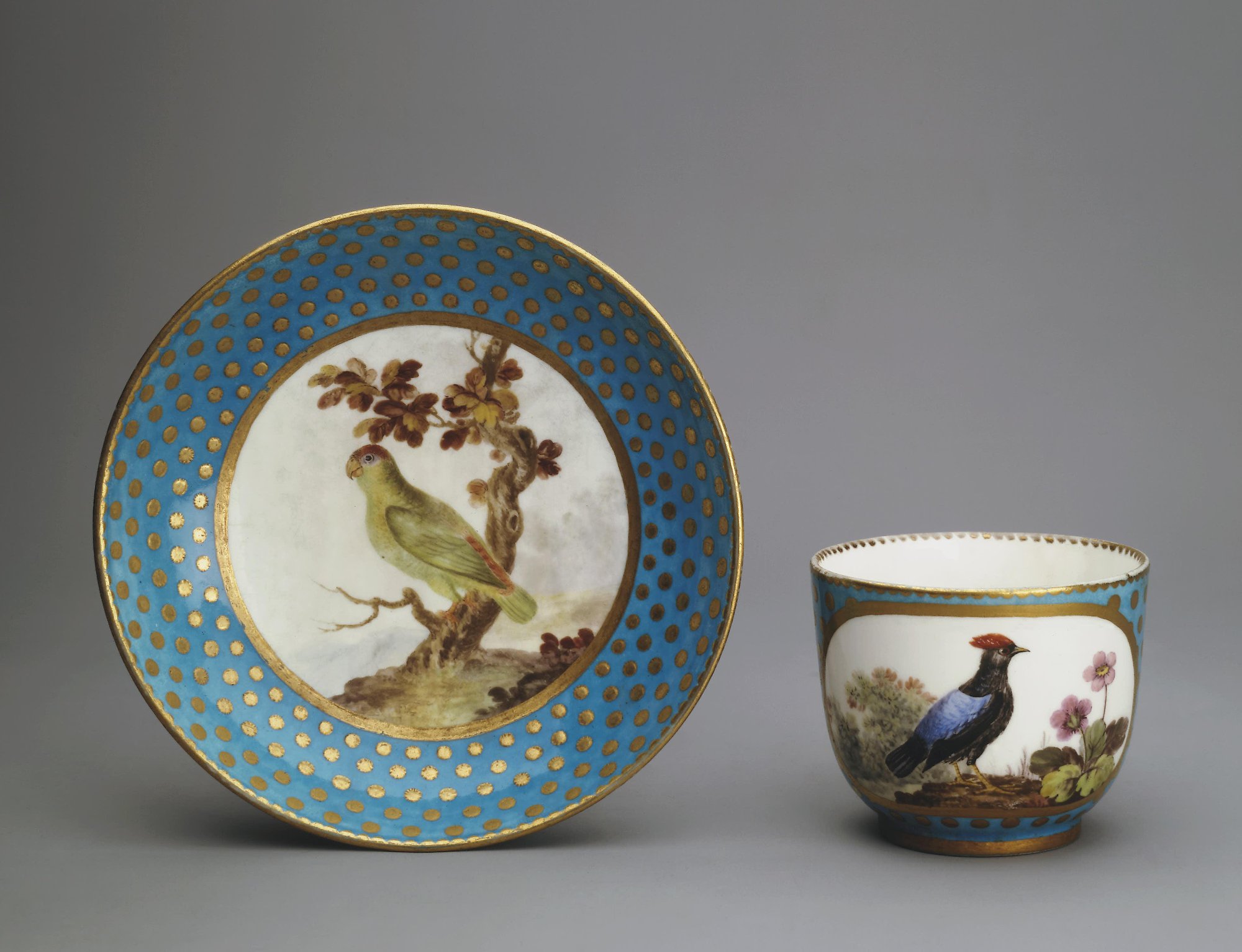
Cup with a Saucer (ZF-19890). The State Hermitage Museum.
The cup and saucer entered the Hermitage in 1919 from the collection of A. K. Rudanovsky. They are not currently on permanent display.
They are small, light and almost weightless in the hand — a cup for coffee or tea, made at the most famous porcelain factory in eighteenth-century Europe.
The Object
The saucer is a shallow dish with a wide rim and a central reserve.
The rim is covered with a turquoise-blue ground, over which gold dots are scattered in a regular pattern. In the centre, framed by a gold band, a bird perches on a branch: a green parrot with a red patch on its head, against a pale ground with brown foliage.
The cup repeats the scheme on a smaller scale: a turquoise band with gold dots, a gold rim, and a reserve containing a crested bird with dark blue and black plumage, standing among flowers.
Sèvres
The Sèvres manufactory was the most prestigious porcelain works in France, and one of the most admired in Europe.
It began at Vincennes in 1740 and moved to Sèvres, near Versailles, in 1756. It became a royal manufactory, protected and patronised by Louis XV and Madame de Pompadour, and it specialised in soft-paste porcelain — a material that was difficult to fire but allowed brilliant colours and delicate painting.
Sèvres pieces were luxury objects, often mounted in gilt bronze and used as diplomatic gifts. A cup and saucer were not everyday ware; they were part of a service made for display as much as for use.
Bleu Céleste
The turquoise ground is one of the signature colours of Sèvres.
It was introduced in the early 1750s and remained popular for decades. The colour was applied as a ground over the glaze or under it, then fired, and it required great skill to achieve an even tone across a curved surface.
The gold dots scattered over the blue are a decorative pattern known as œil de perdrix — partridge eye. Each dot is applied by hand, often with a small tool, and fired to fix the gold. The pattern gives the ground a texture that a flat colour would lack.
The Birds
The birds in the reserves belong to a long tradition of European porcelain painting.
Birds were among the most popular subjects at Sèvres, Meissen and other factories, because they combined bright colour with exotic appeal. Painters worked from prints and drawings of exotic species, often copied from natural history books.
The green parrot on the saucer is a recognisable exotic type; the crested bird on the cup is more difficult to identify. Both are painted with care: the feathers are indicated with fine strokes, the eye is a dark dot, the branch is modelled with light and shadow.
Chappuis
The cup is attributed to the painter recorded as Chappuis le jeune.
Sèvres painters were specialists. Some painted flowers, some landscapes, some figures, some birds; each had his own repertory and his own style. The painter’s mark on the underside of the piece allowed the factory to identify the work and to pay the painter by the piece.
Chappuis le jeune was one of the painters working at Sèvres in the 1760s, and the birds on this cup are consistent with the taste of the period: precise, colourful and slightly artificial.
A Cup for What?
The shape of the cup is worth noting.
It has no handle, a slightly flared rim and a small foot. This is a shape associated with coffee or with a specific kind of tea service; in the eighteenth century, cups were made in different forms for different drinks.
The cup and saucer were probably part of a larger service — a déjeuner or a dinner service — and the survival of a single cup and saucer is a reminder of how such services were dispersed.
Soft-Paste Porcelain
Soft-paste porcelain is different from the hard-paste porcelain of China and Meissen.
It is made from a mixture of clay and glassy materials, fired at a lower temperature. It is softer, more translucent and more fragile than hard-paste, and it allows the painter a wider palette of colours.
The drawback is that soft-paste is prone to warping and cracking in the kiln, and large pieces are difficult to make. A cup and saucer are within its range; a great vase is not.
Gold on Porcelain
The gilding on the cup and saucer is as important as the painting.
Gold was applied to porcelain as a preparation of powdered gold mixed with a flux, painted on with a brush, fired at a low temperature and then burnished to a shine. The process was repeated for every element: the rim, the band around the reserve, the dots on the turquoise ground.
Gilding is fragile. It wears away with use, and on old porcelain it is often rubbed to a faint trace. On this cup and saucer the gold is still visible, which suggests that the objects were used with care — or not used at all.
The Service
A cup and saucer are rarely made alone.
They belong to a service: a set of matching pieces for tea, coffee or dinner, often running to dozens of items. Services were commissioned, painted over months and delivered as a set.
The survival of a single cup and saucer is a reminder of how services were dispersed. Pieces were broken, sold separately, or divided among heirs; what remains is often a fragment of a scheme that once filled a table.
The Painter’s Mark
Sèvres pieces carry marks that allow them to be dated and attributed.
On the underside of the cup and saucer there would be the factory mark — the interlaced Ls of the royal cipher — with a date letter, and often the mark of the painter or the gilder. These marks are the factory’s own archive, applied to every piece.
The painter’s mark is a small letter or symbol, painted in blue or incised in the paste. It allowed the factory to pay the painter and to keep track of production. For the historian, it is the key to attributing the decoration.
Provenance
The cup and saucer carry the inventory number ZF-19890 and entered the Hermitage in 1919 from the collection of A. K. Rudanovsky.
In the Hermitage
The cup and saucer are preserved in the State Hermitage Museum in Saint Petersburg and are not on permanent display.
They are small objects, but they contain a whole world of eighteenth-century taste: the blue of the ground, the gold of the dots, the exotic birds and the delicate porcelain. Held in the hand, they are a reminder that luxury in the eighteenth century was often measured in small things — and that a cup could be as eloquent as a canvas.