Origin: Russia
Date: second half of the 18th – 19th century
Material: glass
Technique: blown, cast, carved, engraved, cut, ground, polished
Dimensions: 8.5 × 5.5 cm
Current Collection: The State Hermitage Museum
Inventory Number: ERS-2857
Hermitage ID: 802850
Rudanovsky Connection: Entered the Hermitage in 1919 from the collection of A. K. Rudanovsky.
A purple glass Easter egg, cut with a diamond grid and polished to a high shine, made in Russia in the late eighteenth or nineteenth century.
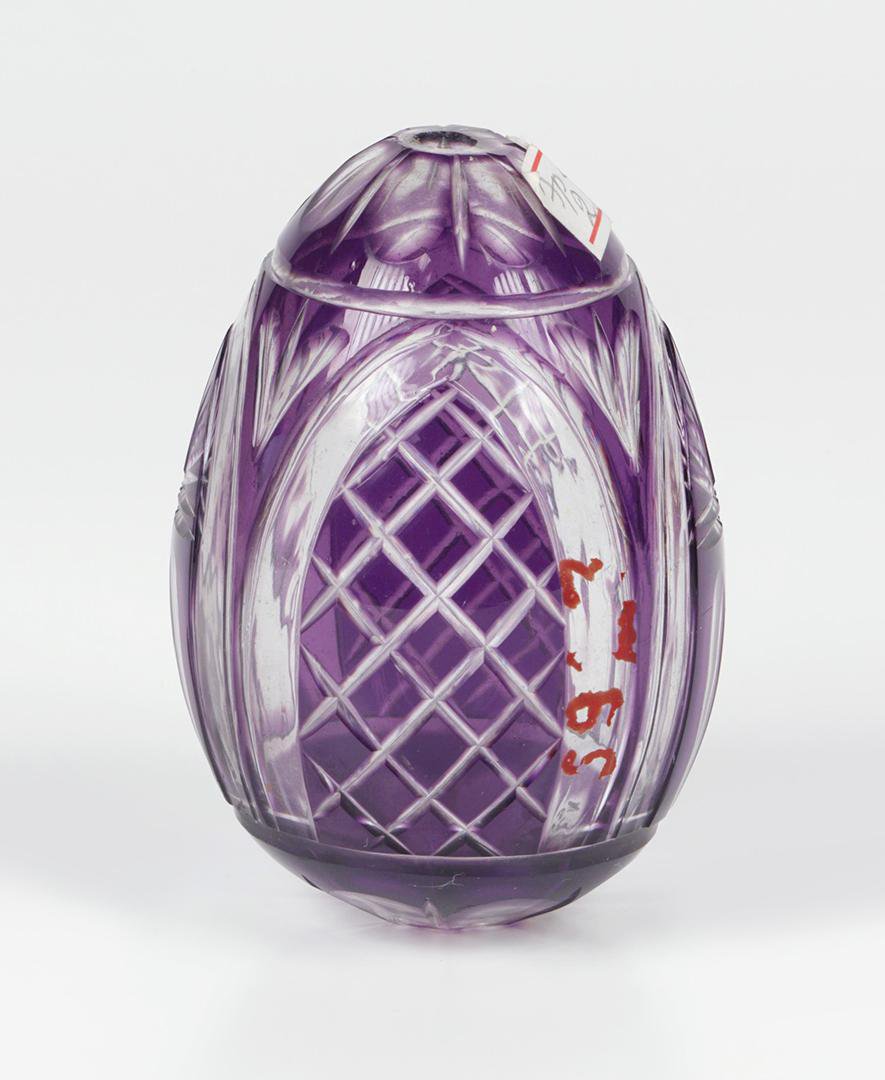
Easter Egg (ERS-2857). The State Hermitage Museum.
The egg entered the Hermitage in 1919 from the collection of A. K. Rudanovsky. It is not currently on permanent display.
It is a little larger than a hen’s egg, and it is made of glass so deeply coloured that it looks almost black until the light passes through it.
The Object
The egg is blown and cut, not solid.
Its surface is divided into panels: a central oval filled with a diamond grid, flanked by smooth lobes, with a band of radial cuts around the top. The glass is a deep violet-purple, with lighter areas where the cutting has exposed the interior and darker areas where the surface is polished smooth.
At the top there is a small round hole, and a paper label is attached near it, with a number written in ink. The label is a museum addition; the hole may be original.
Eggs and Easter
The egg is the central symbol of the Easter feast.
In the Orthodox tradition, eggs are dyed and exchanged at Easter, and the custom of giving decorated eggs goes back centuries. In the eighteenth and nineteenth centuries, wealthy families gave eggs of porcelain, glass, stone and precious metal, and the practice reached its height in the imperial Easter eggs of the late nineteenth century.
A glass egg was a modest version of that tradition: expensive enough to be a gift, sturdy enough to be kept, and beautiful enough to be displayed.
Purple Glass
The colour of the egg comes from manganese.
Manganese added to the glass batch produces a purple or violet tint, and the depth of the colour depends on the amount used and the conditions of the furnace. The result here is a dense, almost wine-dark purple that becomes transparent only at the edges.
Purple glass was fashionable in the eighteenth and nineteenth centuries, and Russian glassworks produced it in quantity. The colour was associated with luxury and with the court, and it was used for vases, cups and decorative objects.
Cutting and Engraving
The egg is a demonstration of the glass-cutter’s art.
The diamond grid in the central oval is cut with a wheel, each facet ground at a precise angle and then polished. The lobes at the sides are cut more deeply, creating a contrast of light and shadow. The band around the top is engraved with radial lines.
Cutting glass is a cold technique: the object is held against a rotating wheel fed with abrasive, and the surface is ground away. The work is slow and irreversible, and the cutter must plan the pattern before touching the glass.
Russian Glass
Russia had a substantial glass industry in the eighteenth and nineteenth centuries.
The imperial glassworks at St Petersburg and the private factories at Gus-Khrustalny and elsewhere produced table glass, mirrors, chandeliers and decorative objects. Russian cut glass was admired for its depth of colour and the boldness of its cutting.
The egg belongs to that tradition. It is not a table object but a gift object, made to be held and admired, and its quality reflects the skills of the Russian glasshouses.
A Hole at the Top
The hole at the top of the egg is a small but significant detail.
It may be a blowing hole, left from the process of forming the egg, or it may be a suspension hole, made so that the egg could be hung. In Orthodox practice, eggs were sometimes hung in front of icons, and a hole would allow a cord to pass through.
Without documentation, the hole cannot be explained with certainty, but it connects the object to the practical life of Easter devotion.
The Label
The paper label near the hole is part of the object’s later history.
Museum labels are usually removed before photography, but this one has been left in place. It records a number, written in ink, and it marks the egg as a registered object rather than a decorative one.
Labels are small documents. They show that the egg passed through a cataloguing process, and they preserve the memory of the moment when it ceased to be a gift and became a museum item.
The Imperial Example
The glass egg belongs to a wider tradition of luxury Easter eggs.
In the nineteenth century, the imperial family commissioned eggs from the Imperial Porcelain Factory, and later from the workshop of Carl Fabergé. These eggs were made of porcelain, gold, enamel and precious stones, and they were given as gifts at Easter.
A glass egg is a more modest version of the same idea: a precious object in the shape of an egg, made to be given and kept. It shows how a religious symbol could be translated into the language of luxury.
The Cutting Wheel
Cutting glass is done on a wheel.
The cutter holds the object against a rotating disc of metal or stone, fed with water and abrasive, and grinds away the surface. The wheel can be shaped to produce flat facets, rounded lobes or fine lines, and the pattern is built up by changing wheels and angles.
The work is slow and requires constant attention. Glass is brittle, and a slip of the hand can crack the object or ruin a facet. The crisp grid on this egg is the result of many hours at the wheel.
Glass and Light
The egg is designed to be seen in light.
Glass of this colour absorbs much of the light that passes through it, so that the object looks almost black in shadow and glows deep purple when held against a window. The cut facets catch the light and break it into highlights, and the smooth lobes reflect the room around them.
This play of light is the real subject of the object. It is not a picture of anything; it is a shape made to catch and hold light.
The Shape of an Egg
The egg is a difficult shape to decorate.
It has no front, no back and no flat surface; every point on its surface is curved in two directions at once. A pattern cut into it must follow the curvature, and the cutter must rotate the object continuously while working.
The solution chosen here is a series of panels: a central oval, flanking lobes and a band at the top. The panels divide the curve into readable areas and allow the cutter to work with flat facets, which are easier to control than curved lines.
Provenance
The egg carries the inventory number ERS-2857 and entered the Hermitage in 1919 from the collection of A. K. Rudanovsky.
In the Hermitage
The egg is preserved in the State Hermitage Museum in Saint Petersburg and is not on permanent display.
It is a small object, but it carries a long history: the Easter egg as religious symbol, the glass egg as luxury gift, and the museum egg as a document of Russian decorative art. Held in the hand, it is cool, heavy and full of light.