Artists: Jacques-François-Louis de Laroche (c. 1740 – c. 1802) and Niquet (painters)
Organization: Sèvres Porcelain Manufactory
Origin: France
Date: 1781
Material: soft-paste porcelain
Dimensions: cup 6.9 cm high; saucer 13.5 cm in diameter
Current Collection: The State Hermitage Museum
Inventory Number: ZF-20548
Hermitage ID: 454004
Rudanovsky Connection: Entered the Hermitage in 1919 from the collection of A. K. Rudanovsky.
A Sèvres cup and saucer of 1781, painted with a blue medallion of flowers and a ribbon garland.
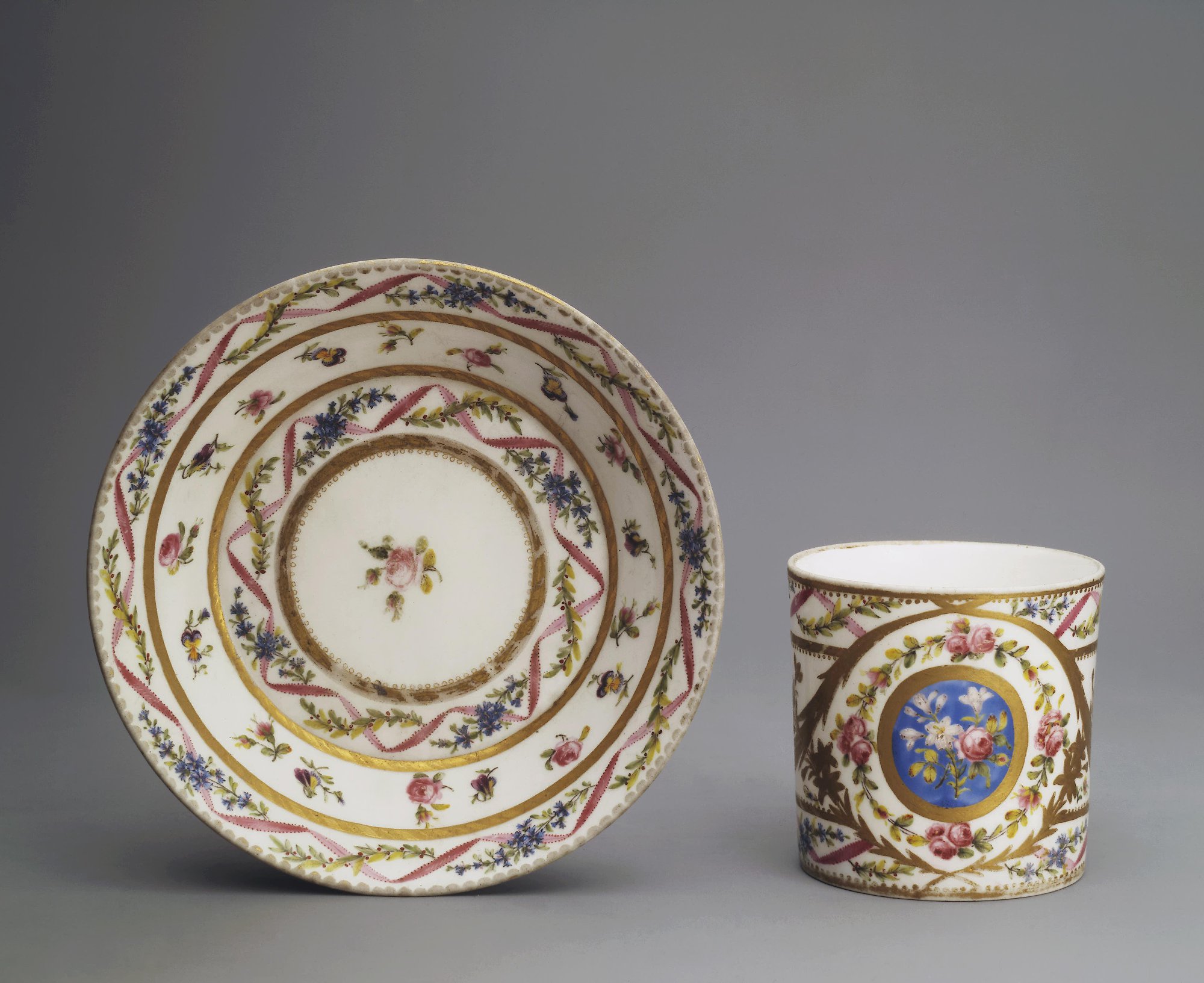
Cup with a Saucer (ZF-20548). The State Hermitage Museum.
The cup entered the Hermitage in 1919, handed over by the Office for the Preservation of Monuments of Art and Antiquity and originally in the collection of A. K. Rudanovsky. It is not currently on permanent display.
It is a cylindrical cup and a round saucer, decorated with gold bands, a ribbon garland and a blue medallion.
The Object
The cup is straight-sided, with a small handle and a gilt rim.
Its body is white, with bands of gold and a garland of pink ribbon and flowers. On the side, a circular medallion of blue ground contains a bouquet of flowers.
The saucer is white, with the same gold bands and a pink ribbon that winds around the centre, and a single rose in the middle.
The Cup
The cup is small and cylindrical.
It holds 6.9 centimetres of liquid, and it is designed for tea or coffee. Its straight sides give it a modern, almost architectural look.
The cup’s shape is a departure from the rounded forms of the earlier eighteenth century, and it reflects the neoclassical taste of the 1780s.
The Medal
The medallion is the cup’s focus.
It is a circle of deep blue ground, framed by a gold ring, and it contains a bouquet of roses, convolvulus and other flowers. The blue makes the flowers stand out, and the gold frames them.
A medallion of this kind is a common device in Sèvres porcelain: it concentrates the decoration and gives the eye a place to rest.
The Saucer
The saucer is white, with gold bands and a ribbon.
The ribbon is pink, painted with a dotted edge, and it winds around the centre in a loose spiral. In the middle, a single rose completes the composition.
The saucer repeats the cup’s decoration at a larger scale, so that the two objects read as a set.
The Ribbon
The ribbon is the set’s motif.
It is pink, with a dotted edge, and it runs around the cup and the saucer in a continuous line. It suggests a garland, a maypole or a ribbon tied around a bouquet.
Ribbons of this kind are a feature of Sèvres in the 1780s: they give the decoration movement and a note of informality.
Laroche
Jacques-François-Louis de Laroche (c. 1740 – c. 1802) was a painter at Sèvres.
He specialised in flowers and birds, and his work is characterised by delicate colours and careful composition. His name appears on many pieces of the period.
The attribution to Laroche connects the cup to a named hand, and it places it within the production of the factory.
Niquet
Niquet was a second painter at Sèvres.
Little is known about him, but his name appears in the factory records, and he is associated with the decoration of this set. The collaboration of two painters on a single object was common.
The set is therefore the work of a team: one painter for the flowers, another for the ornaments.
Sèvres in 1781
The set was made in 1781.
The factory was a royal manufactory, and it supplied the court and the aristocracy with porcelain of extraordinary quality. Its painters, gilders and modellers worked together to produce objects in which every detail was coordinated.
The set belongs to that production: a small, refined object, painted with care.
The Gold Bands
The gold bands frame the cup and the saucer.
They are thin and precise, and they run around the rim, the base and the central field. The gold separates the white from the decoration, and it gives the set its structure.
Gold bands of this kind are a feature of Sèvres in the 1780s: they are simple, and they frame the picture.
The Flowers
The flowers are the set’s charm.
They are roses, convolvulus, bluebells and small blossoms, painted in pinks, blues, yellows and greens. They are delicate and naturalistic, and they are scattered across the cup and the saucer.
Flower painting was a speciality of Sèvres, and the flowers here are among its finest work.
The Handle
The cup’s handle is a simple loop.
It is white, with a gold line, and it curves out from the body. Its shape is elegant and functional, and it allows the cup to be lifted.
Handles of this kind are standard on Sèvres cups of the period, and they give the object its finished look.
The Table
The set was made for a table.
It stood among other cups and saucers, and it was used for tea or coffee. Its blue medallion and pink ribbon would have caught the candlelight.
That table is gone, but the set still carries its logic: a small vessel, made for a festive moment.
The Collector
The set came to the Hermitage with the Rudanovsky collection.
Rudanovsky collected Sèvres porcelain alongside paintings, drawings, glass and miniatures, and his collection included services, cups and decorative objects.
The set is therefore a double document: of Sèvres in 1781 and of a Russian collector’s taste.
The Blue
The blue is the medallion’s ground.
It is a deep, even cobalt, applied over the glaze, and it makes the flowers stand out. It is the only strong colour on the cup.
Blue grounds were expensive, and their use in a small medallion was a way of showing luxury without covering the whole object.
The Cup’s Shape
The cup is straight-sided.
It is a cylinder, with a small foot and a gilt rim, and it is a modern shape for a Sèvres cup. It belongs to the neoclassical taste of the 1780s.
The shape is simple, and it is the vehicle for the decoration: the gold bands, the ribbon and the medallion.
The Roses
The roses are the set’s motif.
A rose appears in the medallion, on the ribbon, and in the centre of the saucer. It is painted in pinks and greens, and it repeats across the set.
A repeated flower is a device of the service: it gives the object a signature, and it unites its parts.
Provenance
The set carries the inventory number ZF-20548. It entered the Hermitage in 1919, handed over by the Office for the Preservation of Monuments of Art and Antiquity and originally in the collection of A. K. Rudanovsky.
In the Hermitage
The set is preserved in the State Hermitage Museum in Saint Petersburg and is not on permanent display.
It is a small, elegant object, and it preserves a moment of the Sèvres table: a blue medallion, a pink ribbon and a bouquet of flowers.
It is a cup and a saucer, and they have kept their ribbon and their blue medallion for two hundred and forty years.
It is a small set, and it is a small pleasure. And the ribbon is still pink.