Origin: France, Paris
Date: 18th century
Material: bronze, gilding, wood, horn
Technique: metal casting, copper inlay
Dimensions: height 57 cm; width 38 cm; length 22 cm
Current Collection: The State Hermitage Museum
Inventory Number: Epr-844
Hermitage ID: 48954
Rudanovsky Connection: Entered the Hermitage in 1919 from the collection of A. K. Rudanovsky.
A French table clock of the eighteenth century, in an inlaid case of wood, horn and gilt bronze.
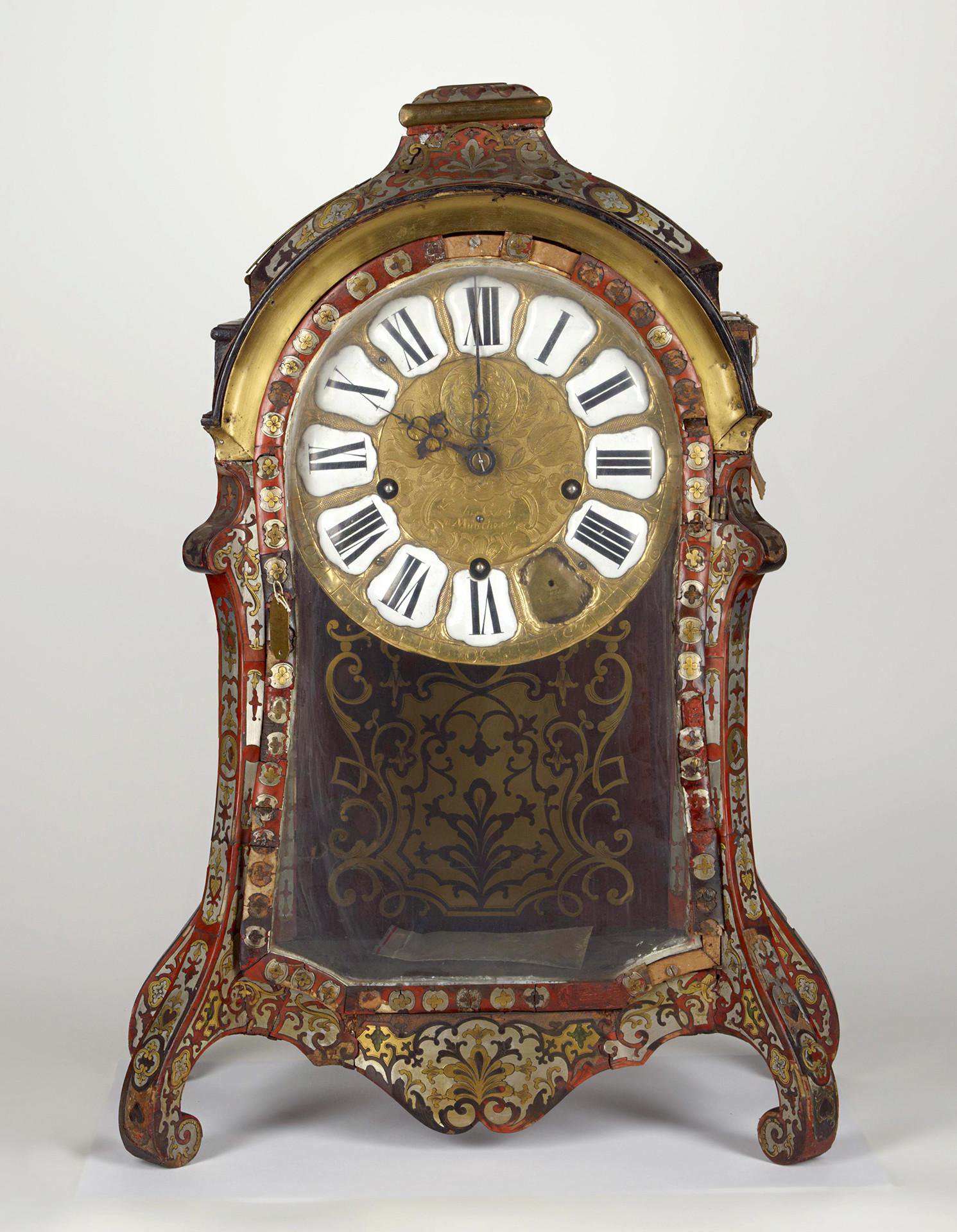
Table Clock in an Inlaid Case. The State Hermitage Museum.
The clock entered the Hermitage in 1919, transferred by the Department for the Protection of Monuments of Art and Antiquities and previously in the collection of A. K. Rudanovsky. It is not currently on permanent display.
It is a tall table clock — 57 centimetres high — with an inlaid case, a gilt dial and a glass panel.
The Object
The clock stands on scrolled feet, and its case rises in a series of curves to a small crest.
The case is covered with inlay: a reddish ground of horn or tortoiseshell, inlaid with gold and coloured patterns of scrolls, flowers and figures. The dial is gilt, with white enamel plaques for the hours.
A glass panel below the dial reveals the movement and a gilt brass backplate engraved with scrolls.
The Case
The case is the clock’s body.
It is shaped like a small cartouche, with a curved top and scrolled sides, and it is made of wood, veneered and inlaid. Its form is rococo: asymmetrical, curved and full of movement.
A clock case is a piece of furniture as well as a machine: it protects the movement, and it gives the object its character.
The Inlay
The inlay is the case’s decoration.
It is made of horn, tortoiseshell and metal, cut into patterns and laid into the surface. The patterns include scrolls, flowers, leaves and small figures, in gold and red.
Inlay of this kind is a French speciality: it imitates the Boulle marquetry of the previous century, and it gives the clock its richness.
The Dial
The dial is gilt.
It is a circular plate of brass, engraved with a pattern of scrolls, and its hours are marked on white enamel plaques with black Roman numerals.
The plaques are set around the dial in a ring, and they stand out against the gold. Their white is the clock’s brightest element.
The Hands
The hands are dark and delicate.
They are made of steel or blued iron, and they are shaped like scrolls. One points to the hours, the other to the minutes.
The hands are the clock’s most functional part, and their shape is one of the details that make the object elegant.
The Glass
A glass panel fills the lower part of the case.
Behind it, the movement and a gilt brass backplate are visible. The backplate is engraved with scrolls, and it catches the light.
The glass turns the clock into a display: the mechanism is part of the object’s beauty, and it is shown as such.
The Clock
The clock is a machine for time.
Its movement, hidden in the case, drives the hands and strikes the hours. It was made by a clockmaker, and it was fitted into a case by a cabinetmaker and a bronzier.
A clock of this kind was a luxury object: it told the time, and it decorated the room.
The Eighteenth Century
The clock is dated to the eighteenth century.
It was a period of great activity in French clockmaking, when Paris was the centre of the trade. Clocks were made in every style, from simple table clocks to elaborate mantelpieces.
The clock belongs to that production, and it shows the French taste for inlay and gilding.
The Crest
The clock is crowned by a small crest.
It is a shaped piece of wood, veneered and inlaid, and it rises above the dial. It gives the case its silhouette, and it finishes the object.
A crest of this kind is a feature of French clocks: it turns the case into a small monument, and it gives the clock its height.
The Feet
The clock stands on scrolled feet.
They are made of wood and bronze, and they curve outward like small consoles. The feet raise the case from the table, and they give the object its stability.
Feet of this kind are a feature of rococo furniture: they are curved, elegant and functional.
The Movement
The movement is hidden in the case.
It is a mechanism of brass and steel, with wheels, springs and a striking train, and it drives the hands and strikes the hours. It was made by a clockmaker.
A clock is a machine before it is a decoration, and its movement is the reason for the case.
The Room
The clock was made for a room.
It stood on a mantelpiece, a console or a table, and it told the time for a household. Its inlay and its gilt dial made it a centrepiece.
The room is gone, but the clock still carries its function: a small machine for time, dressed as a work of art.
The Collector
The clock came to the Hermitage with the Rudanovsky collection.
Rudanovsky collected European applied art, and his collection included clocks, bronzes and furniture as well as porcelain.
The clock is therefore a double document: of French clockmaking and of a Russian collector’s taste.
The Inlay’s Patterns
The inlay’s patterns are varied.
Scrolls, flowers, leaves and small figures cover the case, and each area has its own design. The patterns are cut from metal and horn, and they are laid into the surface.
This variety is characteristic of French inlay: it is dense, rich and full of detail.
The Dial’s Ring
The dial’s hour plaques form a ring.
They are white enamel, with black Roman numerals, and they are set around the gilt centre. The ring is the clock’s face, and it is where the time is read.
Plaques of this kind are a feature of eighteenth-century clocks: they are separate pieces, fitted into the dial, and they stand out against the metal.
The Glass’s Reflection
The glass reflects the light.
It is a sheet of thin glass, and it protects the movement while allowing it to be seen. Its surface catches the room, and it adds a layer of depth to the case.
Glass panels of this kind are a feature of French clocks: they turn the mechanism into a display, and they give the object its transparency.
Provenance
The clock carries the inventory number Epr-844. It entered the Hermitage in 1919, transferred by the Department for the Protection of Monuments of Art and Antiquities and previously in the collection of A. K. Rudanovsky.
In the Hermitage
The clock is preserved in the State Hermitage Museum in Saint Petersburg and is not on permanent display.
It is a fine example of French clockmaking, and it preserves a machine and a decoration: a dial, an inlaid case and a glass panel, made in Paris two centuries ago.
It is a clock, and it has kept the time, or at least the look of it, for two centuries.
It is a machine and a jewel, and the two have stayed together. And the hands, if wound, would still move.