Artist: Christian Berentz (1658–1722)
Origin: Italy
Date: 17th century
Material: canvas
Technique: oil
Dimensions: 97.5 × 134 cm
Current Collection: The State Hermitage Museum
Inventory Number: GE-7200
Hermitage ID: 31687
Rudanovsky Connection: Entered the Hermitage in 1932 from the collection of A. K. Rudanovsky.
A painting by Christian Berentz showing a winged cupid among fruit and flowers.
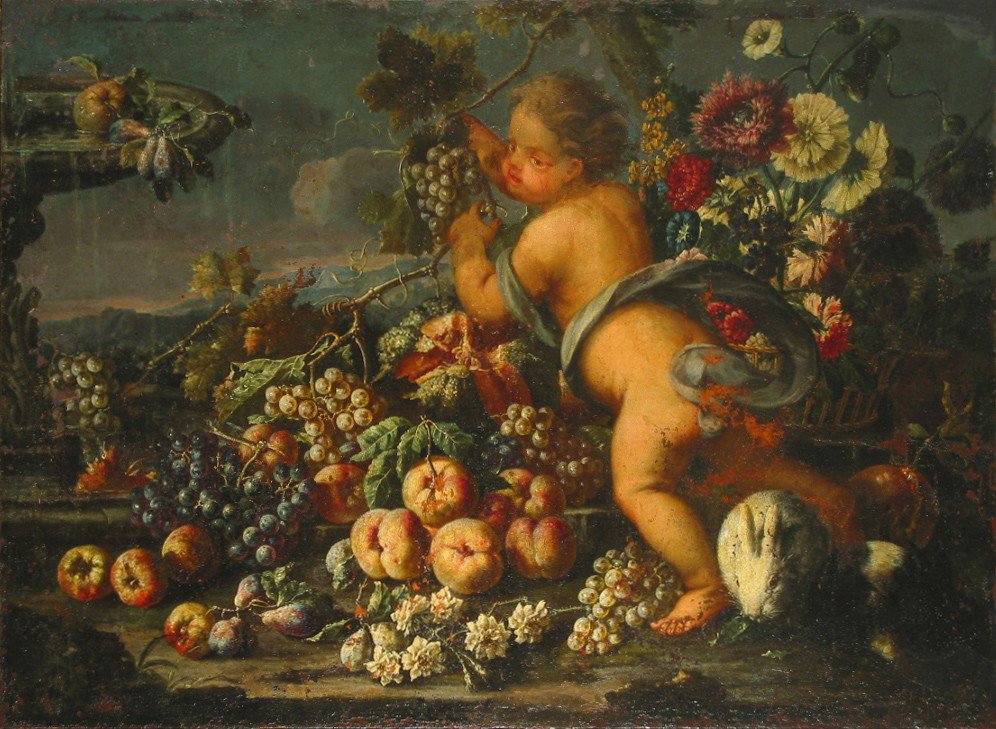
Cupid Amid Fruit. The State Hermitage Museum.
The painting entered the Hermitage in 1932, handed over by the Antikvariat All-Union Association, and it was formerly in the collection of A. K. Rudanovsky. It is not currently on permanent display.
It is a horizontal canvas — 97.5 by 134 centimetres — with a putto at the centre, surrounded by grapes, peaches, figs, flowers and a stone basin.
The Object
The putto stands at the centre, his body turned away from the viewer, his head turned back over his shoulder.
He holds a bunch of grapes in his hands, and he looks out with a mischievous expression. Around him, the fruit is piled: grapes, peaches, figs, apples and a melon, with flowers at the right and a stone basin at the upper left.
The background is a landscape, with a pale sky and a distant hill.
The Cupid
The cupid is the painting’s human centre.
He is a plump child with wings, and he is shown from behind, his body twisted, his head turned. His pose is playful and slightly theatrical, and his face is expressive.
The pose is a device: it allows the painter to show the body from an unusual angle, and it gives the still life a sense of movement.
The Grapes
The grapes are the painting’s most prominent fruit.
The putto holds a large bunch in his hands, and more grapes lie on the ground around him. They are painted in greens and purples, with highlights on each berry.
Grapes are the fruit of abundance, and they connect the painting to the world of wine and of the vintage.
The Flowers
The flowers are the painting’s new element.
At the right, a mass of flowers rises behind the putto: carnations, chrysanthemums and other blossoms, in reds, pinks, yellows and whites. They are painted with a light touch, and they contrast with the heavy fruit.
Flowers and fruit were a favourite combination in seventeenth-century still lifes, and they allowed the painter to show contrasting textures and colours.
The Basin
A stone basin stands at the upper left.
It is a carved fountain or a basin, with a mask and a spout, and it is partly covered with fruit and leaves. The basin is a classical element, and it gives the composition an architectural frame.
Basins and fountains appear in many still lifes of the period: they provide a setting, and they suggest a garden.
Berentz
Christian Berentz (1658–1722) was a painter of German origin who worked in Rome.
He specialised in still lifes of fruit and flowers, often with figures, and his work was much admired by the Roman nobility and by foreign visitors. His paintings combine Dutch precision with Italian richness.
This canvas is a good example of his manner: a lavish still life, animated by a figure, and painted with great care.
The Pair
The painting has a companion in the collection: Cupid and Fruit, also by Berentz, and of almost the same size.
The two canvases share a subject, a palette and a composition: a putto among fruit, with a landscape behind. They were probably made as a pair, and they were hung together.
The Condition
The painting is in fair condition, but it shows signs of age.
The surface is slightly darkened, and there are losses along the edges. The paint is worn in places, especially in the dark areas.
The damage is part of the object’s history, and it records the painting’s age and its travels.
The Peaches
Peaches lie in the foreground.
They are pale and soft, with a blush on one side, and their skin is painted with a delicate touch. Some are split open, showing the stone.
The peaches are the painting’s most delicate fruit, and they contrast with the heavy grapes and the dark foliage.
The Melon
A melon sits at the right.
It is large and pale, with a rough, ridged skin, and it is cut or split at the top. The melon is a luxury fruit, and its size makes it a centrepiece of the still life.
Melons were grown in gardens and greenhouses in the seventeenth century, and their depiction was a sign of wealth.
The Landscape
The background is a landscape.
It is pale and distant: a sky with soft clouds, a hill, a trace of trees. It is not a real place but a backdrop, and it gives the still life an open, airy setting.
The landscape also provides the light: the painting is lit from the left, and the sky is its source.
The Light
The light falls from the left.
It catches the putto’s shoulder, the grapes, the peaches and the flowers, and it leaves the background in soft shadow. The light is warm, and it gives the fruit its ripeness.
Lighting is the soul of a still life: it models the forms, and it makes the textures legible.
The Apples
Apples lie at the left.
They are small and red, with a yellow blush, and they are painted with a few strokes. They are the plainest fruit in the painting, and they contrast with the exotic melon and the luxurious grapes.
Apples are a humble fruit, and their presence in a still life is a reminder that abundance includes the ordinary.
The Composition
The composition is a pyramid.
The putto stands at the centre, and the fruit and flowers rise around him, from the foreground to the top of the canvas. The eye moves from the fruit to the body, and then to the flowers.
This dense, generous arrangement is typical of Berentz, and it gives the painting its richness and its movement.
The Leaves
The leaves are painted in masses.
They are dark green, with lighter edges, and they spread across the fruit and the flowers. The vine leaves are large and serrated, and they frame the composition.
Leaves are a test of a still-life painter’s skill: they must be varied and natural, and they must not dominate the fruit. Here they are subordinate but essential.
Provenance
The painting carries the inventory number GE-7200. It entered the Hermitage in 1932, handed over by the Antikvariat All-Union Association, and it was formerly in the collection of A. K. Rudanovsky.
In the Hermitage
The painting is preserved in the State Hermitage Museum in Saint Petersburg and is not on permanent display.
It is a rich, generous image, and it preserves a world of abundance: a cupid, a bunch of grapes, a garden of flowers and a stone basin, painted in the seventeenth century, in a studio in Rome, for a collector who loved abundance, and who wanted it painted on a canvas two metres wide, in a room where nobody was allowed to touch the fruit, and where the fruit was painted, not eaten, and where a painted grape could outlive a real one, and often did, in a room full of painted fruit.