Artist: Christian Stöcklin (1741–1795)
Origin: Germany
Date: 1776
Material: panel
Technique: oil
Dimensions: 25.5 × 32.6 cm
Current Collection: The State Hermitage Museum
Inventory Number: GE-8263
Hermitage ID: 38511
Rudanovsky Connection: Entered the Hermitage in 1936 from the collection of A. K. Rudanovsky.
A small German panel painting of 1776 by Christian Stöcklin, showing a palace courtyard with figures in the evening light.
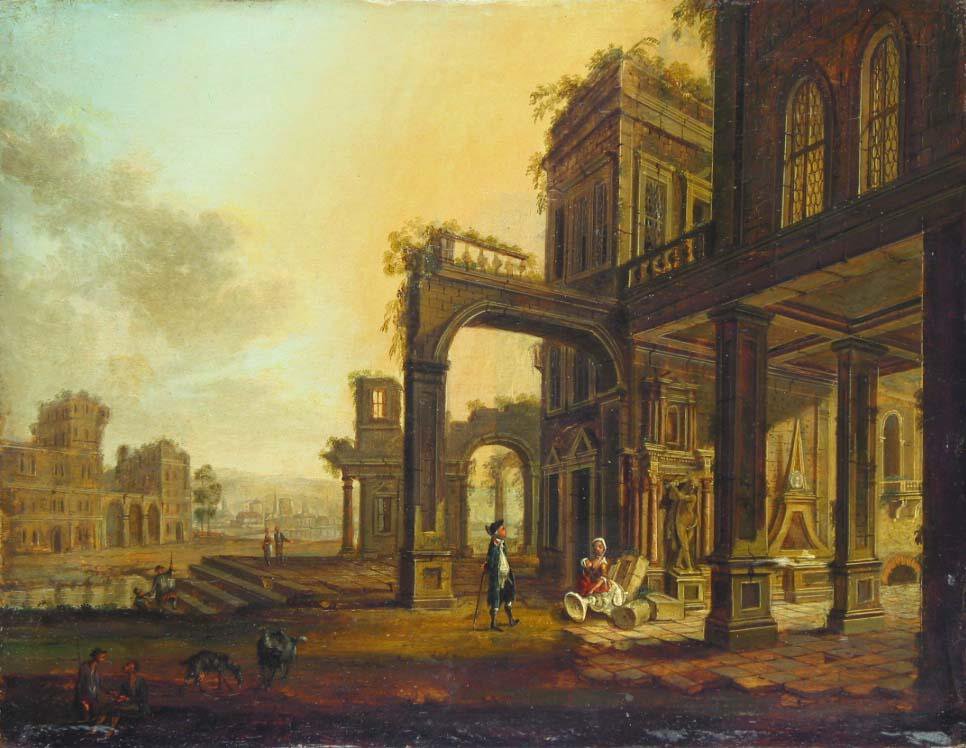
View of a Palace. The State Hermitage Museum.
The painting entered the Hermitage in 1936, handed over by the Antikvariat All-Union Association, and it was originally in the collection of A. K. Rudanovsky. It is not currently on permanent display.
It is a small panel — 25.5 by 32.6 centimetres — with a palace courtyard, a great arch, a vaulted hall and a few figures.
The Object
The painting shows a courtyard of a palace.
At the right, a building with columns, pilasters and arched windows; at the centre, a tall arch, its top overgrown with plants; through the arch, a distant view of a town and a bridge. At the left, lower buildings and a wall.
In the foreground, figures walk and rest, and a dog stands near them. The light is warm, and it falls from the left.
The Palace
The palace is the painting’s setting.
It is a classical building, with columns, a cornice and a vaulted hall, and it is painted in warm greys and ochres. Its architecture is partly ruined: plants grow on the arch, and some parts look abandoned.
The palace is both a real building and an imagined one: the painter has combined elements to create a picturesque scene.
The Arch
The arch is the composition’s centre.
It is a tall, rounded arch, with a moulded edge and a stone face, and it frames the view beyond. Plants grow on its top, and its stone is weathered.
The arch is a classical motif, and it is used here to frame the distance and to give the courtyard depth.
The Figures
A few figures animate the scene.
A gentleman in a dark coat and a tricorn hat walks with a cane; a woman sits with a basket; a child plays; a dog stands at the lower left. Other figures are visible in the distance.
The figures give the courtyard its scale and its life, and they turn an architectural view into a scene of everyday life.
The Light
The light is warm and low.
It comes from the left, and it falls on the stone and the figures, casting long shadows. The sky is a pale golden grey, with soft clouds.
The light is the painting’s atmosphere: it suggests evening, and it gives the architecture a warm, romantic glow.
Stöcklin
Christian Stöcklin (1741–1795) was a German painter.
He specialised in architectural views and capricci: paintings of buildings, ruins and courtyards, often combined with figures. His work belongs to the tradition of the architectural fantasy, which was popular in the eighteenth century.
His paintings are small, carefully finished and full of atmosphere, and they were collected by princes and bourgeois.
The Capriccio
The painting is a capriccio.
A capriccio is an architectural fantasy: a painting that combines real and imagined buildings in a single composition, often with ruins, figures and a picturesque light. It was a popular genre in the eighteenth century.
The capriccio allowed the painter to invent, to compose and to create a scene that was more beautiful than reality.
The Panel
The painting is on panel.
Panel was a common support for small, highly finished paintings in the eighteenth century: it is smooth, rigid and takes fine detail. The panel is small, and it was probably framed when new.
The small size invites close looking, and it makes the painting an intimate object.
The Vaulted Hall
A vaulted hall opens at the right.
It is a deep, shadowed space, with columns, arches and a staircase, and it is painted in warm browns and greys. The hall gives the palace its depth, and it suggests a world beyond the courtyard.
Interiors of this kind are a favourite of capriccio painters: they allow the artist to show perspective, light and shadow in a single frame.
The Town
A town is visible through the arch.
It is small and distant, with a bridge, a tower and a few buildings, painted in pale greys and blues. The town gives the scene its horizon, and it connects the palace to the world outside.
Views through arches are a classical device: they frame the distance and give the composition its depth.
The Dog
A dog stands at the lower left.
It is a small, dark animal, painted in a few strokes, and it looks toward the figures. The dog gives the scene a domestic note, and it is one of the details that make the courtyard feel inhabited.
Animals are common in architectural views: they provide scale, movement and a touch of everyday life.
The Frame
The painting was probably framed when new.
Small panels of this kind were usually set in simple wooden frames, sometimes gilded, and they were hung in cabinets and galleries. The frame is lost or replaced, but the painting still carries the scale of the room for which it was made.
A small painting is an intimate object, and it was meant to be looked at closely.
The Columns
Columns frame the vaulted hall.
They are tall and plain, with simple capitals, and they are painted in warm browns with a light from the side. The columns give the hall its structure, and they lead the eye into the depth of the building.
Columns are the grammar of classical architecture, and in a capriccio they are also a way of creating perspective.
The Sky
The sky is pale and golden.
It is painted in soft washes, with a few clouds, and it fills the upper part of the panel. The sky gives the scene its light, and it sets the warm tone of the whole painting.
A golden sky is characteristic of the picturesque view: it suggests evening, and it gives the architecture a romantic glow.
The Roof
The roofs of the palace are visible at the top.
They are tiled, with chimneys and dormers, and they are painted in warm reds and browns. The roofs give the building its silhouette against the sky.
Roofs are often neglected in architectural painting, but here they are carefully described: they make the palace look inhabited, and they complete the building.
Provenance
The painting carries the inventory number GE-8263. It entered the Hermitage in 1936, handed over by the Antikvariat All-Union Association, and it was originally in the collection of A. K. Rudanovsky.
In the Hermitage
The painting is preserved in the State Hermitage Museum in Saint Petersburg and is not on permanent display.
It is a small, atmospheric image, and it preserves a world of palaces and courtyards: an arch, a vaulted hall, a few figures and a warm evening light, and a painter who knew how to make stone glow, and how to make a courtyard look like a memory, and a memory look like a place, and a place like a dream, at the hour when the stones turn gold, and the courtyard empties, and the picture keeps it.