Artist: Philipp Peter Roos (Rosa da Tivoli) (1657–1706)
Origin: Germany
Date: 17th century
Material: canvas
Technique: oil
Dimensions: 165 × 118 cm
Current Collection: The State Hermitage Museum
Inventory Number: GE-6832
Hermitage ID: 38271
Rudanovsky Connection: Entered the Hermitage in 1931 from the collection of A. K. Rudanovsky.
A large seventeenth-century still life of dead game by Philipp Peter Roos, known as Rosa da Tivoli.
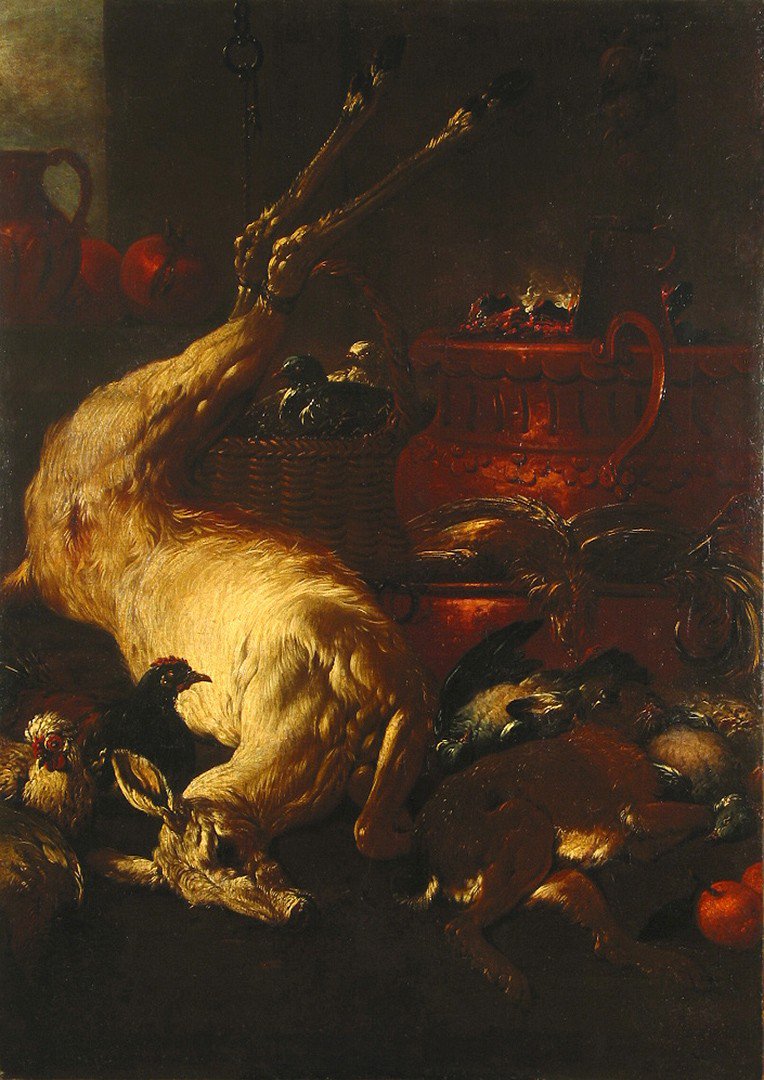
Dead Game. The State Hermitage Museum.
The painting entered the Hermitage in 1931, handed over by the Antikvariat All-Union Association, and it was previously in the collection of A. K. Rudanovsky. It is not currently on permanent display.
It is a tall canvas — 165 by 118 centimetres — showing a hare hanging by its hind legs, another hare on the ground, birds, a basket and a copper pot.
The Object
The composition is built around the hanging hare.
It is suspended by its hind legs from a hook, and its body fills the centre of the canvas, painted in warm ochres and creams. Below, another hare lies on the ground, and around it are birds: partridges, a pigeon, a small dark bird with a red comb.
At the right, a copper pot and a basket; at the upper left, dark red fruit; the background is a dark interior.
The Hares
The hares are the painting’s protagonists.
The hanging hare is painted with great care: its fur, its ears, its paws and its open eye. The second hare lies on the ground, its body relaxed in death.
Hares were a favourite subject of game still lifes: their fur, their size and their association with the hunt made them ideal for a display of the painter’s skill.
The Birds
The birds fill the lower part of the canvas.
Partridges, a pigeon, a dark bird with a red comb, and others lie in a heap, their feathers painted with care. Some are dark, some pale, and their bodies are arranged to show their plumage.
Birds were the standard companions of the hare in a game piece, and their variety gave the painter a chance to show different textures.
The Copper
A copper pot stands at the right.
It is a large vessel with a handle, painted in warm reds and oranges, and it catches the light. Its metal surface is one of the painting’s brightest passages.
Copper and brass vessels were common in still lifes: they reflected the light and gave the painter a chance to show his skill with metals.
The Darkness
The painting is dark.
The background is a brown-black, and the objects emerge from it as if lit by a single source. The light falls from the left, and it picks out the hare, the birds and the copper.
This use of darkness is characteristic of seventeenth-century still lifes: it concentrates attention, and it gives the objects a dramatic presence.
Roos
Philipp Peter Roos (1657–1706) was a German painter.
He worked in Rome, where he was known as Rosa da Tivoli, and he specialised in animals, landscapes and game still lifes. His work is characterised by warm colour, careful observation and a taste for the rustic.
He was one of a family of painters, and his sons continued his tradition of animal painting.
The Game Piece
The painting is a game piece.
Game pieces were a genre of still life: they showed the results of the hunt — hares, birds, deer — hanging or lying on a table. They were hung in dining rooms and kitchens, and they celebrated the abundance of the hunt.
The genre was popular in the seventeenth century, and it was practised by painters across Europe.
The Basket
A woven basket stands behind the hare.
It is filled with dark shapes — perhaps more birds or fruit — and its weave is painted with care. The basket gives the composition a middle ground, and it adds a rustic note to the scene.
Baskets were common in game pieces: they held the spoils of the hunt, and they gave the painter a chance to show texture.
The Fruit
Dark red fruit sits at the upper left.
They are apples or pomegranates, painted in deep reds, and they catch a little light. They are a small detail, but they add a note of colour to the darkness.
Fruit in a game piece is often a secondary element: it fills the corners, and it softens the austerity of the dead animals.
The Hook
The hare hangs from a hook.
The hook is a dark metal curve at the top of the canvas, and it is almost invisible in the shadows. Its presence is implied rather than shown, and it explains the hare’s position.
Hooks and chains are a common device in game pieces: they allow the painter to suspend the animals, and they add a note of the kitchen to the scene.
The Fur
The fur is the painting’s most refined passage.
The hare’s coat is painted in warm ochres and creams, with individual hairs suggested by fine strokes. The fur is soft and thick, and it catches the light on the animal’s flank.
Painting fur is a test of a still-life painter’s skill: it must be soft and detailed at once, and it must suggest the animal’s warmth even in death.
The Collector
The painting came to the Hermitage with the Rudanovsky collection.
Rudanovsky collected European art of many kinds, and his collection included German and Flemish still lifes as well as Italian, French and Dutch works.
The painting is therefore a double document: of German game painting and of a Russian collector’s taste.
The Composition
The composition is built on a diagonal.
The hanging hare runs from the top left to the centre, and the second hare and the birds spread to the right and the bottom. The copper pot and the basket fill the upper right.
This arrangement gives the painting movement, and it prevents the still life from becoming a static display.
The Table
The game lies on a table or a shelf.
It is a dark surface, barely visible in the shadows, and it supports the birds and the second hare. The table gives the objects a ground, and it turns the scene into a display.
Tables of this kind are a convention of still lifes: they provide a surface, and they separate the objects from the background.
Provenance
The painting carries the inventory number GE-6832. It entered the Hermitage in 1931, handed over by the Antikvariat All-Union Association, and it was previously in the collection of A. K. Rudanovsky.
In the Hermitage
The painting is preserved in the State Hermitage Museum in Saint Petersburg and is not on permanent display.
It is a rich, dark, generous image, and it preserves a world of hunting and display: two hares, a heap of birds, a copper pot and a warm light in the darkness, and a hunter’s pride made visible on a canvas taller than a man, in a room where nobody hunts any more.
The hare hangs by its hind legs, the light falls across its fur, and the painting holds the moment between the hunt and the kitchen. It is a still life, and it is also a small theatre of death and display.