Organization: Imperial Porcelain Factory
Origin: Russia, St Petersburg
Date: 1814–1825
Complex: Series with Views of St Petersburg and its Environs
Material: porcelain
Technique: overglaze monochrome printing, overglaze monochrome coating, polychrome painting, gilding
Dimensions: diameter 22.9 cm
Current Collection: The State Hermitage Museum
Inventory Number: ERF-8807
Hermitage ID: 931303
Rudanovsky Connection: Entered the Hermitage in 1919 from the collection of A. K. Rudanovsky.
A Russian dinner plate of 1814–1825 with a printed view of the Pavlovsk Palace.
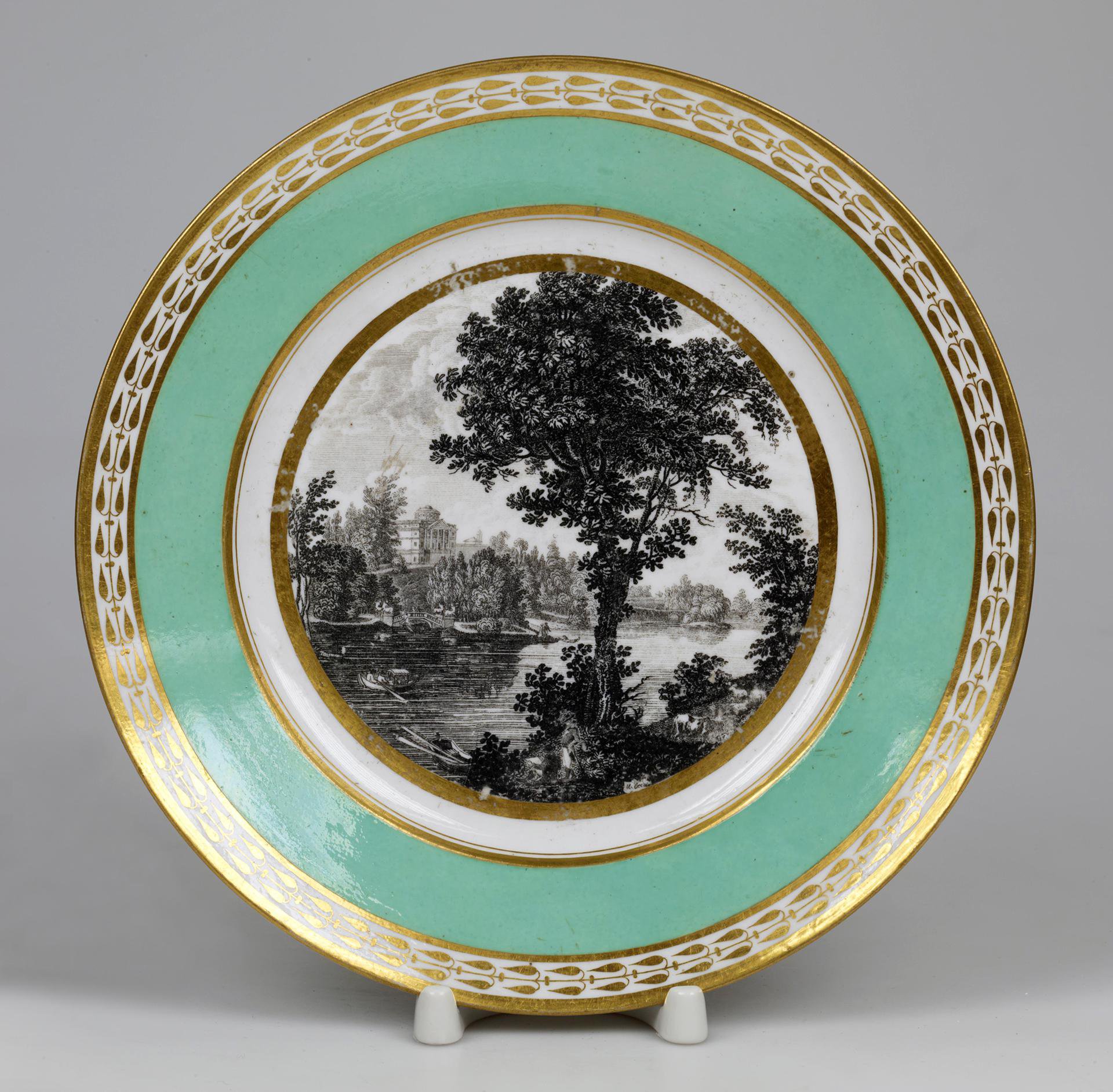
Dinner Plate with a View of the Pavlovsk Palace. The State Hermitage Museum.
The plate entered the Hermitage in 1919, transferred from the Office for the Preservation of Monuments of Art and Antiquity and previously in the collection of A. K. Rudanovsky. It is not currently on permanent display.
It is a round plate — 22.9 centimetres across — with a mint-green border and a black-and-white view of Pavlovsk in the centre.
The Object
The plate has a wide rim and a shallow well.
The rim is mint green, framed by gold bands and a border of gold palmettes. In the centre, a gold ring frames a circular view, printed in black and white.
The view shows the Pavlovsk Palace, a river, trees and a bridge, with a large tree in the foreground.
The View
The view is a landscape.
It shows the palace at the left, on a rise, with a river in front of it and trees around. A large tree dominates the right foreground, and a boat floats on the water.
The scene is topographical: it records a real place, and it was probably based on a print or a drawing.
Pavlovsk
Pavlovsk is a palace and park near St Petersburg.
It was built for the emperor Paul I and his wife Maria Feodorovna in the 1780s and 1790s, and it became one of the most beautiful estates in Russia. Its park, its palace and its pavilions were celebrated across Europe.
A view of Pavlovsk on a plate is a small portrait of the imperial family’s private world.
The Printing
The view is printed, not hand-painted.
It is a monochrome print, in black or dark grey, transferred onto the porcelain and fired. The technique allowed the factory to reproduce detailed views quickly and in series.
Printed views were a speciality of the Imperial Porcelain Factory in the early nineteenth century, and they were used for the «Series with Views of St Petersburg».
The Border
The border is mint green.
It is a soft, slightly blue green, and it covers the wide rim. It is framed by gold bands and by a border of gold palmettes, which run around the edge.
The green gives the plate its colour, and the gold gives it its frame.
The Series
The plate belongs to a series.
The «Series with Views of St Petersburg and its Environs» was produced in the 1810s and 1820s, and it included plates with views of the city’s palaces, parks and monuments.
The series was a patriotic project: it celebrated the capital and its surroundings, and it was made for the court and for collectors.
1814–1825
The plate is dated 1814–1825.
It was made in the years after the Napoleonic wars, when Russia was at the height of its power and St Petersburg was one of the great capitals of Europe. The porcelain factory was producing ambitious series for the court.
The plate belongs to that moment, and it shows the confidence of the period.
The Palace
The palace is the view’s centre.
It is a classical building, pale and low, set on a rise above the river. Its colonnade and its dome are visible through the trees.
Pavlovsk Palace was built for Paul I and Maria Feodorovna, and it was one of the most refined classical buildings in Russia. Its image on a plate is a small portrait of the imperial family’s taste.
The Tree
A large tree dominates the foreground.
It is drawn in black, with detailed foliage, and it frames the view. Its trunk and branches are described with care.
Trees of this kind are a convention of topographical prints: they frame the view and give it depth.
The Boat
A small boat floats on the river.
It is a few strokes in the water, and it gives the scene a human note. The boat suggests the life of the park, and it makes the view less formal.
Details of this kind are what make a topographical print feel like a place.
The Gold Palmette
The border has a gold palmette pattern.
It is a band of stylised leaves, painted in gold, and it runs around the rim. The palmettes frame the green ground, and they give the plate its architecture.
Palmettes are a classical motif, and their presence dates the plate to the neoclassical period.
The Table
The plate was made for a table.
It was a dinner plate, and it stood at the place of a guest at a grand dinner. Its view of Pavlovsk would have been admired between courses.
That table is gone, but the plate still carries its function: a surface for food, and a picture of a palace.
The Collector
The plate came to the Hermitage with the Rudanovsky collection.
Rudanovsky collected Russian and European porcelain, and his collection included services, plates and views.
The plate is therefore a double document: of the Imperial factory in the 1810s and of a Russian collector’s taste.
The Bridge
A bridge crosses the river.
It is small and pale, and it connects the banks. Bridges are a favourite element of park views: they suggest movement, and they frame the water.
The bridge gives the view its depth, and it leads the eye toward the palace.
The Print’s Line
The print is made of fine lines.
The view is built up from hatching and cross-hatching, in black on white, and the lines create the trees, the water and the sky. The technique is that of an engraving.
A printed view of this kind is a small graphic work, transferred onto porcelain, and it shows the factory’s skill in reproduction.
The Water
The river takes up the middle of the view.
It is drawn with fine horizontal lines, and it reflects the sky. Its surface is calm, and its edges are marked by reeds and trees.
Water is the view’s centre of gravity: it reflects the palace, and it gives the scene its light.
Provenance
The plate carries the inventory number ERF-8807. It entered the Hermitage in 1919, transferred from the Office for the Preservation of Monuments of Art and Antiquity and previously in the collection of A. K. Rudanovsky.
In the Hermitage
The plate is preserved in the State Hermitage Museum in Saint Petersburg and is not on permanent display.
It is a fine example of Russian porcelain, and it preserves a view of Pavlovsk: a palace, a river, a tree and a green border, printed on a plate two centuries ago.
It is a plate, and it is a view, and it has kept its palace and its river for two centuries.
It is a small window onto a park that still exists, and it is still open.
It is a small picture of a summer afternoon, and it has lasted. And the water is still calm.