Organization: Imperial Porcelain Factory
Origin: Russia, St Petersburg
Date: 1801–1825
Complex: Service with a Garland of Orange-coloured Flowers and Cornflowers
Material: porcelain
Technique: overglaze polychrome painting, gilding
Dimensions: diameter 24.1 cm
Current Collection: The State Hermitage Museum
Inventory Number: ERF-8816
Hermitage ID: 931312
Rudanovsky Connection: Entered the Hermitage in 1919 from the collection of A. K. Rudanovsky.
A Russian dinner plate of 1801–1825, from a service with a garland of orange flowers and cornflowers.
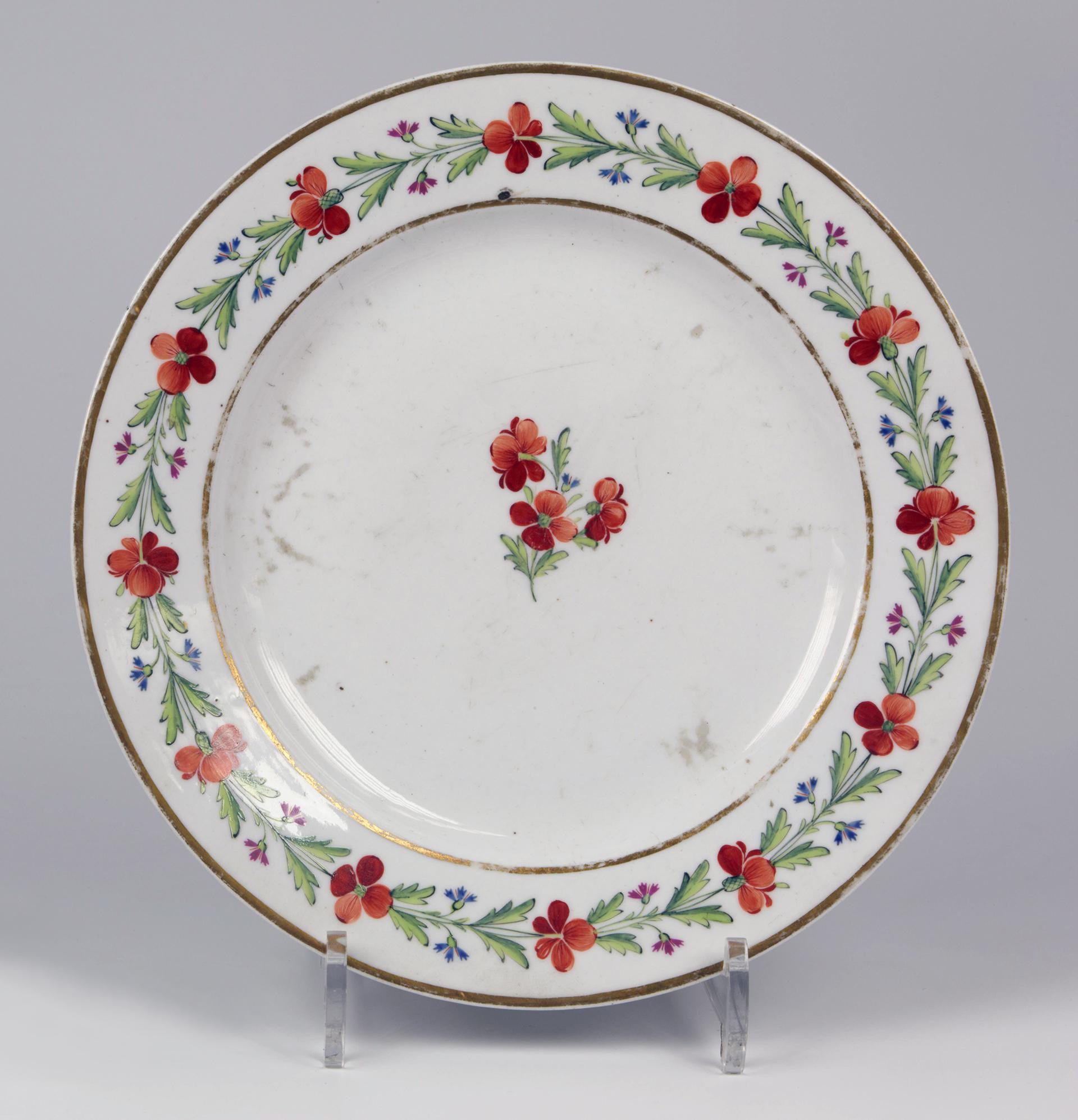
Dinner Plate. The State Hermitage Museum.
The plate entered the Hermitage in 1919, transferred from the Office for the Preservation of Monuments of Art and Antiquity and previously in the collection of A. K. Rudanovsky. It is not currently on permanent display.
It is a large dinner plate — 24.1 centimetres across — with a white ground, a garland of flowers and a gilt rim.
The Object
The plate is round, with a wide rim and a shallow well.
Its rim is decorated with a continuous garland of orange flowers and cornflowers, painted in reds, blues and greens. In the centre, a small spray of the same flowers repeats the pattern.
The edge is banded with gold, and the painting is delicate.
The Garland
The garland is the plate’s ornament.
It runs around the rim in a continuous band, with orange flowers, blue cornflowers and green leaves. It is painted with a fine brush, and each flower is described.
A garland of this kind is a classical device: it frames the plate, and it gives the object its rhythm.
The Flowers
The flowers are of two kinds.
The orange flowers are the dominant note: they are round, with five petals, and they are painted in a warm red-orange. The cornflowers are blue, with a star-shaped head, and they appear between them.
The contrast between orange and blue is the plate’s colour scheme, and it is a bold, cheerful combination.
The Centre
The centre of the plate is a small spray.
It repeats the garland’s flowers at a smaller scale, and it gives the middle of the plate a focus. The spray is surrounded by white, which makes it stand out.
A central spray is a common device in services of the period: it allows each plate to be decorated with the same flowers.
The Gold
The gold is applied in a thin band.
It edges the rim of the plate, and it frames the garland. It was applied over the glaze, fired and burnished.
The gold is worn in places, and it records the plate’s use.
The Service
The plate belongs to a service.
The service was decorated with the garland of orange flowers and cornflowers, and it included plates, dishes and tureens. It was one of the many services produced by the Imperial factory for the court.
The plate is one of its pieces, and it carries the service’s name.
1801–1825
The plate is dated 1801–1825.
It was made in the reigns of Alexander I and Nicholas I, when the Imperial factory was producing large services for the court and the nobility. The style of the period was neoclassical, with clear forms and delicate painting.
The plate belongs to that period, and it shows its taste for garlands and gold.
The Rim
The rim is the plate’s frame.
It is wide and white, with a garland of flowers, and it is banded with gold. The rim is where the decoration is concentrated.
Rims of this kind are a feature of services of the period: they frame the plate and give it its colour.
The Blue
The cornflowers are blue.
They are small, star-shaped flowers, painted in a clear blue, and they appear between the orange flowers. Their blue is the plate’s cool note, and it balances the warm orange.
Cornflowers were a favourite flower in Russian porcelain, and they were used for services and figures.
The Orange
The orange flowers are the plate’s dominant note.
They are round, with five petals, painted in a warm red-orange, and they form the garland’s rhythm. Their colour is strong, and it makes the plate cheerful.
Orange flowers are less common than roses in porcelain, and their use here gives the service its character.
The Leaves
The leaves are painted in greens.
They are small and pointed, and they fill the spaces between the flowers. Their colour gives the garland its freshness.
Leaves of this kind are a convention of flower painting: they support the flowers and give them their context.
The Table
The plate was made for a table.
It was a dinner plate, and it stood at the place of a guest at a grand dinner. Its garland would have repeated across the table, from plate to plate.
That table is gone, but the plate still carries its function: a surface for food, framed by flowers.
The Collector
The plate came to the Hermitage with the Rudanovsky collection.
Rudanovsky collected Russian and European porcelain, and his collection included services and plates of many kinds.
The plate is therefore a double document: of the Imperial factory in the early nineteenth century and of a Russian collector’s taste.
The Gold’s Wear
The gold is worn.
It is rubbed on the rim, and it has disappeared in places, leaving a pale line. The painting is still fresh, but the object shows its age.
The wear is a sign of use, and it records the plate’s long life on a table.
The Plate’s Shape
The plate is round and wide.
It is 24.1 centimetres across, with a broad rim and a shallow well. Its size makes it a dinner plate, and its shape gives the garland room.
A wide rim is a feature of services of the period: it frames the plate and gives the decoration its place.
The Flowers’ Scale
The flowers are small.
Each one is a few centimetres across, and the garland is made of dozens of them. Their small scale gives the plate its delicacy, and it makes the decoration look like a fabric pattern.
Small flowers are a feature of neoclassical porcelain: they are precise, and they reward close looking.
The Cornflower’s Blue
The cornflower’s blue is clear and cool.
It is a pure, slightly violet blue, painted in a few strokes, and it stands out against the warm orange. It is the plate’s cool note, and it gives the garland its balance.
Blue was an expensive colour in porcelain, and its use here is a sign of the service’s quality.
Provenance
The plate carries the inventory number ERF-8816. It entered the Hermitage in 1919, transferred from the Office for the Preservation of Monuments of Art and Antiquity and previously in the collection of A. K. Rudanovsky.
In the Hermitage
The plate is preserved in the State Hermitage Museum in Saint Petersburg and is not on permanent display.
It is a fine example of Russian porcelain, and it preserves a garland: orange flowers, blue cornflowers and a gilt rim, painted two centuries ago.
It is a plate, and it is a garland, and it has kept its orange and its blue through two centuries of use.
It is a small thing, and it is a cheerful one.
It is a plate, and it is also a small garden, and the garden has not faded.