Artist: Michel-Victor Acier (1736–1799), author of the model
Organization: Imperial Porcelain Factory
Origin: Russia, St Petersburg
Date: 1770–1790s
Complex: Additions to the Hunting Service, most of which was produced by Meissen in 1766–1768
Material: porcelain
Technique: overglaze polychrome painting, gilding
Dimensions: tureen 11.5 × 36 × 22 cm; cover 16 × 27 × 20.5 cm
Current Collection: The State Hermitage Museum
Inventory Number: ERF-8937
Hermitage ID: 931432
Rudanovsky Connection: Entered the Hermitage in 1920 from the collection of A. K. Rudanovsky.
A large lidded bowl of 1770–1790s, made at the Imperial Porcelain Factory as an addition to the Meissen «Hunting Service», after a model by Michel-Victor Acier.
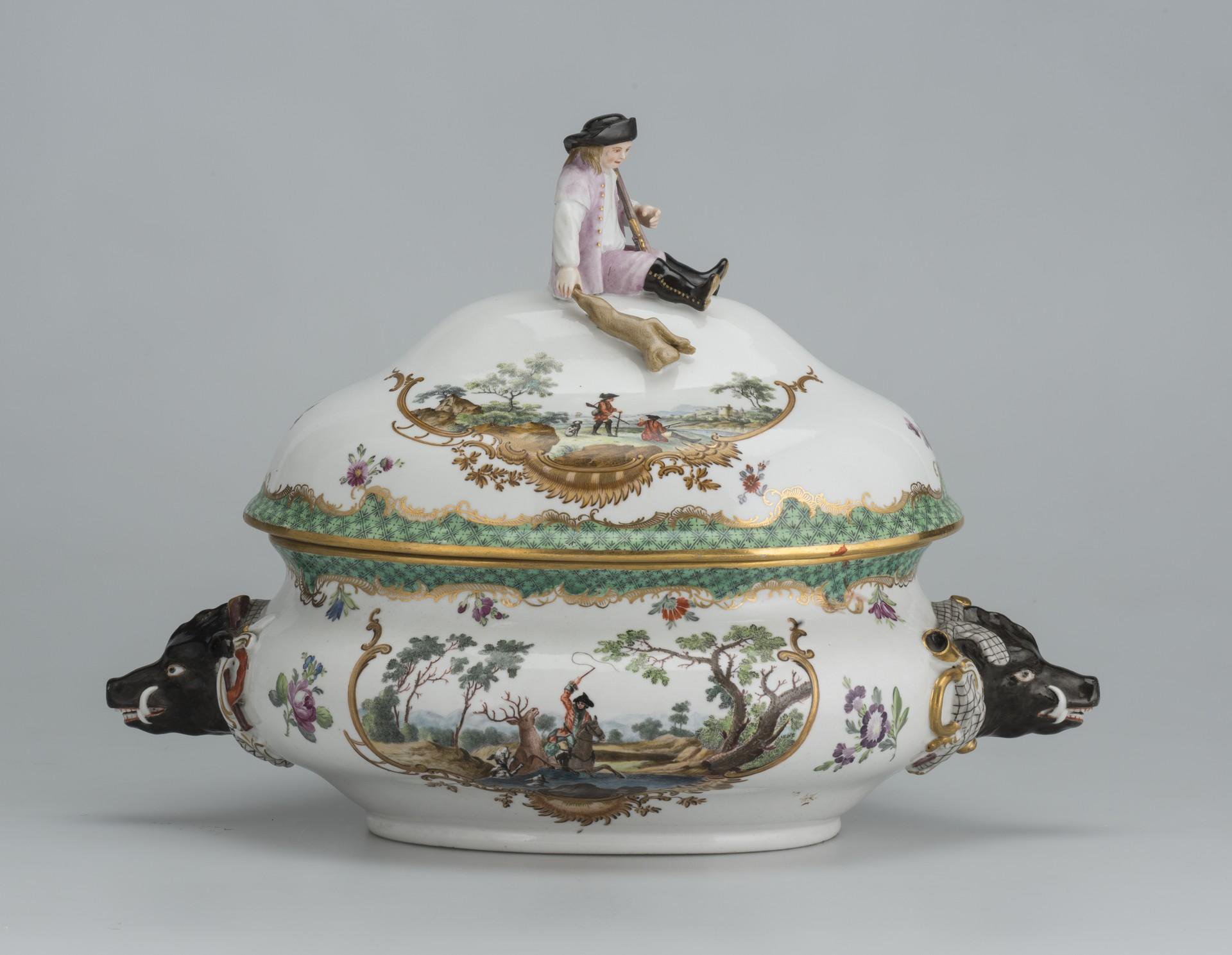
Lidded Bowl. The State Hermitage Museum.
The bowl entered the Hermitage in 1920, handed over by the Department for the Protection of Monuments of Art and Antiquities and originally in the collection of A. K. Rudanovsky. It is not currently on permanent display.
It is a large tureen — 36 centimetres long — with a domed lid, hunting scenes and a figure of a seated hunter on top.
The Object
The tureen has a broad, rounded body and a high domed lid.
Its body is white, painted with hunting scenes in gold cartouches and framed by a green scale border. Its handles are modelled as boars’ heads, painted in dark brown.
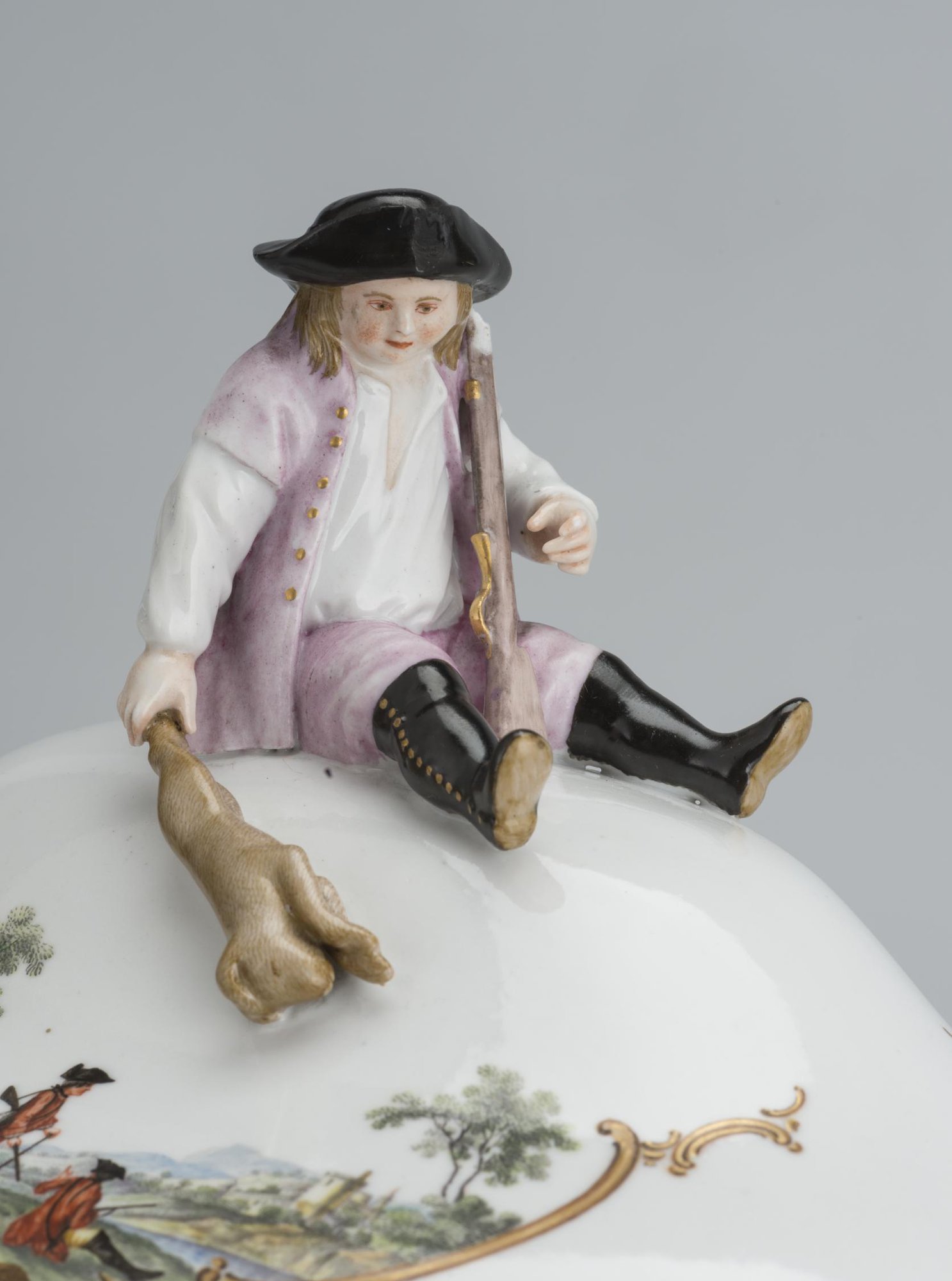
The lid is crowned by a modelled figure: a hunter seated on a log, his gun beside him.
The Figure
The figure is the tureen’s crowning detail.
He is a young man in a pink coat and a black hat, sitting on a log with his gun across his knees. His pose is relaxed, and his face is calm.
The figure turns the lid into a small sculpture, and it gives the tureen its narrative: the hunter rests while the hunt goes on around him.
The Boar’s Heads
The tureen’s handles are boars’ heads.
They are modelled in the round, painted in dark brown, with tusks and ears, and they emerge from the body like trophies. Their mouths are open, and their snouts point outward.
Boars’ heads are a hunting motif, and they give the tureen its aggressive, festive character.
The Scenes
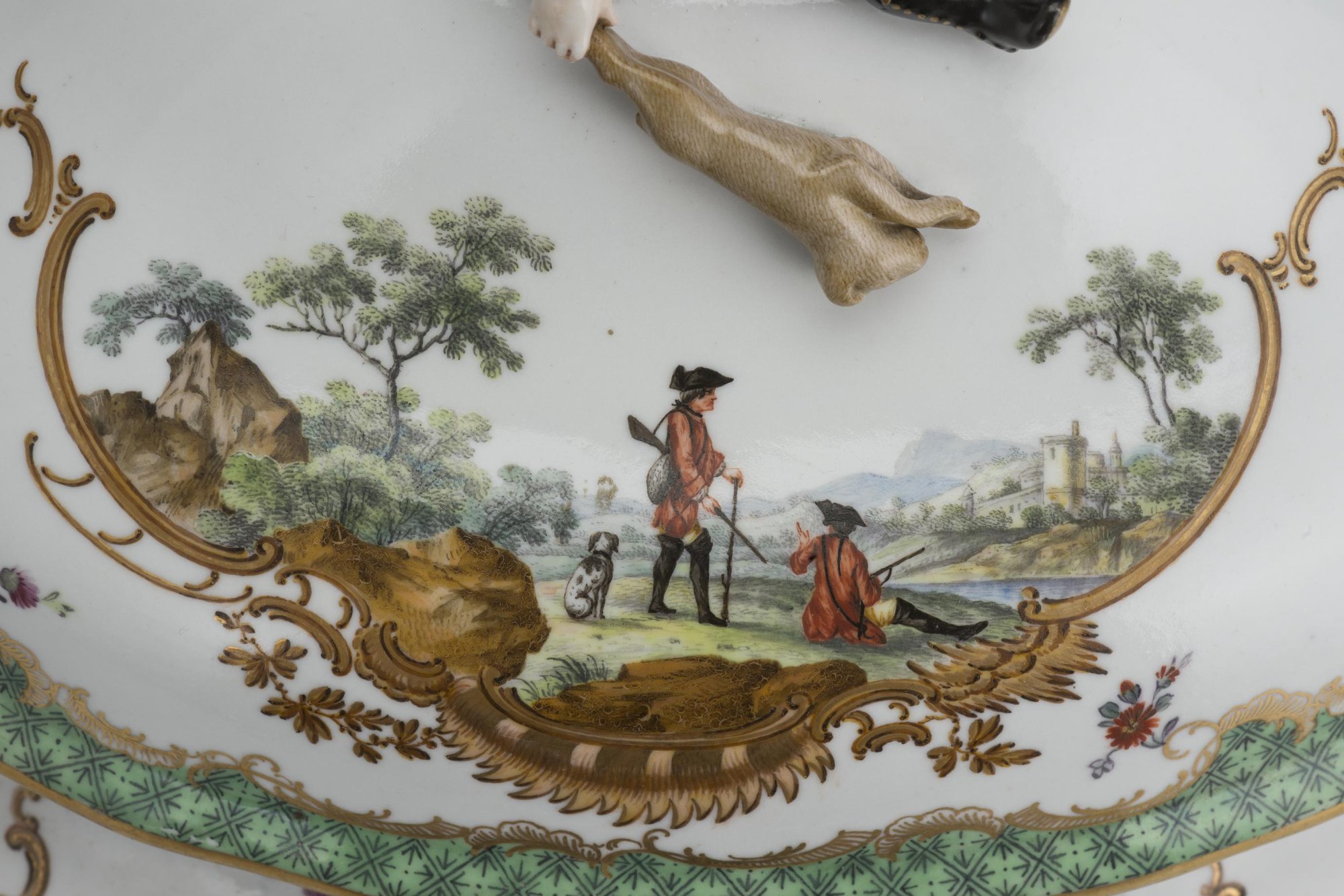
The body is painted with hunting scenes.
They are framed by gold cartouches, and they show huntsmen, dogs and animals in landscapes. The scenes are small and detailed, and they are painted in soft colours.
Hunting scenes of this kind are the subject of the service, and they connect the Russian addition to the Meissen original.
The Border
The border is green.
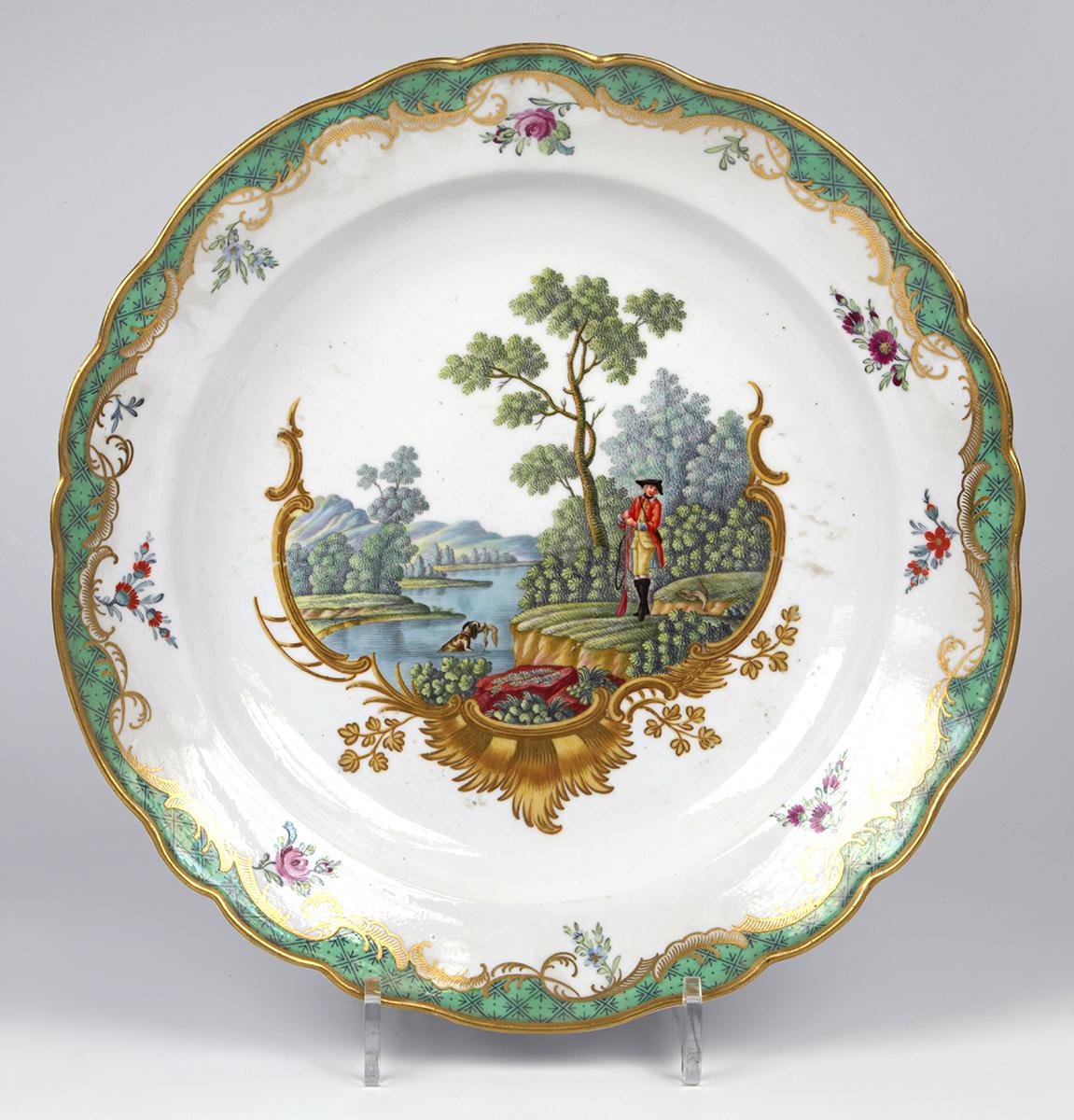
It is painted with a scale pattern, and it runs around the rim of the tureen and the lid. Its colour and its pattern match the Meissen service, and they show that the Russian addition was designed to fit.
Borders of this kind are a sign of the service, and they unite its many pieces.
Acier
Michel-Victor Acier (1736–1799) was a French sculptor.
He worked at Sèvres, where he was the director of the sculpture studio, and he made models for figures, groups and tureens. His work is characterised by elegance and careful modelling.
The model for this tureen is attributed to him, and it shows how French design reached the Russian factory.
The Service
The tureen belongs to the Meissen «Hunting Service», or rather to its Russian additions.
The service was made at Meissen in 1766–1768, and the Imperial factory added pieces to it in the 1770s and later. The tureen is one of those additions, made to complete or enlarge the service.
The Date
The tureen is dated 1770–1790s.
The date places it in the early years of the Imperial factory, when its modellers were working with French and German models. The tureen is a mature work of that period.
The Lid
The lid is domed and high.
It is painted with hunting scenes in gold cartouches, and it is framed by the green scale border. Its knob is the seated hunter.
The lid turns the tureen into a closed vessel, and it gives the object its monumental profile.
The Cover’s Scenes
The cover has its own scenes.
They are painted in gold cartouches, and they show huntsmen, dogs and landscapes. The scenes are small and detailed, and they match the body’s decoration.
A lid with its own scenes is a generous arrangement: it gives the object a second surface, and it continues the story.
The Knob’s Base
The figure sits on a small mound.
It is modelled as a grassy bank, with a log and a few plants, and it supports the hunter. The mound gives the figure a ground, and it turns the lid into a landscape.
Bases of this kind are a feature of porcelain figures: they give the figure a place to stand, and they connect it to the object.
The Foot
The tureen stands on a low foot.
It is a circular ring, white and plain, and it raises the body from the table. The foot gives the tureen stability, and it is the part that is hidden in use.
Foot rings of this kind are a feature of porcelain tureens of the period, and their wear is a sign of use.
The Table
The tureen was made for a table.
It stood at the centre of a grand dinner, and it held soup or stew. Its boars’ heads and its seated hunter made it a centrepiece, and its green border matched the service.
That table is gone, but the tureen still carries its logic: a vessel for food, crowned by a hunter and guarded by boars.
The Boar’s Tusks
The boars’ tusks are white.
They curve up from the mouth, and they are painted in white and grey. They give the heads their ferocity, and they mark them as boars rather than pigs.
Tusks of this kind are a hunting trophy in miniature: they turn the handles into a pair of trophies, and they give the tureen its character.
The Figure’s Gun
The hunter holds a gun.
It lies across his knees, and it is painted in brown and black. The gun is the figure’s attribute, and it identifies him as a sportsman.
A gun of this size, on a figure of this size, is a small piece of modelling, and it is one of the details that make the tureen a work of art.
The Green
The green border is the tureen’s link to Meissen.
It matches the scale pattern of the German service, and it shows that the Russian addition was designed to fit. Without it, the tureen would look like a stranger.
The border is therefore more than decoration: it is a signature of continuity, and it joins two factories across Europe.
Provenance
The tureen carries the inventory number ERF-8937. It entered the Hermitage in 1920, handed over by the Department for the Protection of Monuments of Art and Antiquities and originally in the collection of A. K. Rudanovsky.
In the Hermitage
The tureen is preserved in the State Hermitage Museum in Saint Petersburg and is not on permanent display.
It is a magnificent object, and it preserves a hunting scene: a seated hunter, a pair of boars’ heads and a green border, modelled in porcelain two centuries ago.
It is a bowl, and it is a hunt, and it is still guarded by two boars.