Organization: Imperial Porcelain Manufactory, Vienna
Origin: Austria, Vienna
Date: 1785–1786
Complex: Cobalt-Blue Service
Material: porcelain
Technique: gilding, polychrome painting
Dimensions: length 38 cm; width 29 cm
Current Collection: The State Hermitage Museum
Inventory Number: ZF-16586
Hermitage ID: 352428
Rudanovsky Connection: Entered the Hermitage in 1919 from the collection of A. K. Rudanovsky.
A Vienna porcelain dish of 1785–1786 from the «Cobalt-Blue Service», its deep blue ground covered with a gold scale pattern and interrupted by four reserves of flowers.
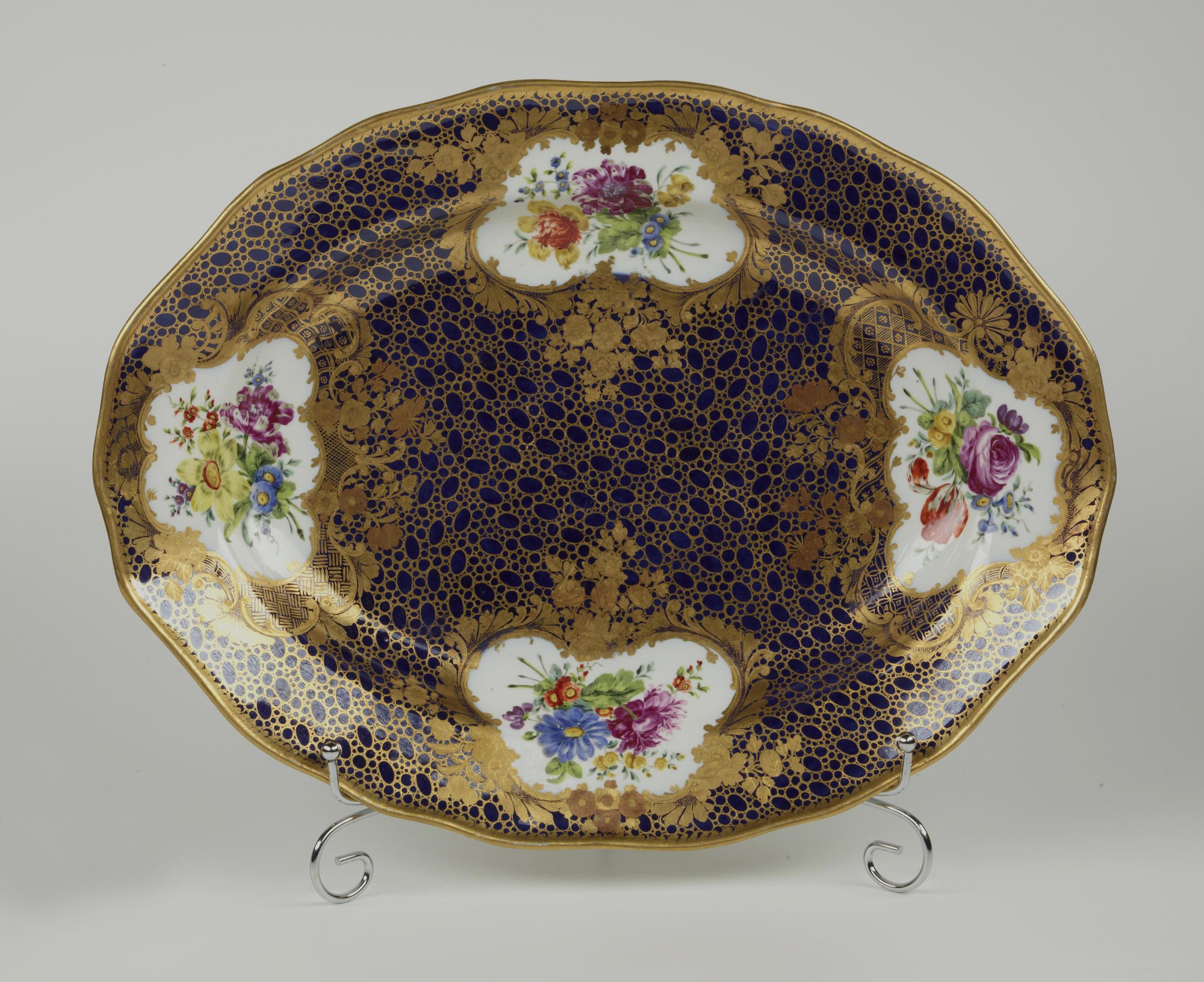
Dish, Cobalt-Blue Service (ZF-16586). The State Hermitage Museum.
The dish entered the Hermitage in 1919 from the collection of A. K. Rudanovsky. It is not currently on permanent display.
It is the largest dish in the group, 38 by 29 centimetres, and it is among the most spectacular: a surface of cobalt blue and gold, with four white windows full of flowers.
The Object
The dish is oval, with a scalloped rim and a shallow well.
The ground is a deep cobalt blue, covered with a pattern of gold scales — small overlapping arcs, like the skin of a fish — and with gold scrollwork and flowers. Four white reserves, shaped like cartouches, break the blue: each contains a bouquet of flowers, painted in the same naturalistic style as the rest of the service.
The rim is gilded, and the whole surface is polished and reflective.
The Blue Ground
The blue ground is the dish’s dominant feature.
It is applied as a wash over the glaze and fired, and it covers almost the entire surface. The colour is deep and even, with a slight variation that comes from hand application.
Cobalt blue was the most expensive colour in the eighteenth-century palette, and a full blue ground was a statement of wealth. On this dish, the blue is combined with a great deal of gold, making it even more luxurious.
The Gold Scale
The gold scale pattern is the most distinctive element of the decoration.
It is painted in gold over the blue, in rows of small overlapping arcs, so that the surface seems to be covered with fish scales. The pattern is regular but not mechanical: each scale is a little different, and the hand of the painter is visible in the variations.
Scale patterns were popular in European porcelain of the 1780s, and they appear on services from Vienna, Sèvres and other factories.
The Four Reserves
Four white reserves interrupt the blue.
They are shaped like cartouches or shields, and each contains a bouquet of flowers: roses, carnations, bluebells, pansies. The white ground of the reserves makes the flowers stand out against the blue, and the gold frames around them connect them to the ground.
The reserves are arranged symmetrically, one at each end and one at each side, giving the dish a balanced composition.
Vienna in the 1780s
The dish belongs to the late period of the Vienna factory.
By the 1780s, Vienna was producing porcelain in the neoclassical taste, with rich grounds, gold decoration and formal compositions. The factory was competing with Sèvres and Meissen for the luxury market.
The Cobalt-Blue Service is one of the most ambitious productions of this period, and the dish is one of its largest pieces.
The Service
The dish belongs to the Cobalt-Blue Service.
The service included dishes, plates, tureens and possibly a centrepiece, all decorated with the same blue and gold ground and the same reserves of flowers. It was made over two years, 1785–1786, and it was probably a commission for a court or aristocratic table.
The survival of several pieces in the Hermitage allows a partial reconstruction of the service.
The Flowers
The flowers in the reserves are painted with care.
Each bouquet is composed of several species, arranged to fill the space: a rose at the centre, smaller flowers around it, leaves and stems. The colours are bright against the white, and they contrast with the blue and gold of the ground.
The flowers are not botanical studies; they are decorative arrangements, designed to be read at a distance.
The Dish
The dish is a serving piece.
Its size — 38 by 29 centimetres — makes it suitable for a large fish, a joint of meat or a ceremonial dish. It would have stood at the centre of the table, surrounded by smaller plates and bowls of the same service.
The dish is therefore both a useful object and a display piece, designed to impress the guests.
The Shape
The dish is oval, with a scalloped rim and a shallow well.
At 38 by 29 centimetres, it is a large serving dish — suitable for a fish, a joint or a ceremonial centrepiece. The oval form is practical, and the scalloped rim gives the object a decorative edge.
The shape is the same as that of the smaller dishes of the service, scaled up to a monumental size.
Gold on Blue
The combination of gold and cobalt is one of the most luxurious in porcelain.
The gold is applied over the blue ground in a scale pattern, and it is fired and burnished so that it shines against the dark colour. The contrast is dramatic: the blue absorbs the light, the gold reflects it.
The effect is of a surface that changes as the viewer moves — now blue, now gold, now both at once.
The Rim
The rim of the dish is gilded.
It is a broad band of gold, slightly worn, which frames the blue ground and catches the light. The gilding is the final touch of the decoration, and it gives the dish its richness.
The rim is also the part most exposed to wear, and on this dish the gold is rubbed in places.
Serving
The dish was made to serve food.
It would have been filled in the kitchen and carried to the table, where it stood at the centre of the arrangement. Its size and its colour made it a focal point, and its decoration was designed to be seen with food on it.
That is the paradox of a serving dish: it is a painting that is meant to be covered.
The Service’s Table
The Cobalt-Blue Service was made for a grand table.
Its pieces — dishes, plates, tureens — were decorated with the same blue and gold, so that the whole table would have shimmered with colour. The service was a statement of wealth and taste.
This dish, the largest of the surviving pieces, would have been the centre of the arrangement, surrounded by smaller dishes and plates in the same scheme.
Provenance
The dish carries the inventory number ZF-16586 and entered the Hermitage in 1919 from the collection of A. K. Rudanovsky.
In the Hermitage
The dish is preserved in the State Hermitage Museum in Saint Petersburg and is not on permanent display.
It is one of the most spectacular pieces of the Rudanovsky porcelain collection, and it shows how Vienna, in the 1780s, could combine cobalt, gold and flowers into an object of extraordinary richness.
Seen in the hand, the dish is a small universe of blue and gold — a surface that seems to move as the light changes, and a reminder that luxury, in the eighteenth century, was often measured in the depth of a colour.