Artist: Christian Wilhelm Ernst Dietrich (1712–1774)
Origin: Germany
Date: 1732–1774
Material: paper
Technique: charcoal pencil
Dimensions: 18.8 × 30.2 cm
Current Collection: The State Hermitage Museum
Inventory Number: OR-27444
Hermitage ID: 358401
Rudanovsky Connection: Entered the Hermitage in 1922 from the collection of A. K. Rudanovsky.
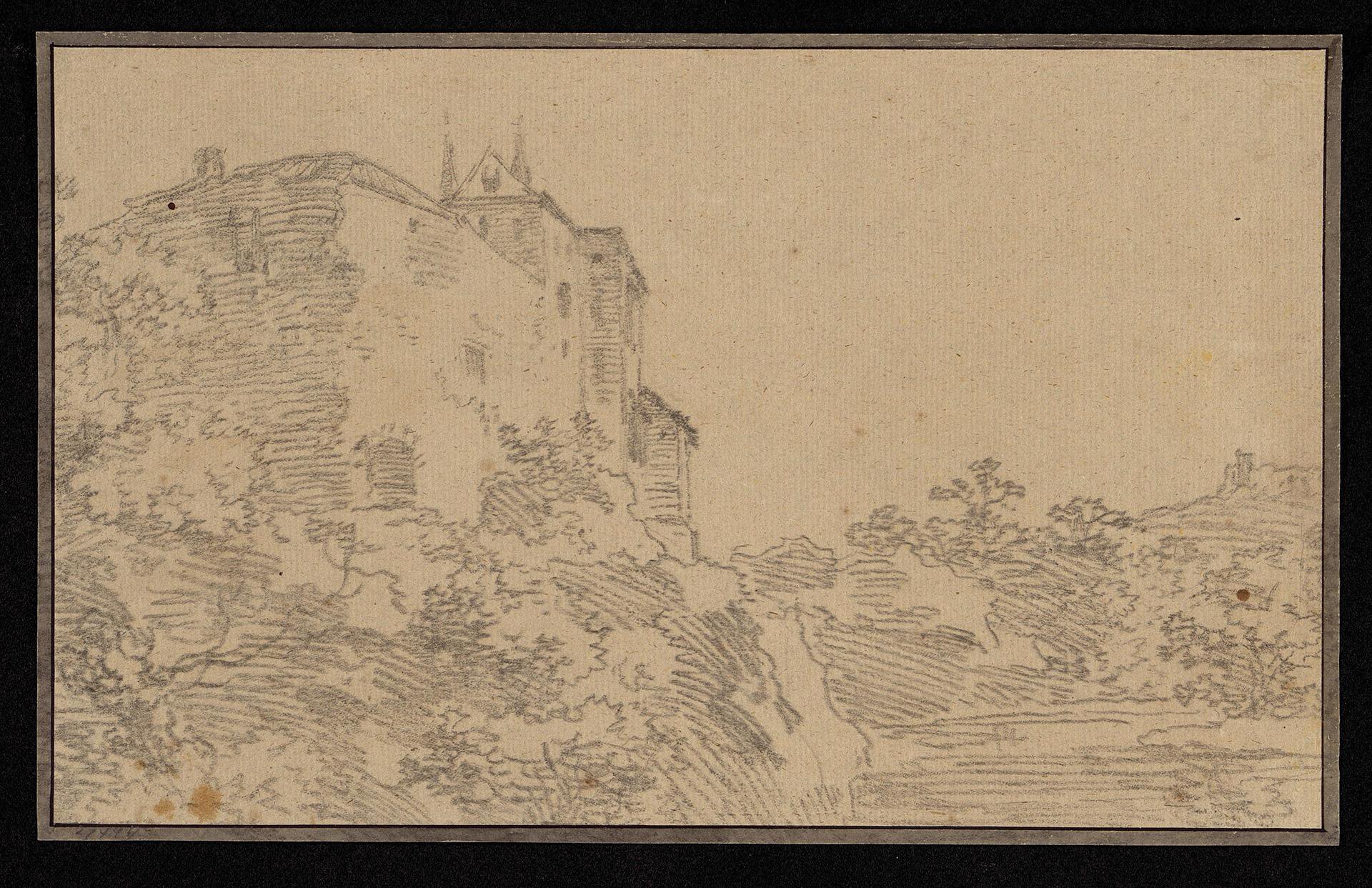
A charcoal drawing of a castle on a rocky hill, made by Christian Wilhelm Ernst Dietrich at some point between 1732 and 1774.
Landscape with a Castle on a Rock. The State Hermitage Museum.
The drawing entered the Hermitage in 1922 from the collection of A. K. Rudanovsky. It is not currently on permanent display.
It is a horizontal sheet, worked in soft black chalk or charcoal, showing a hillside with a cluster of buildings on the left and a wide, open valley on the right.
The Object
The drawing is in a single colour: the black of the chalk, varied by pressure and by the grain of the paper.
The castle — a group of roofs, towers and walls — occupies the left half of the sheet, perched on a steep, wooded rock. The right half is open: a slope descending, a few trees, a distant hill, and a sky left almost blank.
The paper is a warm, slightly browned cream, and the drawing is framed by a thin border, probably added when it was mounted.
Dietrich
Christian Wilhelm Ernst Dietrich (1712–1774) was one of the most versatile German artists of the eighteenth century.
He was born in Weimar, trained in Dresden, and became court painter to Augustus III, Elector of Saxony and King of Poland, in 1741. He later taught at the Dresden Academy and ended his career as its director.
Dietrich was admired for his ability to imitate the styles of other artists — Dutch landscapes, Italianate scenes, genre pictures — and his own work is a synthesis of the European tradition. He was known as «Dietricy», a familiar form of his name.
The Landscape
The landscape is a capriccio rather than a portrait of a place.
The castle, the rock, the trees and the valley are assembled into a composition, not recorded from nature. The artist combines elements — a ruined tower, a cluster of roofs, a winding path — to create a picturesque scene.
This approach was standard in eighteenth-century landscape drawing. The artist was not a topographer but a composer, arranging motifs for effect.
Charcoal
The drawing is made with charcoal or a soft black chalk.
The medium allows rapid, broad strokes: the shadows of the rock, the texture of the foliage and the mass of the buildings are built up in loose, vigorous lines. Detail is suggested rather than described.
Charcoal is a fragile medium. It smudges easily, and drawings of this kind were usually fixed with a spray of gum or kept under glass. The survival of the sheet in good condition is fortunate.
The Castle
The castle is the drawing’s subject.
It is a cluster of buildings rather than a single tower: roofs, chimneys, a pointed gable, a wall running along the edge of the rock. The architecture is generic — a German or Italian hill town rather than a specific fortress.
The castle is drawn with care but without archaeological precision. It is a picturesque object, a silhouette against the sky, and its details are suggested rather than documented.
The Dutch Example
Dietrich’s landscapes owe a debt to Dutch art of the seventeenth century.
The low horizon, the mass of trees on one side, the open sky and the careful gradation of tone are all features of Dutch landscape drawing. Dietrich knew Dutch prints and paintings well, and he adapted their vocabulary to his own purposes.
This drawing is a good example of that adaptation: a Dutch composition, executed in a German hand, for an eighteenth-century audience.
The Sky
The sky is almost empty.
A few faint lines suggest clouds, but most of the upper right of the sheet is left blank, so that the paper itself becomes the sky. This is a common device in chalk drawings: the white of the paper stands for light.
The emptiness of the sky contrasts with the density of the castle and the trees, and it gives the composition its sense of space.
Scale
At 18.8 by 30.2 centimetres, the drawing is a modest sheet — about the size of a small book.
It was made to be kept in a portfolio or a drawer, not to hang on a wall. Drawings of this kind were collected, studied and copied, and they were shared among artists and amateurs.
The small scale is part of the drawing’s intimacy: it invites close looking, not public display.
The Composition
The drawing is built on a simple contrast: mass on the left, openness on the right.
The castle and the wooded rock occupy the left half of the sheet, rising from the bottom edge to the top. The right half is open, with a low horizon and a wide sky. The eye moves from the dark mass to the light void, and the composition breathes.
This asymmetrical balance is a classic device of landscape art. It creates tension and release, and it gives the drawing a sense of depth without the need for elaborate detail.
Drawing and Print
Dietrich was an accomplished etcher as well as a draughtsman.
Many of his drawings were made with print in mind, and his landscapes often have the clarity of an etching: strong outlines, clear masses, a legible distribution of light and dark.
This drawing may have been a study for a print, or an independent work in the same spirit. Either way, it shows a graphic intelligence at work — a way of thinking in black and white.
The Collector’s Portfolio
Drawings like this were kept in portfolios.
Collectors assembled sheets by artist, by subject or by school, and they stored them in albums and boxes. The drawings were taken out, examined, discussed and compared.
Rudanovsky’s collection included a group of drawings, and this sheet is one of them. Its small size and its subject — a landscape — made it a natural addition to a portfolio.
The Paper
The drawing is on paper that has aged to a warm brown.
The paper’s tone is part of the image: the whites are not white but cream, and the blacks are softened by the absorbent surface. This tonality gives the drawing a mellow, antique quality.
Paper was an expensive material in the eighteenth century, and drawings were made on good sheets that have often survived better than the works on canvas. The paper is, in a sense, the drawing’s foundation and its frame.
The Trees
The trees on the rock are drawn as masses, not as individual plants.
The foliage is indicated with looping, scribbled strokes, a technique that suggests volume and movement without describing every leaf. The result is a soft, dark mass that contrasts with the sharper lines of the architecture.
Drawing trees in this way is a convention of landscape art: the artist captures the character of the species — round, spiky, drooping — with a few repeated marks.
Provenance
The drawing carries the inventory number OR-27444 and entered the Hermitage in 1922 from the collection of A. K. Rudanovsky.
In the Hermitage
The drawing is preserved in the State Hermitage Museum in Saint Petersburg and is not on permanent display.
It is a characteristic work by Dietrich — a landscape built from motifs, drawn with energy and economy, and preserved as a small window onto the eighteenth-century imagination of nature.