Organization: Imperial Porcelain Factory
Origin: Russia, St Petersburg
Date: 1796–1801
Complex: Hunting Service; addition to the main set (Meissen Porcelain Manufactory, 1766–1768)
Material: porcelain
Technique: overglaze polychrome painting, gilding
Dimensions: height 6 cm; diameter 35.5 cm
Current Collection: The State Hermitage Museum
Inventory Number: ERF-8936
Hermitage ID: 931431
Rudanovsky Connection: Entered the Hermitage in 1919 from the collection of A. K. Rudanovsky.
A large porcelain dish of 1796–1801, made at the Imperial Porcelain Factory as an addition to the Meissen «Hunting Service».
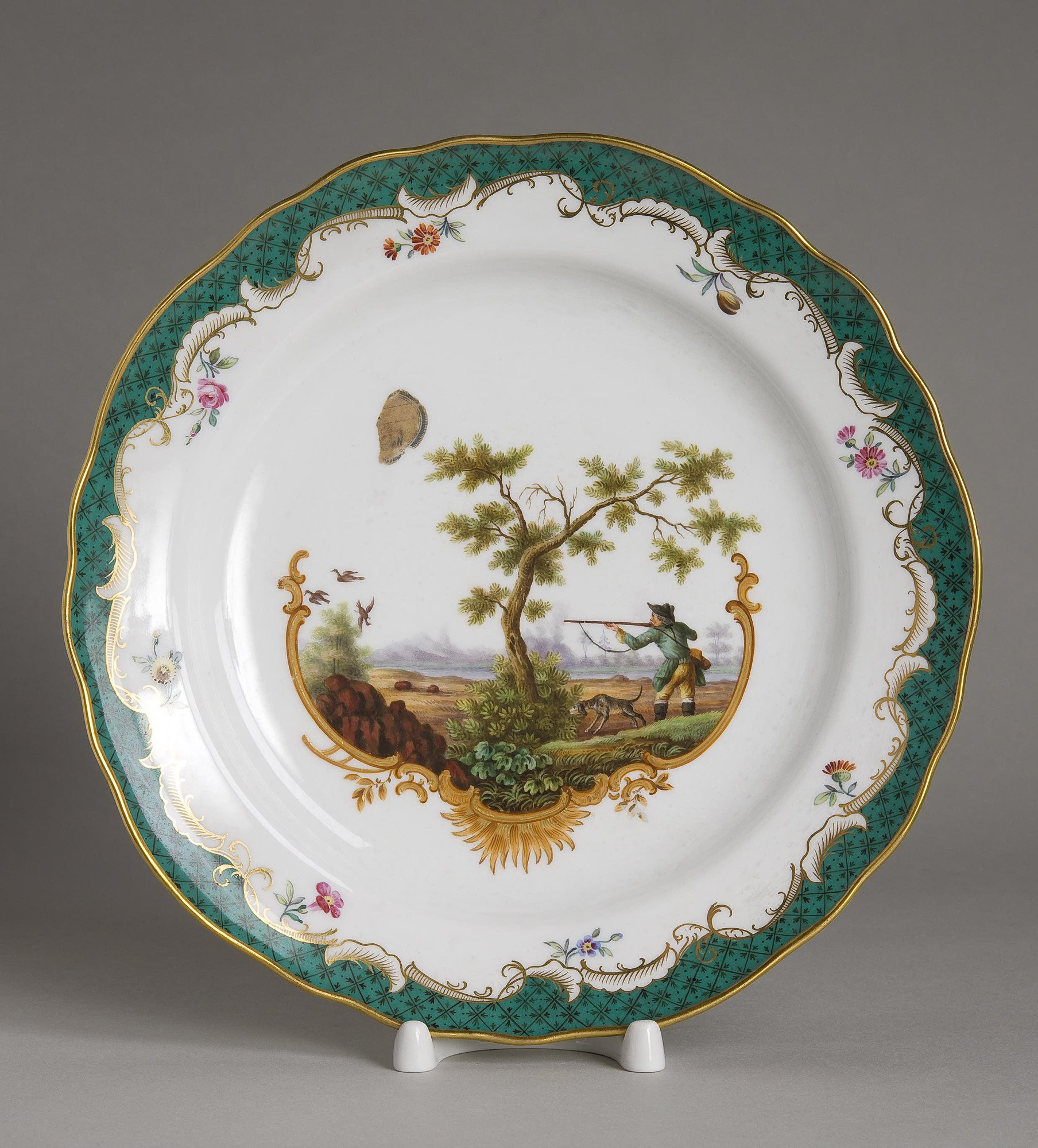
Dish, Hunting Service (ERF-8936). The State Hermitage Museum.
The dish entered the Hermitage in 1919, handed over by the Department for the Protection of Monuments of Art and Antiquities and formerly in the collection of A. K. Rudanovsky. It is not currently on permanent display.
It is a large dish — 35.5 centimetres across — with a green diaper border, a gold cartouche and a painted hunting scene.
The Object
The dish is round, with a scalloped rim and a deep well.
Its border is green, painted with a diamond diaper pattern dotted with stars, and it is framed by gold lines and white scrolls with flowers. In the centre, a gold cartouche contains a hunting scene.
The scene shows a hunter with a gun and a dog, among trees, with ducks flying above and a landscape behind.
The Hunting Service
The dish belongs to the «Hunting Service».
The service was made at Meissen in 1766–1768, and it was decorated with hunting scenes after paintings and prints. It was one of the great services of the eighteenth century, and it was made for the Russian court.
The dish is a later addition, made at the Imperial Porcelain Factory in St Petersburg to complete or enlarge the service.
The Scene
The scene is a hunting picture.
A hunter in a green coat and a hat stands behind a tree, his gun raised, aiming at ducks that fly above a landscape. A dog stands beside him, and rocks and bushes fill the foreground.
The scene is painted in soft colours, and it is framed by a gold cartouche with scrolls and leaves.
The Hunter
The hunter is the scene’s protagonist.
He is small and elegant, dressed in the costume of the eighteenth century, and his pose is that of a sportsman. His gun is raised, and his dog is alert.
The hunter is a type rather than a portrait: he represents the noble pastime of hunting, and his figure gives the dish its subject.
The Border
The border is green.
It is painted with a diamond diaper pattern, and each diamond contains a small star. The border is framed by gold lines and by white scrolls with flowers.
Borders of this kind are a feature of the service, and they frame the central scene like a picture.
The Gold Cartouche
The cartouche is gold.
It is a frame of scrolls and leaves, and it is painted around the hunting scene. Its shape is irregular, almost rococo, and it gives the scene a decorative setting.
Cartouches of this kind are common in eighteenth-century porcelain: they frame a picture and separate it from the border.
The Imperial Factory
The dish was made at the Imperial Porcelain Factory in St Petersburg.
The factory was founded in 1744, and it became the principal porcelain manufactory of the Russian empire. In the 1790s, it produced services for the court, and it was often asked to supplement older services.
The dish belongs to that work, and it shows the factory’s ability to match an existing decoration.
The Meissen Original
The service was originally made at Meissen.
Meissen was the first European factory to produce true porcelain, and its «Hunting Service» was one of its most ambitious productions. The decoration was based on hunting paintings and prints.
The dish is a Russian addition to that service, and it shows how a great service could grow over decades, across borders and factories.
The Landscape
The landscape is soft and pale.
A low horizon, a few trees, a distant hill and a cloudy sky: the setting is simple, and it gives the hunter a stage. The colours are muted, and they contrast with the green border.
Landscapes of this kind are a convention of hunting scenes: they provide depth without distracting from the action.
The Ducks
The ducks fly above the hunter.
They are painted in brown and grey, with spread wings, and they are small against the sky. Their flight gives the scene its movement, and it explains the hunter’s aim.
Birds in flight are a test of a porcelain painter’s skill: they must be light and legible, and they must suggest movement.
The Dog
The dog stands beside the hunter.
It is painted in brown and white, with a raised head, and it watches the ducks. The dog gives the scene its companion, and it is one of the details that make it alive.
Dogs are a common element in hunting scenes, and they add a note of loyalty and excitement.
The Rim
The rim of the dish is scalloped.
It is cut into a series of small waves, and it is edged with gold. The scallops follow the border, and they give the dish its elegant outline.
Scalloped rims are a feature of eighteenth-century services, and they frame the decoration.
The Collector
The dish came to the Hermitage with the Rudanovsky collection.
Rudanovsky collected Russian and European porcelain, and his collection included services, figures and dishes of many kinds.
The dish is therefore a double document: of the Imperial factory in the 1790s and of a Russian collector’s taste.
The White Ground
The white ground is the dish’s space.
It is the colour of the porcelain, glazed and smooth, and it gives the painting its emptiness. The white of the dish is warm, and it makes the green border and the gold cartouche stand out.
In the Meissen hunting service, white plays the same role: it is the sky, the field and the paper of the picture.
The Gold
The gold is applied in bands and lines.
It edges the rim, outlines the cartouche and covers the scrolls of the border. It was applied over the glaze, fired and burnished, and it is the most expensive part of the decoration.
The gold gives the dish its richness, and it frames the hunting scene.
The Scene’s Frame
The scene is framed twice.
First by the gold cartouche, then by the green border. The two frames separate the picture from the dish, and they give the object its hierarchy.
A double frame is a device of the service: it turns each dish into a small painting, and it makes the table a gallery.
Provenance
The dish carries the inventory number ERF-8936. It entered the Hermitage in 1919, handed over by the Department for the Protection of Monuments of Art and Antiquities and formerly in the collection of A. K. Rudanovsky.
In the Hermitage
The dish is preserved in the State Hermitage Museum in Saint Petersburg and is not on permanent display.
It is a fine example of Russian porcelain, and it preserves a hunting scene: a hunter, a dog, ducks and a green border, painted on a dish more than two centuries ago.