Organization: Imperial Porcelain Manufactory, Vienna
Origin: Austria, Vienna
Date: 1760–1765
Material: porcelain
Technique: polychrome glaze painting
Dimensions: length 31.5 cm; width 24 cm
Current Collection: The State Hermitage Museum
Inventory Number: ZF-16555
Hermitage ID: 352426
Rudanovsky Connection: Entered the Hermitage in 1919 from the collection of A. K. Rudanovsky.
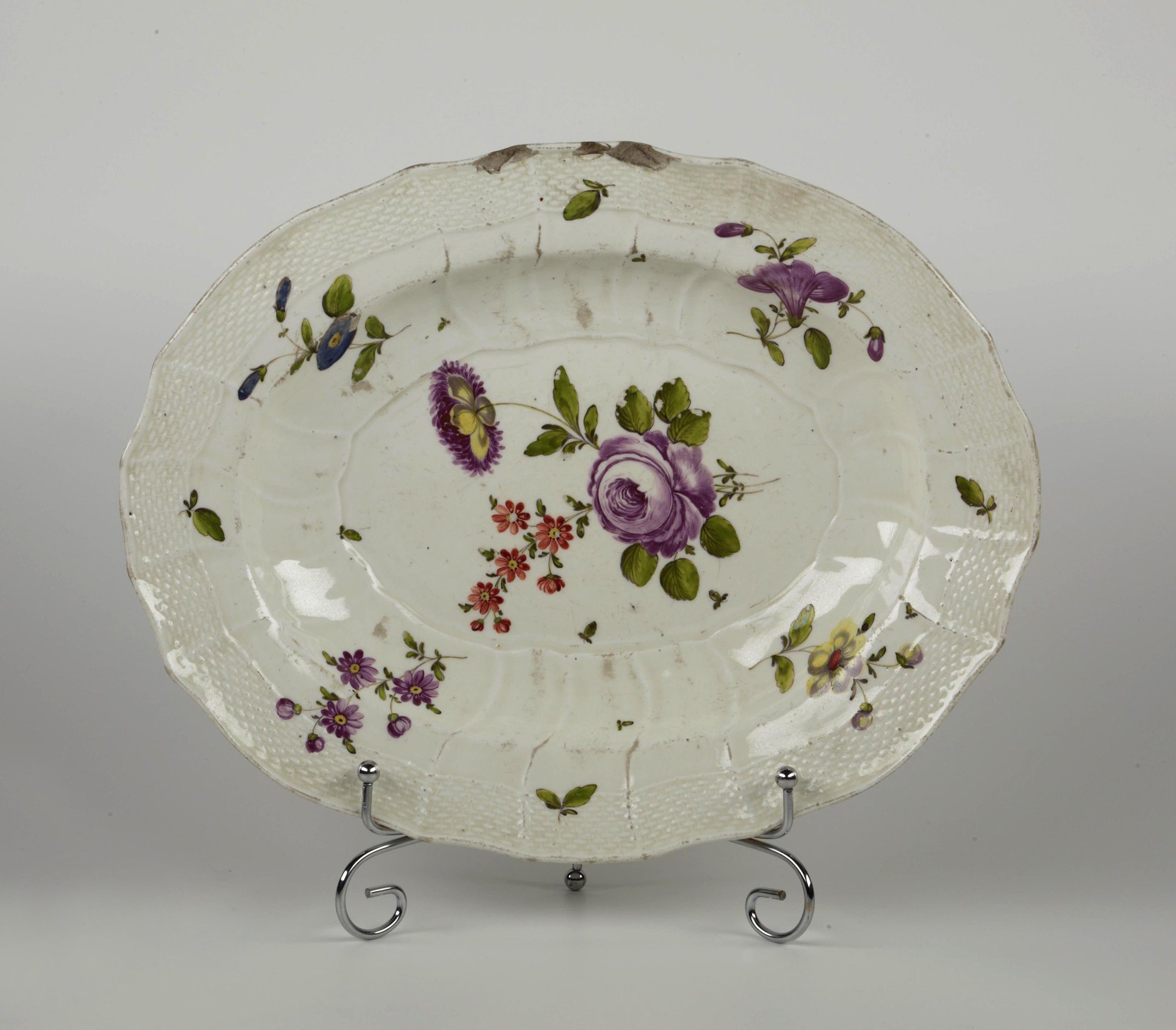
A Vienna porcelain dish of 1760–1765, its rim embossed with basketwork and its centre painted with a spray of flowers dominated by a purple rose.
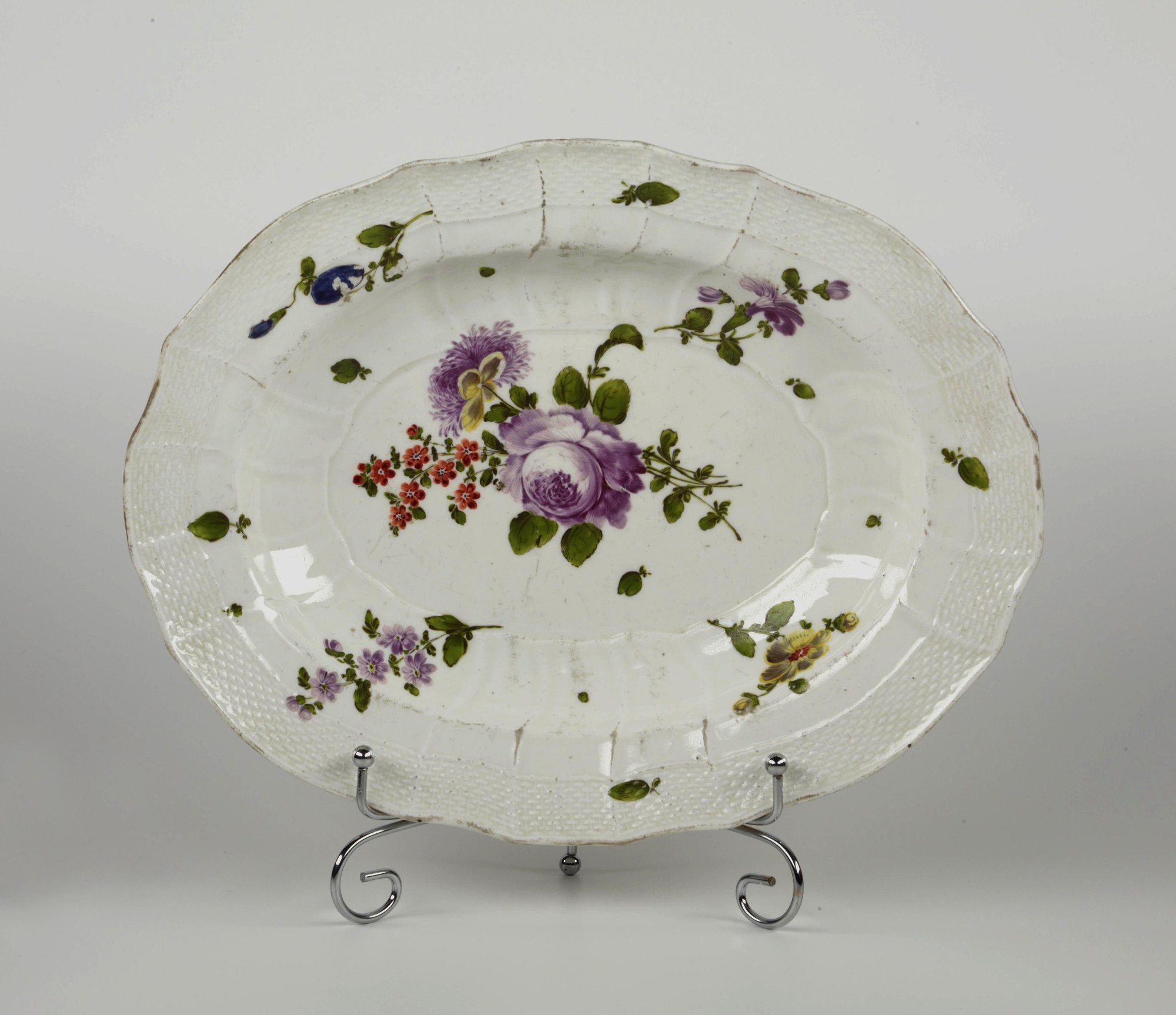
Dish (ZF-16555). The State Hermitage Museum.
The dish entered the Hermitage in 1919 from the collection of A. K. Rudanovsky. It is not currently on permanent display.
It is an oval serving dish, large enough for a joint of meat or a fish, with a scalloped edge and a surface that is not smooth but textured, as if woven.
The Object
The dish is oval, with a wavy, scalloped rim and a shallow well.
The rim is covered with an embossed basketwork pattern — a fine diagonal weave, pressed into the porcelain before firing. The centre is smooth and white, painted with a spray of flowers: a large purple rose, a yellow-and-purple pansy, small red blossoms and green leaves, with scattered flowers and leaves on the rim.
The colours are soft and slightly faded, and the glaze has a warm, creamy tone.
The Rim
The basketwork rim is the dish’s most distinctive feature.
It is an embossed pattern, made by pressing the soft porcelain into a mould or by incising it with a tool. The result is a texture that catches the light and gives the dish a rustic, almost woven appearance.
Basketwork patterns were popular in European porcelain in the 1750s and 1760s, at Meissen, Vienna and elsewhere. They imitated the wicker baskets in which food was served, and they gave porcelain the look of a natural material.
Vienna
The dish was made at the Imperial Porcelain Manufactory in Vienna.
The factory was founded in 1718 by Claudius Innocentius du Paquier, an entrepreneur who brought the secret of porcelain from Meissen. In 1744 it became an imperial manufactory under Maria Theresa, and it produced services, figures and decorative objects for the court.
The Vienna factory was one of the most important in Europe, and its products were exported widely, including to Russia.
The Flowers
The flowers are painted in the naturalistic style of the period.
A large purple rose dominates the centre, surrounded by a pansy, small red blossoms and green leaves. The flowers are modelled with care: the petals are shaded, the leaves have veins, and the colours are layered.
The painting is not botanical illustration but decorative art: the flowers are arranged to fill the centre of the dish and to please the eye.
The Purple Rose
The purple rose is unusual.
Roses in porcelain painting are usually pink or red; a purple rose is a deliberate choice, and it gives the dish a cooler, more aristocratic tone. The purple is soft and slightly grey, like the colour of old silk.
The rose is the focal point of the composition, and its colour determines the palette of the whole dish.
The Scattered Flowers
The flowers on the rim are scattered rather than arranged.
Small blossoms and single leaves are placed here and there, as if fallen from the bouquet in the centre. This scatter is a deliberate effect: it gives the dish a lightness and a sense of movement, and it prevents the formal rim from feeling rigid.
The contrast between the dense centre and the scattered rim is one of the pleasures of the design.
The Dish
The dish is a serving piece.
It would have been used for meat, fish or a large dessert, and it would have stood at the centre of the table. Its size — 31 by 24 centimetres — is that of a substantial serving dish.
The form is oval, which is practical for a fish or a joint, and the scalloped rim gives it a decorative edge.
Painting on Glaze
The decoration is painted on the glaze.
The painter worked with enamel colours, applied over the fired glaze and then fired again at a lower temperature. The colours fuse with the glaze, and the result is a smooth, glossy surface.
This technique allows a wide range of colours, but it is delicate: each firing can alter the colours or cause them to run.
The Shape
The dish is oval, a form that suits a fish or a joint of meat.
Oval dishes were standard in eighteenth-century services, and they were made in several sizes for different courses. This one, at 31 by 24 centimetres, is a medium serving dish — large enough for a substantial piece of meat, small enough to be carried by one hand.
The scalloped rim gives the dish a decorative edge and softens the oval outline.
Vienna and the Market
Vienna porcelain competed with Meissen and Sèvres across Europe.
The factory’s wares were exported to the Habsburg lands, to Italy, to the Ottoman Empire and to Russia. They were prized for their warm glaze, their delicate painting and their inventive shapes.
This dish belongs to that export production: a well-made, beautifully painted object, designed for a market that wanted luxury without the price of Sèvres.
The Glaze
The glaze of Vienna porcelain has a warm, slightly creamy tone.
It is softer than the cold white of hard-paste porcelain, and it gives the colours a mellow quality. The surface is glossy, with a fine crazing that has developed over time.
The glaze is also the surface on which the enamel painting sits, and its quality determines the brightness of the colours.
Serving
The dish was made to serve food.
It would have been filled in the kitchen and carried to the table, where it stood at the centre of the arrangement. Its decoration was designed to be seen with food on it, not instead of food.
That is the paradox of a serving dish: it is a painting that is meant to be covered.
The Scalloped Edge
The edge of the dish is cut into shallow scallops.
This is not a simple circle or oval: the rim rises and falls in a series of curves, like the edge of a leaf. The scallops soften the outline and give the dish a hand-made, organic quality.
They also catch the light: each curve throws a small shadow, and the rim becomes a sequence of highlights. The effect is subtle, but it changes the way the dish reads on a table.
Provenance
The dish carries the inventory number ZF-16555 and entered the Hermitage in 1919 from the collection of A. K. Rudanovsky.
In the Hermitage
The dish is preserved in the State Hermitage Museum in Saint Petersburg and is not on permanent display.
It is a fine example of Vienna porcelain of the 1760s, and it shows how a serving dish could be turned into a small painting — a basket of flowers, woven in porcelain and painted in enamel.
It is a dish, and it is also a small landscape: a woven edge, a painted bouquet, a white field, and a century and a half of light resting quietly on the glaze. For a dish, that is a long life well spent.