Organization: Imperial Porcelain Manufactory, Vienna
Origin: Austria, Vienna
Date: 1760–1765
Material: porcelain
Technique: polychrome glaze painting
Dimensions: length 31.3 cm; width 24.5 cm
Current Collection: The State Hermitage Museum
Inventory Number: ZF-16556
Hermitage ID: 352427
Rudanovsky Connection: Entered the Hermitage in 1919 from the collection of A. K. Rudanovsky.
A Vienna porcelain dish of 1760–1765, twin to another in the same collection, its rim chipped and its glaze worn by use.
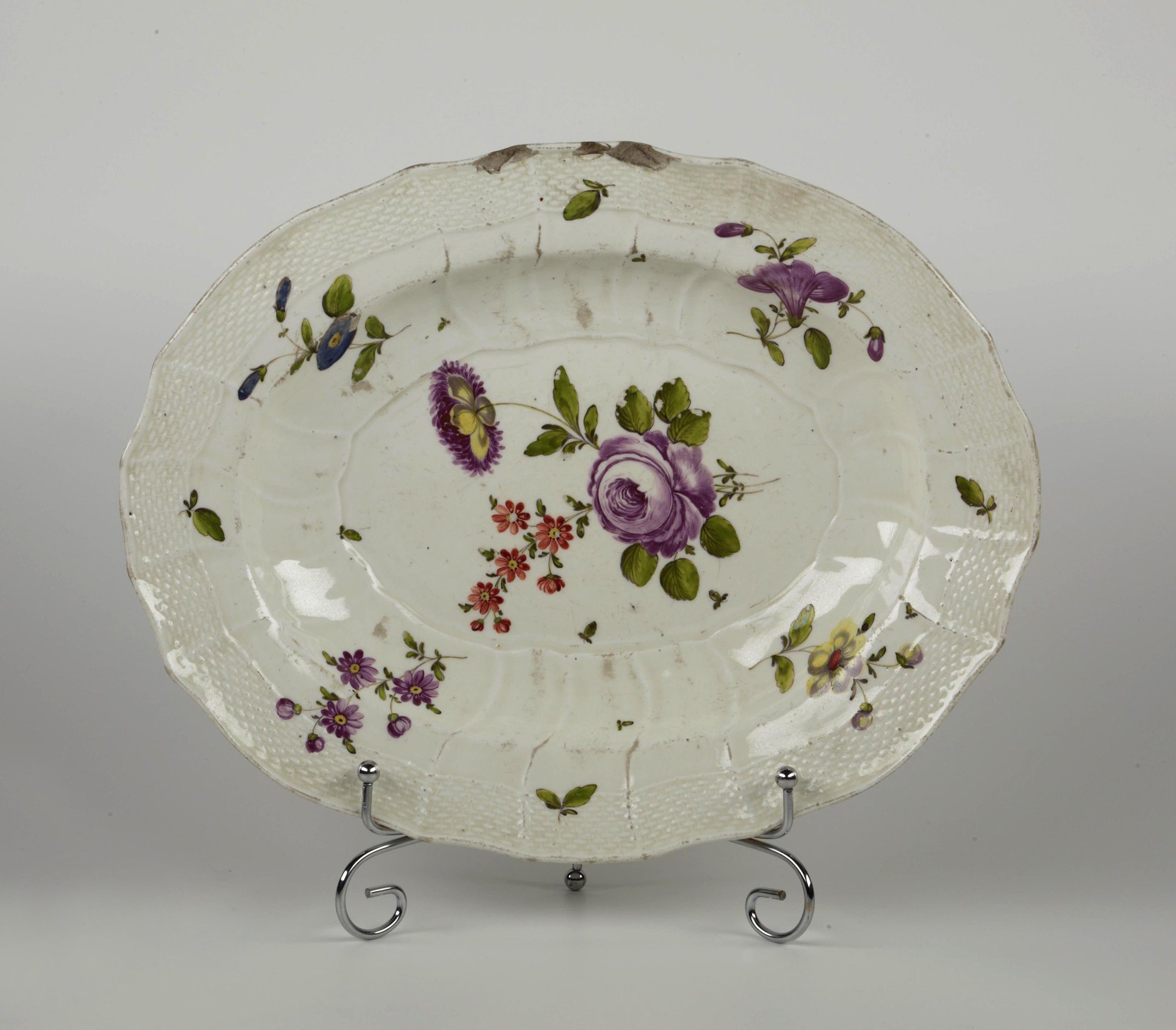
Dish (ZF-16556). The State Hermitage Museum.
The dish entered the Hermitage in 1919 from the collection of A. K. Rudanovsky. It is not currently on permanent display.
It is almost identical to another dish in the collection: same shape, same basketwork rim, same flowers. What distinguishes it is its condition: the rim is chipped, the glaze is worn, and the object carries the marks of a long life at table.
The Object
The dish is oval, with a scalloped rim and a shallow well.
The rim is embossed with a basketwork pattern; the centre is painted with a spray of flowers — a purple rose, a pansy, red blossoms and green leaves — and the rim is scattered with small flowers and leaves.
The colours are soft, and the glaze has a creamy, slightly yellow tone.
The Damage
The damage is concentrated on the rim.
There are chips along the edge, where the porcelain has broken away, and the glaze is worn in places, exposing the white body beneath. The chips are old: their edges are smooth, and the dirt of age has settled into them.
Such damage is normal for a serving dish. The rim is the part that is lifted, knocked and stacked, and it is the first to suffer.
What Chips Tell
A chip is a small document.
It records the moment when the object was hit, the force of the blow and the fragility of the material. The position of the chips — along the rim, at the points of the scallops — tells us how the dish was handled.
Chips are also a record of survival. A dish that was used for two centuries and survived with only a few losses was handled with care, even if it was not treated as a museum object.
The Basketwork Rim
The embossed basketwork is the dish’s most distinctive feature.
It imitates the texture of a woven basket, with a fine diagonal pattern that catches the light. The pattern was made by pressing the soft porcelain into a mould, and it covers the whole rim.
Basketwork was a popular motif in European porcelain of the 1750s and 1760s, and it gave ceramic objects the look of natural materials.
Vienna
The dish was made at the Imperial Porcelain Manufactory in Vienna.
The factory, founded in 1718, became imperial in 1744 and produced services, figures and decorative objects for the court and for export. Its wares are known for their warm glaze, their delicate painting and their inventive shapes.
The dish belongs to the period of the Seven Years’ War, when Vienna was competing with Meissen and Sèvres for the European market.
The Flowers
The flowers are painted in the style of the 1760s.
A purple rose dominates the centre, with a pansy, red blossoms and green leaves. The flowers are modelled with care, but they are decorative rather than botanical: they are arranged to fill the space and to please the eye.
The purple of the rose is unusual and gives the dish a cool, slightly melancholy tone.
The Pair
The dish has a twin in the collection.
The two dishes are almost identical: same dimensions, same rim, same flowers. They were probably made as a pair, and they may have been part of a larger service.
The survival of both is fortunate. Pairs are often separated, and the comparison of the two — one in good condition, one chipped — is a lesson in how objects age differently.
The Shape
The dish is oval, with a scalloped rim and a shallow well.
Oval dishes were standard in eighteenth-century services, and they were made in several sizes for different courses. This one is a medium serving dish, large enough for a fish or a joint.
The shape is practical and elegant: the oval fits the food, and the scalloped rim gives it a decorative edge.
Repair and Restraint
The dish has not been restored.
Museums often leave old damage visible, because repair can obscure the object’s history and introduce new materials. The chips on this rim are clean and stable, and they do not threaten the structure of the dish.
The decision to preserve rather than repair is a curatorial one, and it reflects a preference for evidence over smoothness.
The Glaze
The glaze of the dish is warm and slightly crazed.
Crazing — a network of fine cracks in the glaze — is common in old porcelain, and it is caused by the different expansion rates of body and glaze. It does not necessarily weaken the object, but it is part of its texture.
The glaze also determines the appearance of the colours: a warm glaze makes the pinks and greens softer, a cold one makes them sharper.
Serving
The dish was made to serve food.
It would have been filled in the kitchen and carried to the table, where it stood at the centre of the arrangement. Its decoration was designed to be seen with food on it, not instead of food.
That is the paradox of a serving dish: it is a painting that is meant to be covered.
A Pair of Dishes
The dish has a twin in the collection.
The two are almost identical: same dimensions, same rim, same flowers. They were probably made as a pair, and they may have belonged to a larger service.
The comparison of the two is instructive. One is relatively well preserved; the other has lost pieces of its rim. The difference is not one of quality but of use: one was handled more, or stored less carefully.
The Scalloped Edge
The edge of the dish is cut into shallow scallops.
The scallops soften the outline and give the dish a hand-made quality. They also catch the light, so that the rim becomes a sequence of small highlights.
On this dish, the scallops are where the chips are concentrated: the projecting points are the most vulnerable part of the rim.
Provenance
The dish carries the inventory number ZF-16556 and entered the Hermitage in 1919 from the collection of A. K. Rudanovsky.
In the Hermitage
The dish is preserved in the State Hermitage Museum in Saint Petersburg and is not on permanent display.
It is a beautiful object, but it is also a used one, and its chips and wear are part of its history. In a museum, such traces are preserved rather than repaired: they are evidence of the life the object led before it became a museum piece.
A dish that has been used is more eloquent than a dish that has not: its damage is a record of hands, of tables and of the long afternoon of the eighteenth century, and of the patient work of those who kept it. It has earned every one of its chips, and then some.