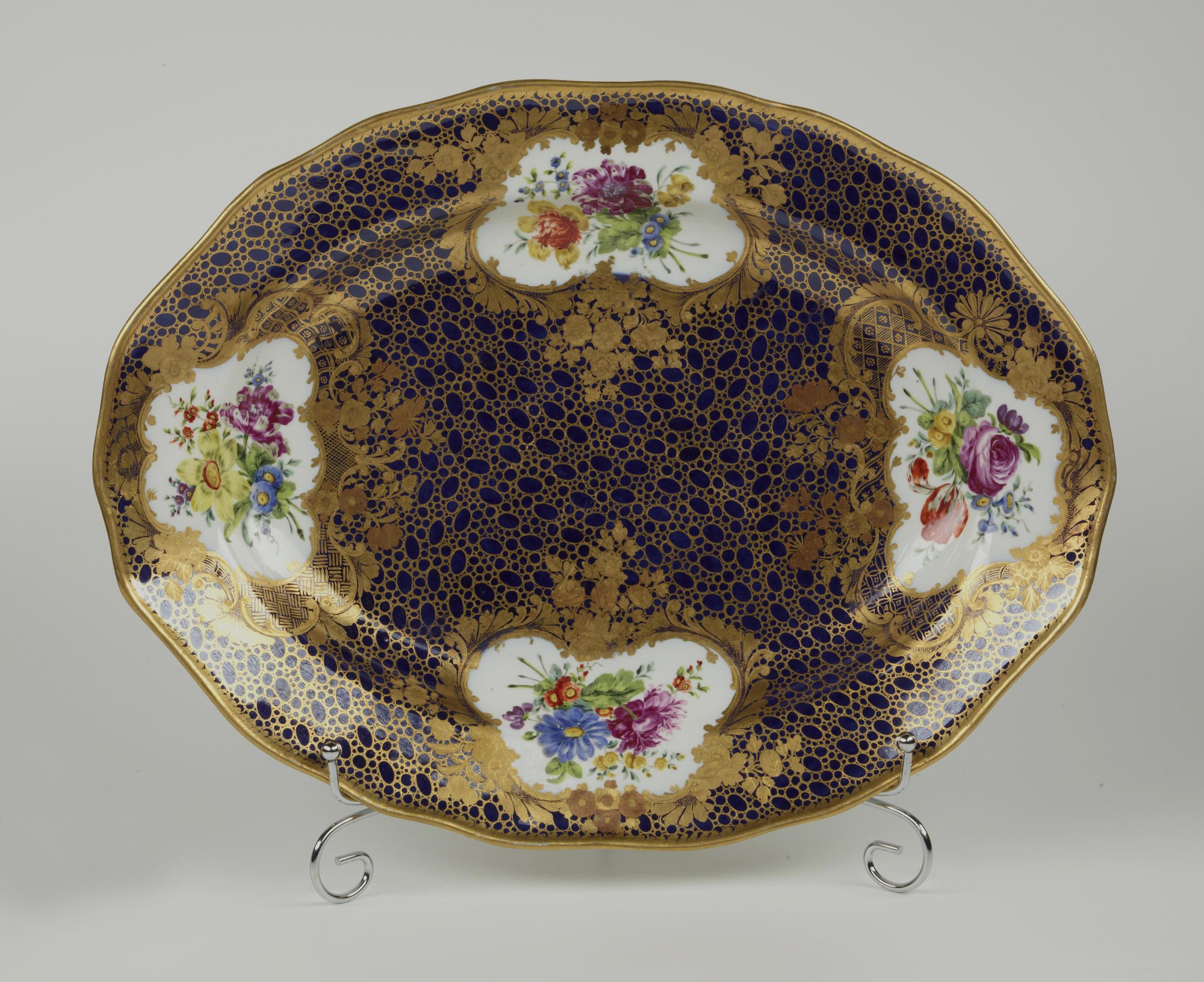
Organization: Imperial Porcelain Manufactory, Vienna
Origin: Austria, Vienna
Date: 1730–1735
Material: porcelain
Technique: gilding, polychrome glaze painting
Dimensions: height 8 cm; diameter 28 cm
Current Collection: The State Hermitage Museum
Inventory Number: ZF-16450
Hermitage ID: 352425
Rudanovsky Connection: Entered the Hermitage in 1919 from the collection of A. K. Rudanovsky.
An early Vienna porcelain bowl of 1730–1735, with a black rim, two handles and a painted frieze of flowers and scrollwork.
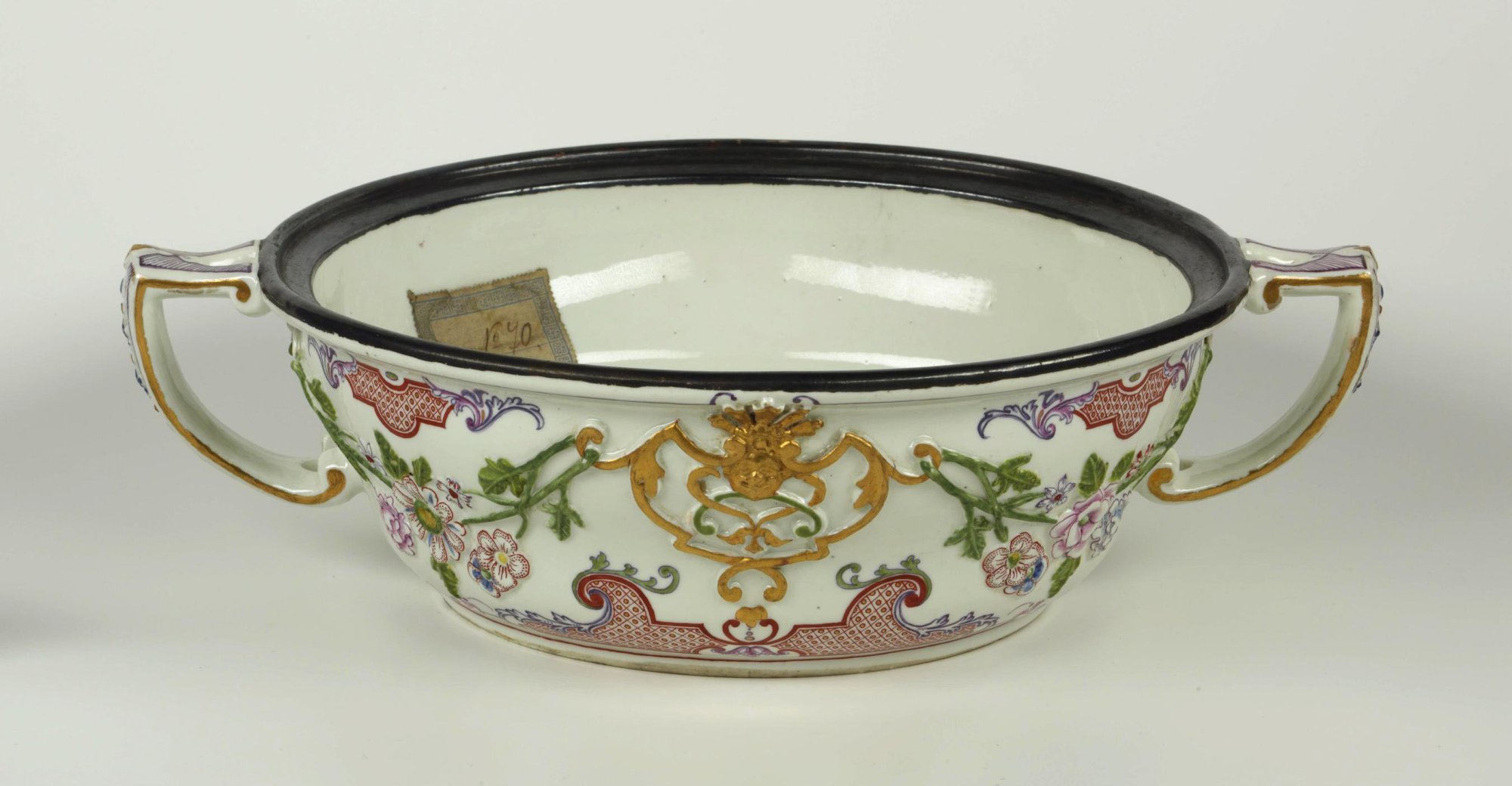
Round Bowl. The State Hermitage Museum.
The bowl entered the Hermitage in 1919 from the collection of A. K. Rudanovsky. It is not currently on permanent display.
It is a wide, shallow bowl, 28 centimetres across, with two loop handles and a dark rim. Inside, resting on the bottom, is an old paper label with the number 1640 written in ink.
The Object
The bowl has a rounded body, a broad mouth and two handles that curve out from the sides.
The rim is painted a deep black-brown, a striking contrast with the white body. The exterior is decorated with a frieze of flowers and scrolls: green stems, pink and purple blossoms, and gold scrollwork framing a central motif.
The gilding is applied to the handles, the scrollwork and the rim, and it is worn in places.
The Black Rim
The dark rim is the bowl’s most unusual feature.
Most European porcelain of the period has a white or gilded rim; this one is painted a deep, almost black brown, which gives the bowl a strong outline and a slightly exotic character.
The colour may imitate the dark rims of some Chinese porcelains, or it may be a Viennese invention. Either way, it makes the bowl instantly recognisable on a table.
Du Paquier
The bowl belongs to the early period of the Vienna factory, when it was still in the hands of its founder, Claudius Innocentius du Paquier.
Du Paquier founded the factory in 1718, after bringing the secret of porcelain from Meissen. His period — 1718 to 1744 — is known for its experimental character, its rich colours and its chinoiserie decoration.
Du Paquier porcelain is rare, and pieces with a secure provenance are prized by collectors and museums.
Chinoiserie
The decoration of the bowl is influenced by Chinese porcelain.
The flowers, the scrolls and the framing motifs are European versions of Chinese ornament, painted in a loose, slightly fantastical style. This is chinoiserie: the European taste for an imagined China, filtered through trade goods and illustrated books.
The bowl’s decoration is not an exact copy of a Chinese model. It is a European interpretation, adapted to the shape of the object and to the taste of the market.
The Handles
The two handles are simple loops, painted with gold and small flowers.
They are functional — a bowl of this size needs handles to be lifted — and decorative, giving the object a symmetrical silhouette. The gilding on the handles is worn, a sign that they were used.
Handles of this kind are characteristic of Du Paquier services, which often included tureens, bowls and dishes with loop handles.
The Label
The paper label inside the bowl is a small archive.
It is inscribed with the number 1640, written in ink, and it was probably attached by a collector or a dealer before the bowl entered the Hermitage. Such labels are common on objects that passed through the art market.
The label is now part of the object’s history, and it is preserved as evidence of the bowl’s journey.
The Bowl
The bowl is a serving piece.
It would have been used for a large dish — a stew, a salad, a compote — and it would have stood at the centre of the table. Its size and its dark rim make it a striking object.
The shape is simple and generous, and the decoration follows the curve of the body in a continuous frieze.
The Shape
The bowl is wide and shallow, with a broad mouth and a rounded body.
It is a serving shape: large enough to hold a substantial dish, open enough to allow the contents to be seen. The two handles make it possible to lift when full.
The proportions are generous and calm, and the dark rim gives the bowl a strong outline.
The Frieze
The decoration runs around the body as a continuous frieze.
Flowers and scrolls alternate, with gold framing a central motif. The frieze follows the curve of the bowl, so that the design is read as a band rather than as a picture.
This is a characteristic solution of porcelain decoration: the object is round, and the ornament must go around it.
Du Paquier’s Workshop
Du Paquier’s factory was small and experimental.
It employed painters from Vienna and from abroad, and it produced a relatively small number of pieces, often with rich colours and bold designs. The workshop’s output is marked by its variety: no two pieces are quite the same.
This bowl belongs to that experimental period, before the factory became an imperial institution in 1744.
Serving
The bowl was made to serve food.
It would have held a stew, a compote or a salad, and it would have stood at the centre of the table. The dark rim and the gold handles made it a striking object even when full.
The bowl is therefore both a container and a decoration, and its design serves both functions.
Early Vienna
Early Viennese porcelain is rare and prized.
Du Paquier’s production was small, and many pieces were destroyed or lost. The surviving objects are often in museums, and they are studied for their colours, their shapes and their decoration.
This bowl is a good example of the early style: bold, colourful and slightly irregular, with a dark rim and a rich frieze of ornament.
The Table
The bowl was made for a table.
It would have stood at the centre of a service, surrounded by dishes and plates, and it would have been filled with food. Its dark rim and gold handles made it a focal point.
That table is gone, but the bowl still carries its logic: a serving vessel designed to be both useful and beautiful.
Provenance
The bowl carries the inventory number ZF-16450 and entered the Hermitage in 1919 from the collection of A. K. Rudanovsky.
In the Hermitage
The bowl is preserved in the State Hermitage Museum in Saint Petersburg and is not on permanent display.
It is a rare example of Du Paquier porcelain, and it carries the marks of its time: the dark rim, the chinoiserie flowers, the gold scrolls and the old label inside.
The bowl is a document as much as a vessel — of a short-lived workshop, of a taste for the exotic, and of the fragile beginnings of European porcelain.
It is also, simply, a beautiful object: dark rim, gold handles, a garland of flowers running around a white field, and a label from another century resting in the bottom.
Objects like this make the past tangible: not as a story but as a surface, cool and smooth, that the hand can still hold, and that the eye can still read. It is a small thing, but it is more than enough, after all this time.