Origin: Western Europe
Date: 18th century
Material: satin (ground), silk, silk threads and cord
Technique: appliqué, embroidery in laid and couched stitches
Dimensions: 100 × 87 cm
Current Collection: The State Hermitage Museum
Inventory Number: T-15660
Hermitage ID: 271713
Rudanovsky Connection: Entered the Hermitage in 1919 from the collection of A. K. Rudanovsky.
An eighteenth-century silk panel worked in appliqué and couched embroidery, showing a bouquet in a vase on a deep crimson satin ground.
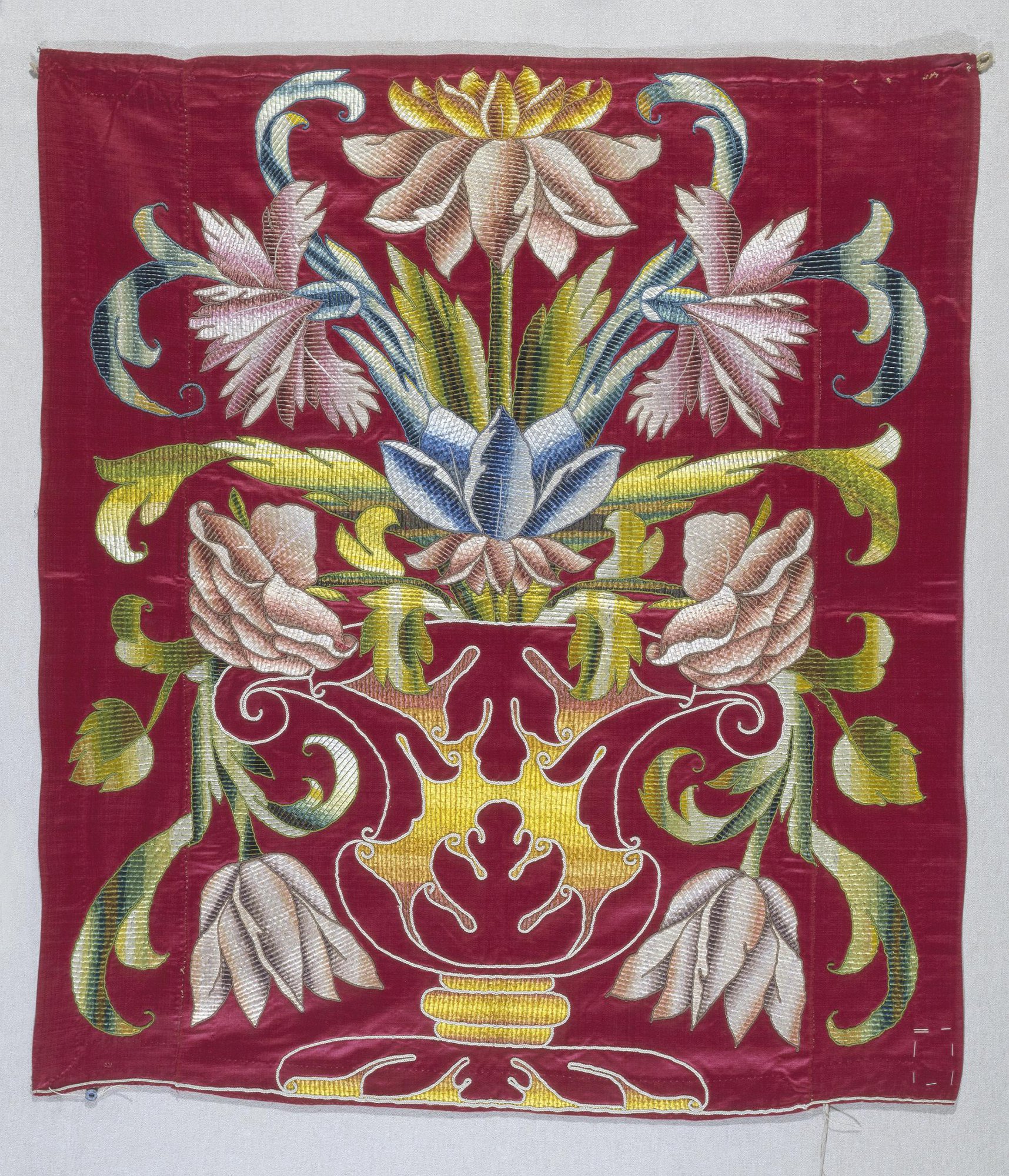
Drapery Depicting a Bouquet in a Vase (fragment). The State Hermitage Museum.
The panel entered the Hermitage from the collection of A. K. Rudanovsky through the State Museum Fund. It is not currently on permanent display.
It is a fragment, but a fragment of a very particular kind: the design is complete in itself, symmetrical, centred, closed. Whatever surrounded it has been lost, yet the panel still reads as a finished composition — a bouquet rising from a vase, framed by scrolling leaves, on a ground of deep, almost black-red silk.
The Object
The ground is a crimson satin with a pronounced sheen. It is not a flat colour: depending on the angle of the light, the red shifts from a dark wine tone to a brighter, almost orange-crimson, and the weave of the satin produces a subtle horizontal grain across the surface.
Against this ground the ornament is built up in relief. The vase is a golden-yellow form with a broad body, a narrow neck and scrolled handles, outlined in white cord. From it rises a symmetrical bouquet: a large central flower with layered, fringed petals, two smaller pink-and-white blooms at either side, and a fan of leaves and scrolls.
The whole composition is bordered by a continuous line of white cord, and the individual motifs are outlined in the same way. These outlines are not mere decoration: they define the edges of the applied pieces and hold the design together across the red ground.
The Vase and the Bouquet
The subject is one of the oldest in European ornament: a vase of flowers, treated as a symmetrical emblem rather than as a still life.
The arrangement is strictly bilateral. The central flower sits on the axis; the side flowers mirror each other; the leaves curl outward in matching pairs. Nothing is accidental, nothing is observed from nature. This is ornament in the service of order.
Such compositions descend from the grotesque decorations of the Renaissance, from the acanthus scrolls of antiquity and from the floral vocabulary of seventeenth-century ornament prints. By the eighteenth century the vase of flowers had become a standard motif for silk hangings, furniture covers, porcelain and wall painting.
The flowers themselves are stylised. The central bloom, with its fan of petals, resembles a carnation or a double ranunculus; the side flowers are softer and rounder. Their colours — cream, rose, yellow, pale green — are set against the red ground with a contrast that is almost heraldic.
Silk and Stitch
Two techniques are combined in the panel.
Appliqué means that pieces of silk were cut to shape and sewn onto the satin ground. The vase, the flowers and the leaves were prepared separately, then fixed in place, so that the design stands slightly proud of the surface and casts a faint shadow.
Couching is the stitch that holds the threads down. Instead of passing the needle through the fabric at every stitch, the embroiderer lays a thread or a cord along the surface and catches it at intervals with a fine, almost invisible stitch. The result is a smooth, continuous line of colour with a slight ribbed texture, and it allows the worker to cover large areas quickly with a rich, even surface.
The combination is characteristic of professional silk embroidery. Appliqué gives the design its body and its sharp edges; couching gives it its colour and its sheen. Together they produce an object that is closer to metalwork than to painting: a surface built up in layers, catching the light at every turn of a thread.
The Textile Interior
In the eighteenth century, silk hangings were among the most expensive elements of an interior.
They covered walls, beds, windows and furniture; they were changed with the seasons; they were inherited, recut and reused. A set of hangings for a single room could represent a fortune, and its design was coordinated with the upholstery, the curtains and the painted decoration.
Panels of this kind were usually part of a larger scheme — a bed hanging, a wall panel, a valance or a door curtain. The fact that this one survives as an independent rectangle suggests that it was cut down when the scheme was broken up, or that it was preserved precisely because its design could stand alone.
Symmetry and Ornament
The symmetry of the panel is not simply a matter of taste. It is a practical solution to a technical problem.
Silk embroidery on this scale was expensive and slow. A symmetrical design could be planned once and worked in mirror image, and the repetition reduced the number of decisions the embroiderer had to make. The result is an image that can be read from a distance as a single ornamental mass and from close up as a sequence of individual stitches.
Symmetry also carries meaning. In the decorative vocabulary of the eighteenth century, a centred, balanced composition implied order, harmony and abundance — the qualities that a wealthy interior was meant to project.
Red
The choice of a crimson ground governs everything else in the panel.
Red was the most expensive and most assertive colour available to the silk weaver. It was associated with ceremony, with power and with the interior of the church; in a domestic setting it created an impression of warmth and wealth that no pale colour could match.
Against such a ground, every other colour had to fight for attention. The designer solves the problem by keeping the bouquet light — cream, rose, pale yellow — and by outlining every motif in white cord, so that the forms separate sharply from the red.
The result is an image that reads from across a room. That was the first requirement of a hanging: to be legible at a distance, before it is examined at close range.
A Fragment
The panel is a fragment, and its edges show it. The satin is worn in places, the couched threads are rubbed, and the border is irregular.
Yet the composition is complete. Unlike a tapestry fragment, which often preserves only part of a design, this panel preserves the whole of its ornament: the vase, the bouquet, the scrolls and the frame. What has been lost is the context — the room, the furniture, the rest of the hangings.
Provenance
The panel carries the inventory number T-15660. It entered the Hermitage through the State Museum Fund from the collection of A. K. Rudanovsky.
The route is typical of the collection’s history. A private interior was dispersed, its contents were nationalised and distributed, and individual pieces were assigned to museums according to their material and quality.
In the Hermitage
The panel is preserved in the State Hermitage Museum in Saint Petersburg and is not on permanent display.
Textiles of this kind are fragile in a way that paintings are not. Light fades the silk, handling breaks the couched threads, and the weight of the object pulls at its own stitching. Most of the time it rests in storage, wrapped and protected.
When it is shown, it is as a document of the eighteenth-century interior — and as a work of art in its own right, in which the needle has done what the brush does: built a surface, modelled a form and made colour hold the light.