Origin: France
Date: second half of the 18th century
Material: wool, silk
Technique: tapestry weaving
Dimensions: height 77 cm; width 190 cm
Current Collection: The State Hermitage Museum
Inventory Number: T-15718
Hermitage ID: 488816
Rudanovsky Connection: Entered the Hermitage in 1919 from the collection of A. K. Rudanovsky.
A wide tapestry panel woven for the seat of a sofa, with two bouquets of garden flowers on a cream ground and a garland of roses looping along the upper edge.
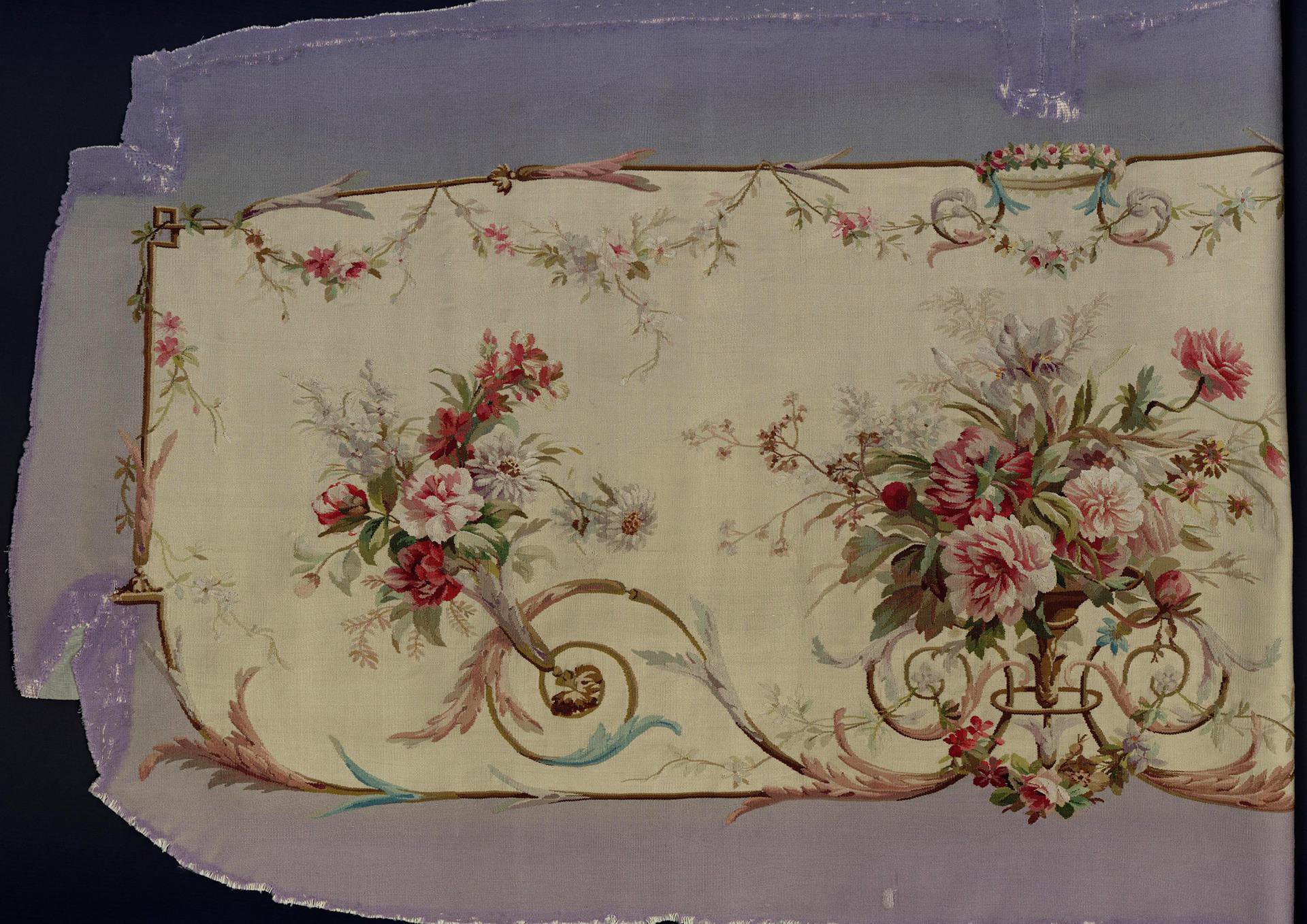
Tapestry: Upholstery for a Sofa Seat. The State Hermitage Museum.
The panel comes from the collection of A. K. Rudanovsky and entered the Hermitage through the Department for the Protection of Monuments. It is not currently on permanent display.
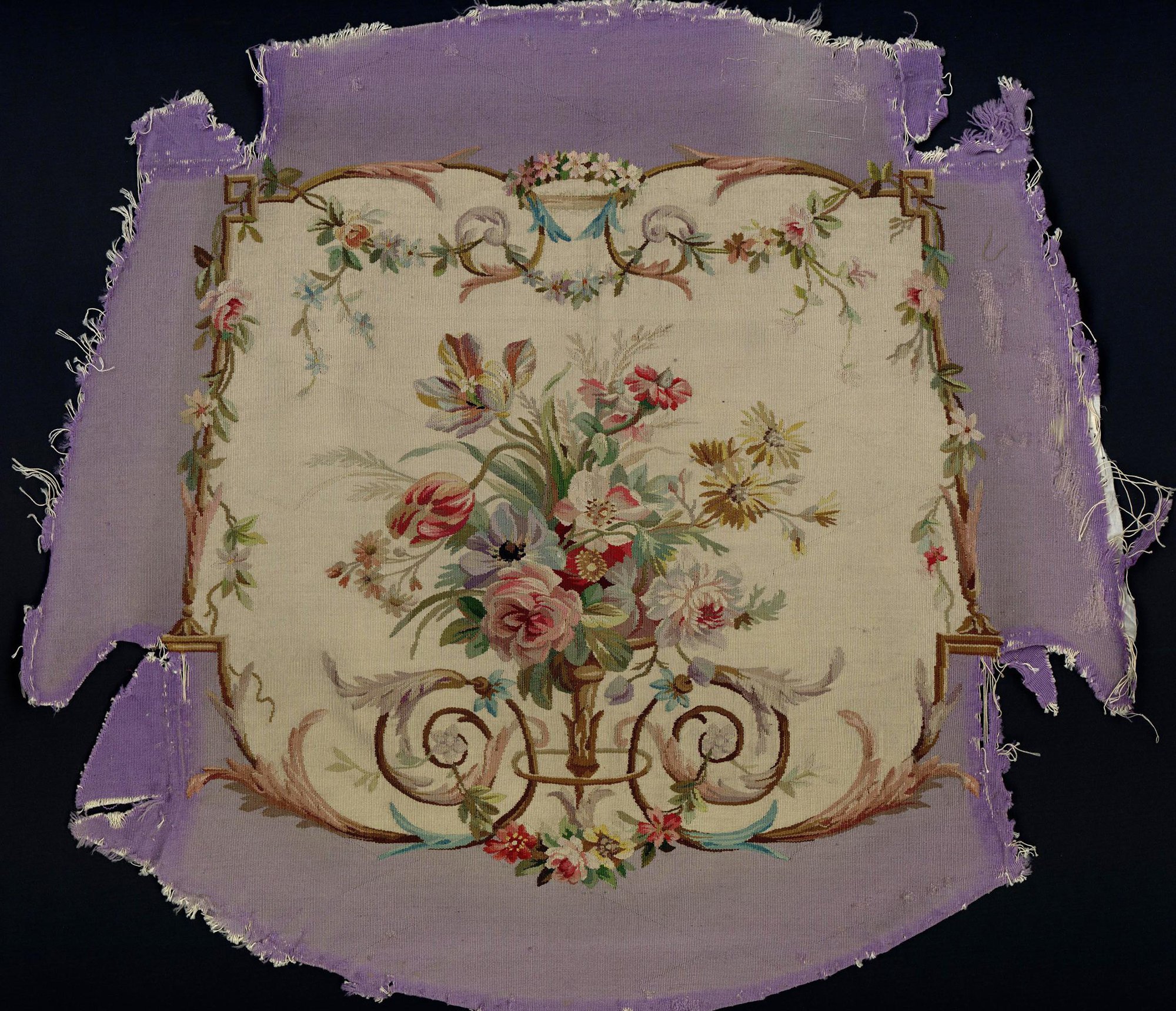
At 190 centimetres wide it is the largest piece of the group to which it belongs — a set of tapestry covers for a sofa and chairs, of which several others survive in the same collection. The width tells us what it was: not a picture, not a hanging, but the seat of a piece of furniture long enough for three people.
The Object
The woven field is a warm cream colour, lightly shaded, with the slight irregularities of tone that come from hand-dyed wool.
Two bouquets stand on the field. The one on the right is large and dense, rising from a gilded vase or support: peonies, roses, a tall iris, sprays of smaller flowers and feathery leaves. The one on the left is smaller and looser, a cluster of roses and daisies with long stems trailing to the left.
Along the top edge runs a garland of roses and small blossoms, tied at intervals with ribbons and looped into a wreath at the right. Below, the composition is anchored by rocaille scrolls in olive and gold, with a bold curl at the left and a symmetrical pair at the right beneath the large bouquet.
Around the tapestry runs a border of lilac silk. It is plain, slightly shiny and noticeably cooler in tone than the cream field, and it frames the woven panel like a mount.
A Sofa in the Eighteenth Century
The sofa was one of the defining pieces of eighteenth-century domestic comfort.
In the seventeenth century seating had been relatively formal: stools, benches, chairs with straight backs. The eighteenth century invented a range of upholstered furniture designed for conversation, reading, music and repose — the sofa, the ottoman, the chaise longue, the bergère.
A sofa was a social object. It seated several people, it anchored a room, and its upholstery was one of the largest and most visible surfaces in the interior. For a wealthy household, covering a sofa in tapestry was a way of turning furniture into a display of colour and craftsmanship.
The Composition
The design of this panel is deliberately asymmetrical.
A strictly symmetrical seat cover would have been easier to weave and easier to plan, but it would also have looked static on a piece of furniture nearly two metres wide. The designer solves the problem by opposing a large bouquet on the right to a smaller one on the left, and by letting the garland along the top rise and fall unevenly.
The eye is led from the small bouquet, along the garland, to the large bouquet, and then down through the scrolls to the carved giltwood frame that would have surrounded the seat. The composition is not a picture with a centre; it is a surface designed to be seen from an angle, in a room, under moving light.
This asymmetry is characteristic of the late eighteenth century. Earlier tapestry upholstery tended to be more regular; the later fashion allowed a looser, more pictorial arrangement, closer to the flower paintings of the period.
Aubusson and the Upholstery Trade
The panel belongs to the production of Aubusson, the French tapestry town that dominated the market for furnishing textiles in the eighteenth century.
Aubusson worked on low-warp looms and specialised in exactly this kind of commission: covers for seats and backs, screens, bed hangings, wall panels. Its weavers were organised in workshops that could produce a complete suite to a single design, adjusting the composition to the dimensions of each piece of furniture.
The trade was closely linked to the upholsterer. The tapestry was woven to the size of the seat, delivered to the menuisier and mounted on the frame, and the finished chair or sofa left the workshop as a single object. When the furniture was later re-covered, the tapestry was removed and often cut down — which is why so many eighteenth-century covers survive as separate panels.
Flowers and Ornament
The flowers in the panel are not botanical specimens. They are ornamental types, chosen for their colour and their silhouette.
Peonies and roses provide mass and softness; the iris provides a vertical accent; daisies and small blossoms provide variety of scale. The leaves are stylised, curling into scrolls at the edges, and the whole bouquet is tied together by stems that bend in decorative rather than natural curves.
This is the vocabulary of the eighteenth-century flower piece, developed in painting, porcelain and textile alike. It depends on the observation of nature but submits it to the requirements of ornament: symmetry where needed, variety of scale, and a colour scheme that reads at a distance.
The Silk Border
The lilac border is a reminder that a tapestry was never a finished object on its own.
Textiles were mounted, lined, bordered and trimmed. A border could protect the edges of the weaving, provide a transition to the wooden frame, or simply add a fashionable colour. The lilac silk here is cool and plain, and it sets the warm cream of the tapestry in relief.
Whether this border belongs to the original mounting or to a later re-covering is not recorded. Either way, it is part of the object’s history: a decision made by an upholsterer, not by a weaver.
Garlands and Swags
The garland along the upper edge belongs to a tradition that goes back to antiquity.
Festoons of flowers and fruit were carved on Roman altars, painted on Renaissance ceilings and modelled in stucco in Baroque churches. In the eighteenth century the garland became lighter and more informal: a swag of roses tied with ribbons, allowed to dip and rise across a surface.
On a sofa seat the garland has a practical role. It marks the edge of the design, softens the transition between the tapestry and the frame, and gives the eye a path across a very wide surface. It also introduces a note of celebration — the garland is a festive form, and its presence turns a piece of furniture into something closer to a decorative scheme.
Provenance
The panel carries the inventory number T-15718 and entered the Hermitage through the Department for the Protection of Monuments from the collection of A. K. Rudanovsky.
The provenance line places it among the thousands of objects that passed from private houses into public collections in the years after 1917. The Department for the Protection of Monuments was one of the bodies responsible for that transfer, and its name in a museum record marks the moment when a furnishing became a museum object.
In the Hermitage
The panel is preserved in the State Hermitage Museum in Saint Petersburg and is not on permanent display.
It survives as a fragment of a room: the seat of a sofa whose frame, whose back and whose companions are dispersed or lost. What remains is the surface — cream wool, coloured silk, a garland of roses — and the evidence of a design made for a specific piece of furniture in a specific house.