Origin: Russia
Date: second half of the 18th – 19th century
Material: glass
Technique: blown, cast, carved, engraved, cut, ground, polished
Dimensions: 7.5 × 5.5 × 5.5 cm
Current Collection: The State Hermitage Museum
Inventory Number: ERS-2935
Hermitage ID: 802928
Rudanovsky Connection: Entered the Hermitage in 1919 from the collection of A. K. Rudanovsky.
A Russian glass Easter egg of the eighteenth or nineteenth century, cut and engraved with a star and floral ornament.
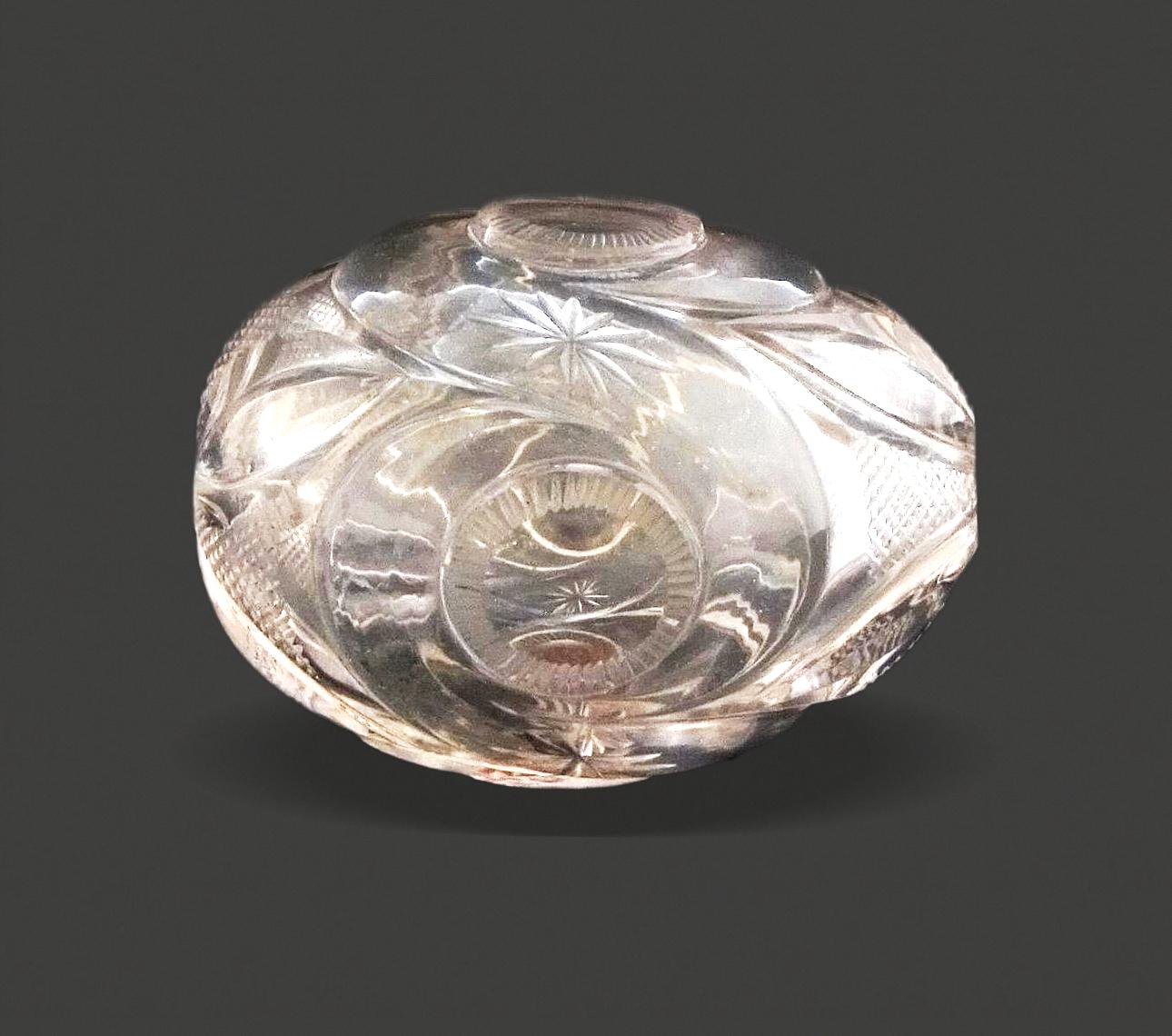
Easter Egg (ERS-2935). The State Hermitage Museum.
The egg entered the Hermitage in 1919, transferred through the Department for the Protection of Monuments of Art and Antiquities from the collection of A. K. Rudanovsky. It is not currently on permanent display.
It is a small object — 7.5 centimetres long — made of clear glass, cut and engraved with a pattern that catches the light.
The Object
The egg is oval, slightly flattened, with a smooth surface.
Its glass is clear and colourless, and it is cut with a pattern of stars, scrolls and floral motifs. The cutting is shallow, and it catches the light in a series of small reflections.
The surface is polished, and the egg is translucent: light passes through it, and the pattern glows.
Easter
The egg is an Easter egg.
In Russia, Easter was the most important feast of the Orthodox year, and eggs were exchanged as a sign of greeting and of the resurrection. The tradition was widespread, and eggs were made in every material: wood, porcelain, glass, stone and precious metal.
The glass egg belongs to that tradition: a small, precious object, made to be given and kept.
The Glass
The egg is made of glass.
Glass was produced in Russia from the seventeenth century, and by the eighteenth century there were factories making table glass, mirrors, beads and decorative objects. Clear glass was a luxury, and it was cut and engraved like a gemstone.
The glass here is colourless and clear, and it is free of bubbles: a sign of good quality.
The Cutting
The egg is cut, not painted.
The pattern is cut into the surface with a wheel, and the cuts are polished. The technique is related to the cutting of rock crystal and gems, and it requires great skill.
Cut glass is an art of light: the pattern is invisible until the light catches it, and then it appears.
The Pattern
The pattern is a star with floral and scroll ornament.
At the centre, a star with radiating points; around it, scrolls, leaves and small flowers. The design is symmetrical, and it covers the whole surface of the egg.
The pattern is classical in spirit, and it belongs to the decorative vocabulary of the eighteenth and nineteenth centuries.
Russian Glass
Russian glass of the eighteenth and nineteenth centuries was highly developed.
The imperial factories and private works produced table glass, mirrors, chandeliers, beads and decorative objects, and their products were prized for their quality and their cutting.
Carved and engraved glass was a speciality, and it is the subject of a recent study by Tatiana Pankova, cited in the museum record.
The Date
The egg is dated to the second half of the eighteenth or the nineteenth century.
The uncertainty is honest: the object is difficult to date precisely, and glass of this kind was made over a long period. The cutting and the pattern suggest the late eighteenth or early nineteenth century.
The date places the egg in the great age of Russian glass, when the art of cutting reached its height.
The Shape
The egg is oval and slightly flattened.
Its form is simple, but it is also difficult to make in glass: it must be blown or cast, then ground and polished. The flattened shape makes it lie in the hand.
Eggs of this kind were made in several sizes, and they were often mounted or placed in a stand.
The Light
The egg is an object of light.
Its glass is clear, and the cut pattern is only visible when the light catches it. The reflections move as the egg is turned, and the star seems to appear and disappear.
This play of light is the essence of cut glass, and it is what makes the egg a precious object.
The Workshop
The egg was made in a glass workshop.
Russian glass was produced in imperial and private factories, and the cutting and engraving were done by specialists. The egg was blown or cast, then cut, ground and polished.
The workshop that made it is unknown, but its skill is visible in the precision of the cutting.
The Gift
The egg was a gift.
Easter eggs were exchanged between family, friends and patrons, and they were a sign of affection and of faith. The glass egg was a precious version of a simple custom.
The object was meant to be given, kept and displayed, and it carries the memory of that exchange.
The Collector
The egg came to the Hermitage with the Rudanovsky collection.
Rudanovsky collected Russian and European applied art of many kinds, and his collection included glass as well as porcelain, paintings and miniatures.
The egg is therefore a double document: of Russian glass in the eighteenth or nineteenth century and of a collector’s taste.
The Star
The star is the egg’s central motif.
It has eight or twelve points, cut into the glass, and it radiates from a small centre. Around it, scrolls and leaves repeat the pattern.
The star is a symbol of light and of the resurrection, and it is a fitting motif for an Easter egg.
The Glass’s Age
The glass is old, and its surface shows it.
There are small scratches and chips, and the edges of the cuts are slightly worn. The glass has lost some of its original sparkle, but it still catches the light.
Wear of this kind is a sign of age, and it adds to the object’s character.
The Collection
The egg belongs to the Hermitage’s collection of Russian glass.
The collection includes table glass, mirrors, beads, Easter eggs and decorative objects, and it documents the development of Russian glassmaking over three centuries.
The egg is one of its smallest and most personal objects.
The Stand
The egg may have had a stand.
Glass eggs were often placed on a small stand or in a case, so that they could stand upright on a table. The stand turned the egg into a display object.
The stand is not preserved, but the egg still lies in the hand as it did when it was made.
Provenance
The egg carries the inventory number ERS-2935. It entered the Hermitage in 1919, transferred through the Department for the Protection of Monuments of Art and Antiquities from the collection of A. K. Rudanovsky.
In the Hermitage
The egg is preserved in the State Hermitage Museum in Saint Petersburg and is not on permanent display.
It is a small, beautiful object, and it preserves a tradition: an egg, a star and a piece of clear glass, made for Easter in Russia.
It is a small object, and it carries the light of a Russian Easter.
It was made to be given, and it has been kept for two centuries, which is its own kind of gift.