Origin: Austria, Vienna
Date: 18th century
Material: porcelain
Technique: polychrome painting, gilding
Dimensions: height 25.5 cm; base 23.5 × 22.5 cm
Current Collection: The State Hermitage Museum
Inventory Number: ZF-13890
Hermitage ID: 329994
Rudanovsky Connection: Entered the Hermitage in 1919 from the collection of A. K. Rudanovsky.
A Viennese porcelain figure group of the eighteenth century, showing a family gathered by a spring.
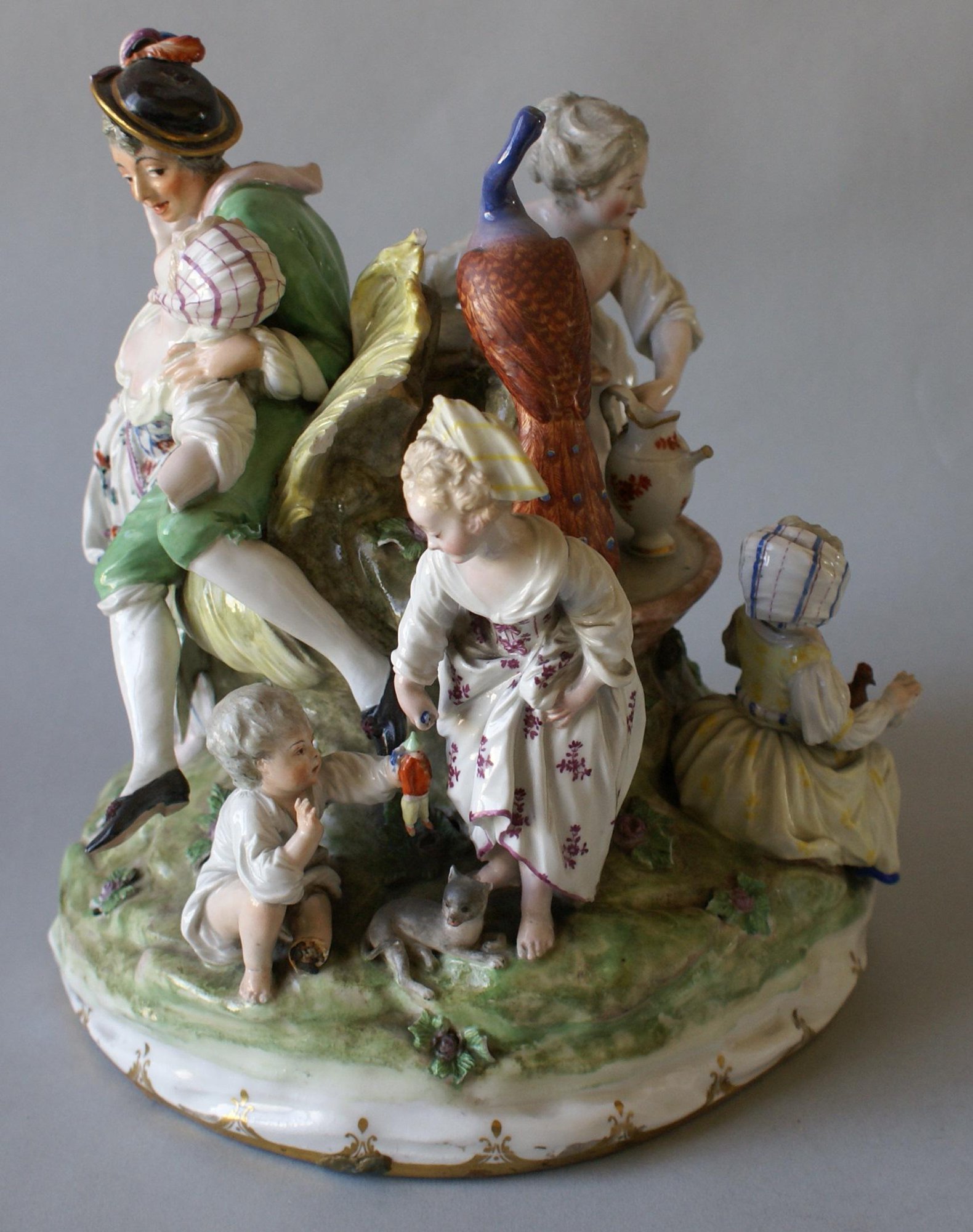
Figure Group ‘Scene by the Spring‘. The State Hermitage Museum.
The group entered the Hermitage in 1919, transferred from the Office for the Preservation of Monuments of Art and Antiquity and previously in the collection of A. K. Rudanovsky. It is not currently on permanent display.
It is a porcelain group — 25.5 centimetres high — with five figures, a dog and a spring, arranged on a green mound.
The Object
The group is built on a circular base painted as a grassy bank.
At the left, a man in a green coat sits with a child on his lap; at the right, a woman pours water from a jug into a vessel; a girl stands in the centre, holding a flower; a small child points at it, and a dog lies nearby.
Behind them, a large, leafy form rises — a cornucopia or a shell — and a second woman sits at the far right.
The Figures
The figures are the group’s subject.
They are dressed in the costume of the eighteenth century: the man in a green coat, the women in pale dresses with flowered patterns, the children in simple clothes. Their faces are young and calm.
The group represents a family or a pastoral scene, and its subject is domestic happiness: parents, children, a spring and a moment of rest.
The Spring
The spring is the group’s setting.
A woman pours water from a jug into a vessel at the right, and the water is the reason for the gathering. A spring is a place of life and refreshment, and it gives the scene its title.
The spring is also a classical motif: springs and fountains were the settings of pastoral poetry and of mythological scenes.
The Dog
A dog lies at the front of the base.
It is small and grey, painted with a few strokes, and it looks toward the child. The dog gives the group a domestic note, and it is one of the details that make the scene feel real.
Animals are common in porcelain groups: they provide scale, movement and a touch of everyday life.
The Base
The base is a green mound.
It is painted with grass, leaves and small flowers, and it is bordered by a gilded rim. The mound supports the figures and gives them a landscape, and its colours contrast with the pale dresses.
Bases of this kind are characteristic of eighteenth-century porcelain groups: they are part of the composition, and they turn the figures into a scene.
Vienna
The group was made in Vienna.
The Imperial Porcelain Manufactory of Vienna was one of the earliest in Europe, and it produced figures, groups, services and decorative objects. Its wares are characterised by rich colours, careful modelling and a taste for pastoral subjects.
The group belongs to the Viennese tradition of figure modelling, which flourished in the eighteenth century.
The Pastoral
The group belongs to the pastoral tradition.
Pastoral scenes — shepherds, families, springs, gardens — were popular in the eighteenth century, in painting, poetry, opera and porcelain. They offered an image of simple, happy life, far from the city.
The group is a pastoral in porcelain: a family by a spring, with a dog and a child, in a green and gentle world.
The Man
The man sits at the left.
He wears a green coat and a dark hat with a red ribbon, and he holds a child on his lap. His face is young, and he looks down toward the child with a calm, affectionate expression.
He is the group’s father figure, and his pose — seated, relaxed, holding a child — sets the tone of the scene: domestic, peaceful and happy.
The Woman
The woman stands at the right.
She is pouring water from a jug into a vessel, and her body is turned toward the group. Her dress is pale, with a pattern of flowers, and her hair is bound up.
She is the group’s mother figure, and her activity — drawing water — gives the scene its action and its title.
The Children
Two children animate the group.
A girl stands in the centre, holding a flower, and a small child sits at the front, pointing at it. Their interaction — the offering and the pointing — is the group’s emotional centre.
Children were a favourite subject of eighteenth-century porcelain: they allowed the modeller to show movement, play and tenderness.
The Cornucopia
A large, leafy form rises behind the figures.
It is painted in yellow and green, and it looks like a cornucopia, a shell or a giant leaf. It gives the group its height, and it frames the figures.
Cornucopias are classical symbols of abundance, and their presence turns the pastoral scene into an allegory of plenty.
The Table
The group was made for a table.
It stood on a dining table, a cabinet or a mantelpiece, and it was admired for its modelling and its colour. Groups of this kind were the centrepieces of a dessert table or a porcelain collection.
The group is large enough to be a presence, and small enough to be held.
The Painting
The group is painted in soft colours.
Green, white, pale yellow, pink and blue: the palette of the pastoral. The painting is delicate, and the colours are applied in thin layers.
The figures’ faces are painted with care, and their eyes, mouths and hair are all described. The painting gives the porcelain its life.
The Porcelain
The group is made of porcelain.
Porcelain is a difficult material for sculpture: it shrinks in the kiln, and it can warp or crack. A group with five figures and a dog is a technical achievement, and it required a skilled modeller and a careful kiln.
The survival of the group is a sign of the factory’s skill.
The Green
Green is the group’s ground colour.
The man’s coat, the leaves, the mound and the cornucopia are all green, in different shades, and the colour unites the composition. It is the colour of the pastoral: grass, trees and spring.
The green is painted with care, and its variations give the group depth and freshness.
Provenance
The group carries the inventory number ZF-13890. It entered the Hermitage in 1919, transferred from the Office for the Preservation of Monuments of Art and Antiquity and previously in the collection of A. K. Rudanovsky.
In the Hermitage
The group is preserved in the State Hermitage Museum in Saint Petersburg and is not on permanent display.
It is a charming, lively object, and it preserves a scene of eighteenth-century domestic life: a family, a spring and a green mound, modelled in porcelain.
It is a small world, and it has its own weather: a green afternoon, a spring, a dog asleep, and no one in a hurry.
And it is still afternoon, and the dog is still asleep.