Artist: Jean-Baptiste Marie Huet (1745–1811)
Origin: France
Date: 1789
Material: canvas
Technique: oil
Dimensions: 65 × 97 cm
Current Collection: The State Hermitage Museum
Inventory Number: GE-6399
Hermitage ID: 38075
Rudanovsky Connection: Entered the Hermitage in 1919 from the collection of A. K. Rudanovsky.
A farmyard scene of 1789 by Jean-Baptiste Huet, showing a spaniel and a turkey cock locked in combat.
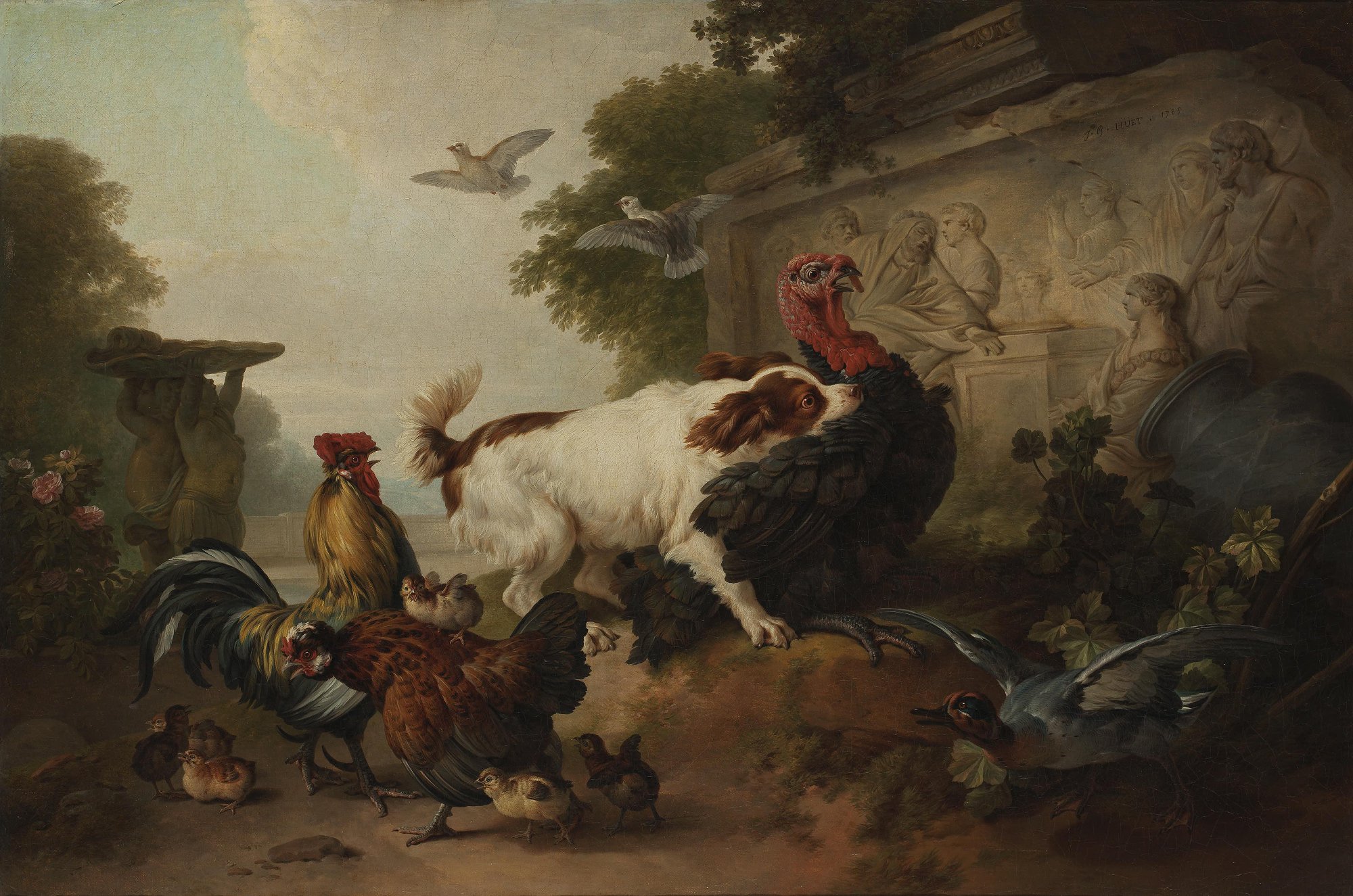
Fight of a Dog and a Turkey Cock. The State Hermitage Museum.
The painting entered the Hermitage in 1919 from the collection of A. K. Rudanovsky. It is not currently on permanent display.
It is a horizontal canvas, 65 by 97 centimetres, painted in the open air: a dog, a turkey, poultry, a stone relief and a classical statue, all in a garden or a farmyard.
The Object
At the centre, a white spaniel with brown patches grips a dark turkey cock by the neck.
Around them, the farmyard continues: a rooster with his hens and chicks at the left, ducks at the right, two doves flying above. Behind, a stone relief is set into a wall, with classical figures; at the left, a statue of a putto holds a basket.
The scene is painted in soft greens, browns and greys, with the red of the turkey’s head as its strongest note.
The Fight
The fight is the painting’s centre.
The spaniel has seized the turkey by the neck, and the bird is struggling, its wings spread, its red head thrust forward. The dog’s body is tense, its paws braced, its eyes fixed on its prey.
The confrontation is both violent and comic: a farmyard brawl, painted with the grandeur of a history painting.
The Dog
The dog is a spaniel, white with brown patches.
It is painted with attention to breed: long ears, a feathered tail, a soft coat. Its body is stretched in the attack, and its paws grip the ground.
The dog is the painting’s protagonist, and its energy drives the composition.
The Turkey
The turkey cock is the dog’s adversary.
It is a large, dark bird, with a red head and neck, and its wings are spread in a last attempt to escape. Its body is painted in dark browns and blacks, with the red head as a vivid accent.
The turkey was a recent arrival in Europe — it had come from the Americas — and it was a fashionable subject for animal painters of the eighteenth century.
The Poultry
The poultry fills the foreground.
A rooster with a red comb and a dark tail stands at the left, with hens and chicks around him; ducks move at the right; doves fly above. Each bird is painted with care, and each has its own character.
The poultry turns the fight into a scene: the farmyard continues around the combat, indifferent to it.
The Relief
A stone relief is set into the wall behind.
It shows classical figures in low relief — a group of men and women, perhaps a sacrifice or a myth — carved in stone. It is a strange, grand backdrop for a farmyard brawl.
The relief is a reminder of the classical tradition, and it places the animal fight in a setting of art and antiquity.
Huet
Jean-Baptiste Marie Huet (1745–1811) was a French painter and designer.
He was one of the most important animal painters of the eighteenth century, and he painted farmyards, pastorals, hunts and exotic animals. He also designed textiles and wallpapers for the Jouy factory.
His work is characterised by careful observation, soft colour and a taste for rural life.
1789
The date 1789 is the year of the French Revolution.
The painting, however, is a scene of rural tranquillity: a farmyard, a fight between animals, a classical relief. It belongs to the taste for pastoral and animal subjects that flourished in the last years of the ancien régime.
The contrast between the date and the subject is striking: history was happening elsewhere.
The Garden
The setting is a garden or a farmyard.
There is a wall with a relief, a statue, a clump of roses, and grass underfoot. The garden is a stage: it is arranged, like a theatre set, for the animals to perform on.
This artificial nature is characteristic of eighteenth-century animal painting, where the farmyard was a carefully composed scene.
The Statue
A statue of a putto stands at the left.
It is a stone figure, a chubby child holding a basket on its head, and it is set among roses. The statue is a garden ornament, and it introduces a note of classical art into the farmyard.
Statues of this kind were common in eighteenth-century gardens, and they were a sign of taste and wealth.
The Doves
Two doves fly above the fight.
They are pale grey, with spread wings, and they are painted against the sky. Doves are a symbol of peace and love, and their presence above the combat is a small irony: the birds of Venus fly over a brawl.
The doves also fill the empty sky, and they give the composition its upper movement.
The Humour
The painting has a comic side.
A spaniel and a turkey, a farmyard, a classical relief: the contrast between the grandeur of the setting and the vulgarity of the fight is part of the pleasure. The bird is ridiculous, the dog is earnest, and the scene is both violent and funny.
This mixture of the heroic and the everyday is characteristic of eighteenth-century animal painting.
The Background
The background is a wall with a relief.
It is a stone surface, carved with classical figures, and it fills the upper right of the canvas. The relief is painted in grisaille, in greys and browns, and it looks like a fragment of an ancient monument.
The wall closes the composition, and it gives the farmyard a monumental backdrop.
The Feathers
The turkey’s feathers are painted with care.
They are dark, with a green and bronze sheen, and they are described in individual strokes. The bird’s wing is spread, and its feathers catch the light.
Feathers are a test of an animal painter’s skill: they must be soft and detailed at once, and they must suggest the texture of the bird without becoming a pattern.
The Sky
The sky is pale and soft.
It is painted in light greys and creams, with a few clouds, and it gives the composition its air and its light. The two doves fly across it, and their pale wings are almost the same colour as the sky.
The sky is a quiet background for a noisy scene, and it balances the dark relief and the dark turkey.
The Roses
Roses bloom at the left, beside the statue.
They are pink and white, with green leaves, and they are painted with a light touch. They are a garden detail, and they soften the violence of the fight.
Flowers of this kind are a reminder that the scene is set in a garden, not a farmyard: a place of pleasure as well as of poultry.
Provenance
The painting carries the inventory number GE-6399 and entered the Hermitage in 1919 from the collection of A. K. Rudanovsky.
In the Hermitage
The painting is preserved in the State Hermitage Museum in Saint Petersburg and is not on permanent display.
It is a lively, carefully observed image, and it preserves a moment of rural drama: a dog, a turkey, a farmyard and a classical relief, all in the same frame.