Artist: Anonymous German painter, early 19th century
Origin: Germany
Date: early 19th century
Material: canvas
Technique: oil
Dimensions: 112 × 147 cm
Current Collection: The State Hermitage Museum
Inventory Number: GE-5339
Hermitage ID: 25970
Rudanovsky Connection: Entered the Hermitage in 1919 from the collection of A. K. Rudanovsky.
A German moonlit landscape of the early nineteenth century, painted in darkness and silver light.
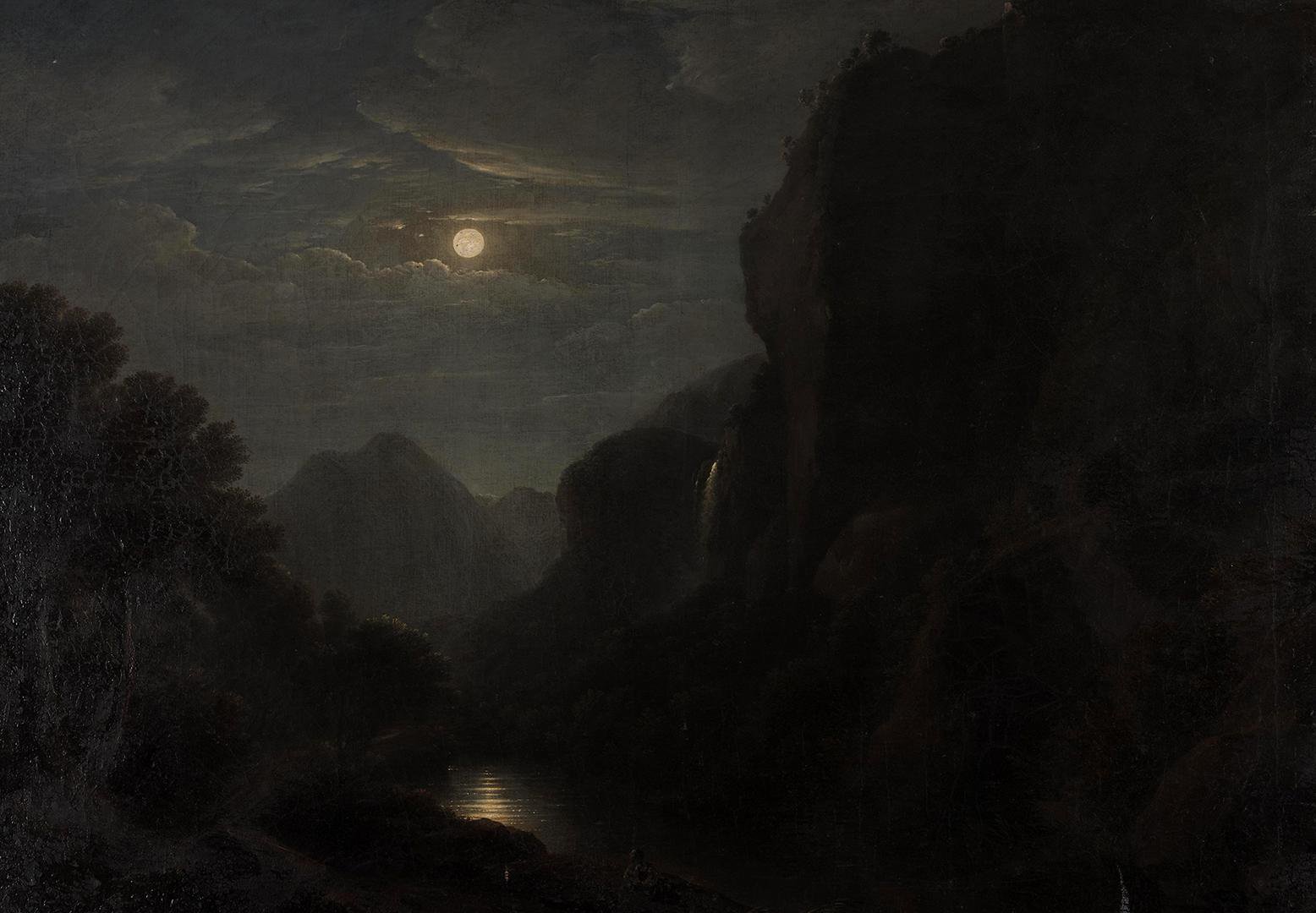
Moon Landscape (GE-5339). The State Hermitage Museum.
The painting entered the Hermitage in 1919 from the collection of A. K. Rudanovsky. It is not currently on permanent display.
It is a large landscape — 112 by 147 centimetres — almost entirely dark, with a full moon above and a river reflecting its light below.
The Object
The painting shows a valley at night.
Mountains rise on both sides, dark and wooded; a river runs through the valley, catching the moonlight; a waterfall falls from a cliff at the right. In the foreground, the ground is dark, with rocks and roots.
Above, the moon hangs among clouds, and its light spreads across the sky and the water. Two tiny figures stand at the lower edge, almost invisible.
The Moon
The moon is the painting’s source of light.
It is a pale disc, surrounded by a halo of cloud, and it is painted with a delicate, almost transparent touch. Its light falls on the clouds, the mountains and the river, and it gives the whole scene its silver tone.
The moon is also the painting’s subject: a night landscape is a study of light, and the moon is its lamp.
The Valley
The valley is the painting’s space.
It is enclosed by mountains, dark and massive, and it opens toward the distance, where the river disappears into the haze. The valley is both a real place and a state of mind: a sheltered, silent world.
The mountains are painted in dark greens and browns, and their shapes are simplified, almost silhouettes.
The River
The river is the painting’s brightest element.
It runs through the valley, and it catches the moonlight in a long, broken reflection. The water is painted in pale greys and whites, and it contrasts with the dark banks.
The river is the painting’s guide: it leads the eye from the foreground to the distance, and it connects the moon to the earth.
The Waterfall
A waterfall falls from a cliff at the right.
It is a thin, pale stream, painted with vertical strokes, and it catches a little of the moonlight. It is a small detail, but it adds movement and sound to a silent scene.
Waterfalls were a favourite motif of Romantic landscape painting, and they gave the scene a note of wild nature.
The Figures
Two tiny figures stand at the lower edge of the painting.
They are almost invisible in the darkness: a small silhouette, perhaps a traveller and a companion. They give the landscape its scale, and they remind the viewer that the scene is inhabited.
Figures of this kind are a convention of Romantic landscape: the human presence is small, and nature is vast.
German Romanticism
The painting belongs to German Romantic landscape.
German Romantic painters — Caspar David Friedrich, Carl Gustav Carus, Ludwig Richter — specialised in landscapes of mood: moonlight, fog, ruins, forests. Their work was philosophical as well as visual: nature was a mirror of the soul.
This painting, by an anonymous artist, belongs to that tradition, and it shares its preoccupations: night, solitude and light.
The Night Piece
The night piece is a genre of its own.
Night paintings require a particular skill: the artist must suggest darkness without making the canvas black, and light without making it day. The palette is restricted to blues, greys, silvers and browns.
This painting is a good example of the genre: the darkness is varied and legible, and the moonlight is convincing.
The Early Nineteenth Century
The date places the painting in the early nineteenth century.
It was a period of transition in German art: the classical and the romantic coexisted, and landscape painting became a major genre. The taste for night scenes was part of the romantic sensibility.
The painting is a product of that moment, and it preserves its mood: silence, moonlight and distance.
The Clouds
The clouds are the painting’s atmosphere.
They are painted in grey and silver, with soft edges, and they partly cover the moon. The light passes through them, and it gives the sky its depth.
Clouds of this kind are a test of a landscape painter’s skill: they must be soft and solid at once, and they must carry the light.
The Trees
The trees are dark masses.
They stand at the left and along the river, and they are painted as silhouettes, without individual leaves. Their darkness makes the moonlight visible, and their shapes frame the valley.
Trees of this kind are characteristic of Romantic landscape: they are not botanical specimens but moods.
Scale
The scale of the painting is large for a night scene.
At 112 by 147 centimetres, it invites the viewer to step into the landscape, and it gives the darkness a physical presence. The small figures at the bottom emphasise the size of the valley.
A large night landscape is an ambitious object, and this one is painted with care.
The Silence
The painting is silent.
There is no action, no crowd, no drama: only the moon, the water and the dark hills. The silence is part of the subject, and it is what makes the painting a meditation rather than a record.
In a room full of paintings, this one asks for quiet.
The Horizon
The horizon is low and distant.
It is visible between the mountains, where the valley opens toward the plain, and it is painted in a pale grey band. The horizon gives the painting its depth, and it suggests a world beyond the valley.
A low horizon is a device of landscape painting: it makes the sky large and the earth small, and it gives the scene its romantic grandeur.
The Palette
The palette is restricted.
Blues, greys, silvers, browns and dark greens: the colours of night, applied in thin layers. There is almost no red, and the warm tones are limited to the earth and the trees.
This restriction is what makes the moonlight convincing: the eye accepts the darkness because the colours are consistent.
The Rocks
Rocks and roots fill the foreground.
They are dark and rough, painted with a few decisive strokes, and they give the painting its texture. The foreground is almost black, and it frames the luminous valley beyond.
Foregrounds of this kind are a device of landscape painting: they push the scene back, and they make the light seem farther and brighter, and the valley deeper, and the night quieter still.
Provenance
The painting carries the inventory number GE-5339 and entered the Hermitage in 1919 from the collection of A. K. Rudanovsky.
In the Hermitage
The painting is preserved in the State Hermitage Museum in Saint Petersburg and is not on permanent display.
It is a quiet, atmospheric image, and it preserves a moment of German romanticism: a valley, a river, a moon and two small figures, all in silver light.