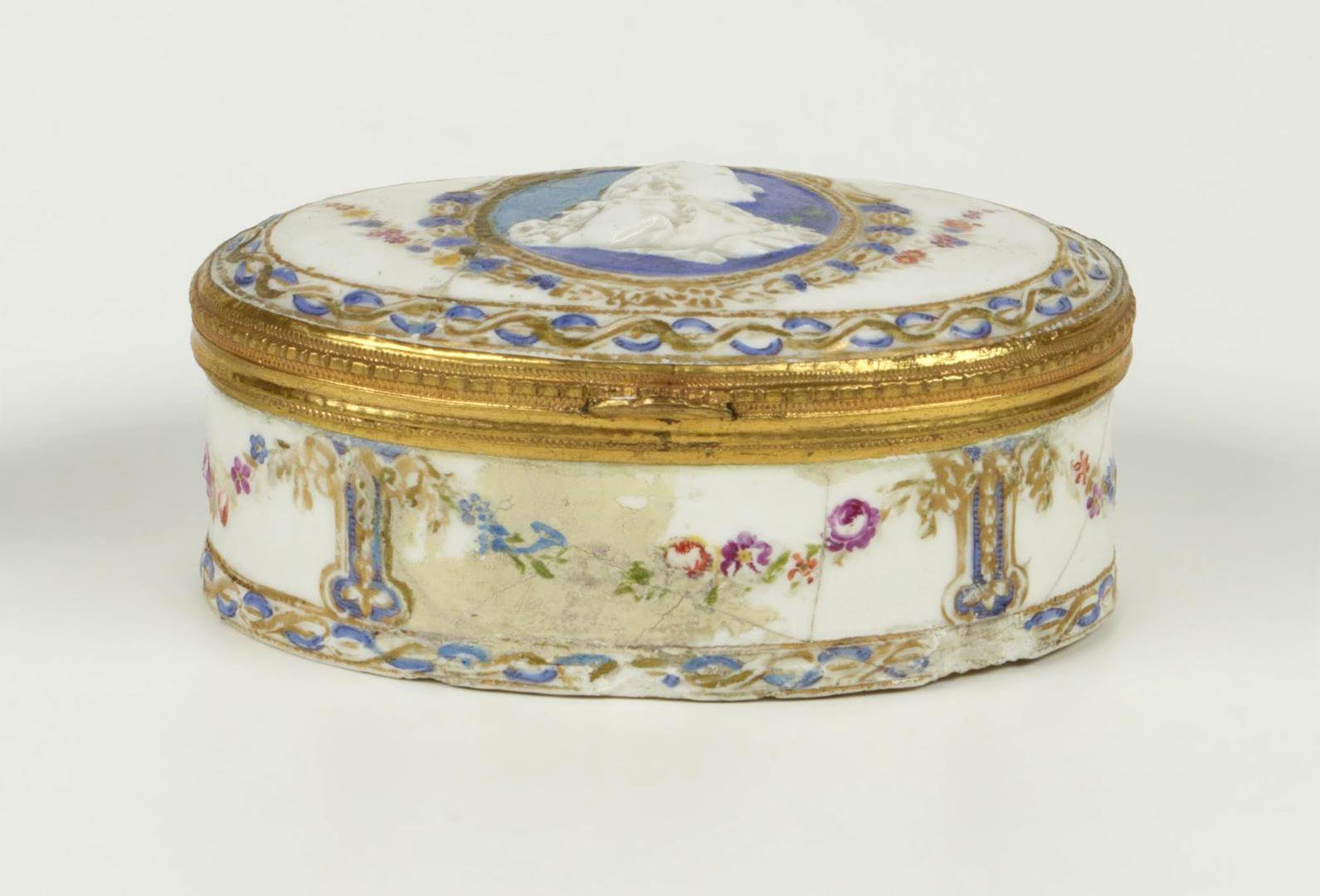
Organization: Sèvres Porcelain Manufactory
Origin: France
Date: 1845
Material: bisque
Dimensions: diameter 12.8 cm
Current Collection: The State Hermitage Museum
Inventory Number: ZF-14984
Hermitage ID: 330086
Rudanovsky Connection: Entered the Hermitage in 1919 from the collection of A. K. Rudanovsky.
A Sèvres bisque medallion of 1845 with a profile portrait of Louis-Philippe, King of the French.
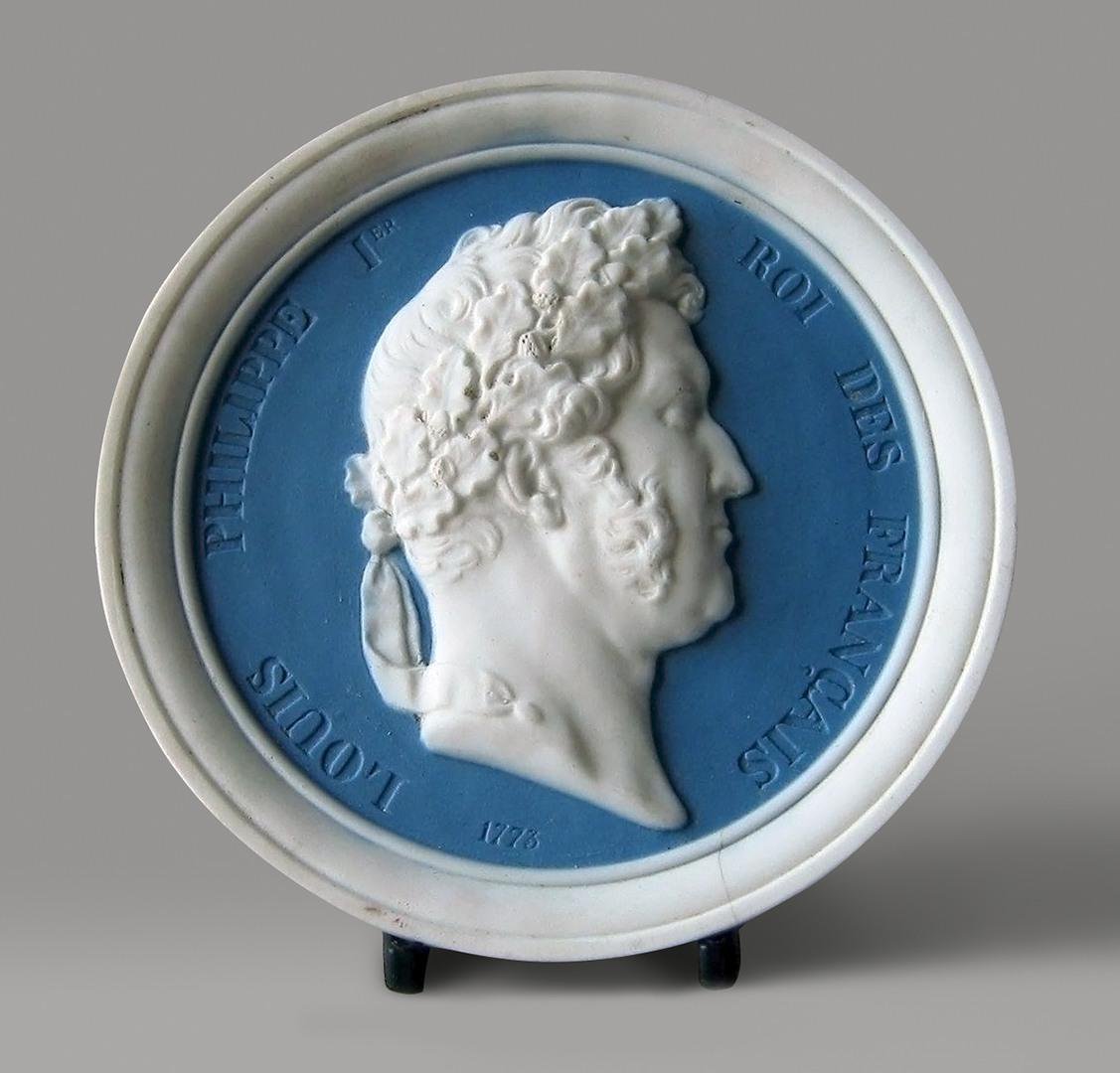
Medallion with a Portrait of Louis-Philippe. The State Hermitage Museum.
The medallion entered the Hermitage in 1919, transferred through the Department for the Protection of Monuments of Art and Antiquities from the collection of A. K. Rudanovsky. It is not currently on permanent display.
It is a round medallion — 12.8 centimetres in diameter — of white bisque on a blue ground, with the king’s profile in relief.
The Object
The medallion is circular, with a raised white border.
Inside, a blue ground carries a white relief profile of Louis-Philippe, facing left, and an inscription in white letters: LOUIS PHILIPPE Ier ROI DES FRANÇAIS.
At the bottom, the date 1845 is modelled in small figures, and the whole is framed by a simple white rim.
Louis-Philippe
Louis-Philippe (1773–1850) was King of the French from 1830 to 1848.
He came to the throne after the July Revolution, and he was known as the «bourgeois king»: he dressed plainly, carried an umbrella and presented himself as a citizen monarch. He was overthrown in the revolution of 1848.
The medallion shows him in profile, with his characteristic hairstyle and sideburns, and it presents him as a calm, solid ruler.
The Profile
The portrait is in profile.
It is a classical form, derived from coins and medals, and it gives the king a monumental, official image. The profile is modelled in low relief, with the hair, the nose, the chin and the neck carefully described.
The profile is the language of official portraiture: it is clear, legible and reproducible, and it was used for coins, medals, stamps and porcelain.
The Inscription
The inscription names the king and his title.
LOUIS PHILIPPE Ier ROI DES FRANÇAIS — «Louis-Philippe I, King of the French» — is modelled in white letters around the blue ground. The title is significant: «King of the French», not «King of France», reflects the constitutional monarchy of 1830.
The date 1845 is placed at the bottom, and it records the year of manufacture.
The Blue
The blue ground is the medallion’s colour.
It is a deep, even blue, applied to the bisque, and it contrasts with the white relief and the white inscription. The blue gives the medallion its depth, and it makes the profile stand out.
Blue grounds were common in Sèvres medallions of the period, and they were used to imitate the appearance of a cameo.
Bisque
The medallion is made of bisque.
Bisque is unglazed porcelain, fired once, and it has a matte, slightly granular surface. It was used for medallions, busts and reliefs, and it imitates the appearance of marble or of a cameo.
Bisque was a speciality of Sèvres in the nineteenth century, and it was used for portraits of the royal family and of public figures.
Sèvres in 1845
The medallion was made at Sèvres in 1845.
The factory was by then a national manufactory, and it produced services, vases, medallions and sculptures for the state and for private clients. Its production included official portraits, which were used as gifts and as diplomatic presents.
The medallion belongs to that production: a small, official object, made for display.
The Medallion
The medallion is a portable portrait.
It could be framed, mounted or placed in a case, and it was meant to be seen at close range. Its small size and its relief make it an object to be held and examined.
Medallions of this kind were collected, and they were a way of owning the image of a ruler.
The Hair
The king’s hair is modelled in thick curls.
It is swept up and back, in the fashion of the 1830s and 1840s, and it frames the face with a mass of soft, rounded forms. The curls are one of the most detailed parts of the relief.
Hair of this kind is a test of a modeller’s skill: it must be varied and natural, and it must catch the light.
The Border
The medallion has a raised white border.
It frames the blue ground and the profile, and it gives the object a finished, coin-like edge. The border is part of the relief, and it turns the medallion into a complete object.
Borders of this kind were standard in Sèvres medallions, and they protected the edge from chipping.
The Medal
The medallion is a medal in porcelain.
It imitates the form of a coin or a medal: the circular shape, the profile, the inscription around the edge. The imitation is deliberate, and it connects the object to the tradition of official commemorative medals.
Medals were struck in metal, but porcelain medallions were cheaper and more colourful, and they were produced in large numbers.
The King’s Image
The medallion is an official image.
It presents Louis-Philippe as a calm, dignified ruler, in the classical language of the profile. It was made for display, and it was probably given as a gift or kept as a souvenir.
Official portraits of this kind were part of the state’s image-making, and they circulated in every medium.
The Collector
The medallion came to the Hermitage with the Rudanovsky collection.
Rudanovsky collected European porcelain alongside paintings, drawings, glass and miniatures, and his collection included Sèvres medallions and portraits.
The medallion is therefore a double document: of Sèvres in 1845 and of a Russian collector’s taste.
The Relief
The profile is in low relief.
It rises slightly from the blue ground, and its edges catch the light. The relief is shallow, but it is enough to give the face volume.
Low relief is the technique of the medal and the cameo, and it requires great precision: a millimetre too much, and the profile becomes coarse.
The Frame
The medallion was probably framed.
It could be set in a wooden or gilt frame, or mounted in a case, and it was meant to be hung or displayed. The frame is lost, but the object still carries the scale of a small picture.
Medallions of this kind were collected and arranged in cabinets and galleries.
The Title
The inscription’s title is a political statement.
«King of the French» was the title adopted in 1830, after the July Revolution, and it replaced «King of France». It asserted that the king derived his authority from the people, not from divine right.
The medallion’s inscription thus records not only a name but a constitution, and it places the object in the political history of the July Monarchy.
Provenance
The medallion carries the inventory number ZF-14984. It entered the Hermitage in 1919, transferred through the Department for the Protection of Monuments of Art and Antiquities from the collection of A. K. Rudanovsky.
In the Hermitage
The medallion is preserved in the State Hermitage Museum in Saint Petersburg and is not on permanent display.
It is a small, official object, and it preserves the image of a king: a profile, a title and a date, modelled in white on blue.
It is a king in white on blue, and he has been here ever since.