Organization: Gardner Porcelain Factory
Origin: Russia, Moscow Governorate, Verbilki Village
Date: second half of the 18th century
Material: porcelain
Technique: polychrome overglaze painting, gilding
Dimensions: 29 × 15.8 × 15.8 cm
Current Collection: The State Hermitage Museum
Inventory Number: ERF-231
Hermitage ID: 909333
Rudanovsky Connection: Entered the Hermitage in 1919 from the collection of A. K. Rudanovsky.
A porcelain group of children as gardeners, made at the Gardner factory in the second half of the eighteenth century.
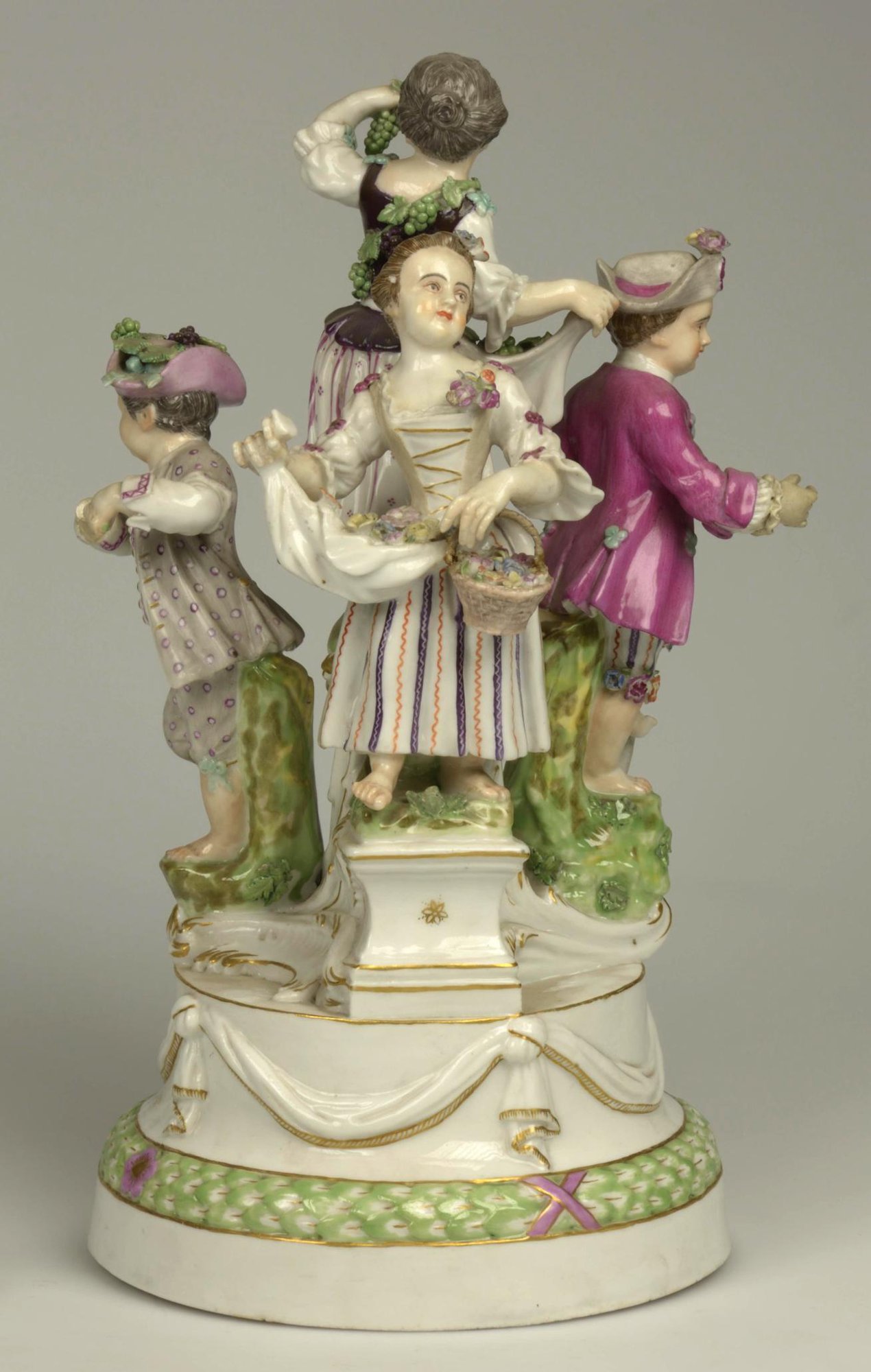
Sculptural Group: Children Gardeners. The State Hermitage Museum.
The group entered the Hermitage in 1919 from the collection of A. K. Rudanovsky. It is not currently on permanent display.
It is a tall group — 29 centimetres — with three children standing on a rocky mound above a circular base, surrounded by flowers and vines.
The Object
The group is built around a central girl.
She stands on a small pedestal, wearing a white dress with vertical purple and orange stripes, a laced bodice and a flowered apron. In her hands she holds a basket of flowers and a cloth filled with blossoms.
To her left, a boy in a pale coat with a flowered pattern climbs a rock; to her right, a boy in a magenta coat and a straw hat steps forward. Above them, a third figure — a girl with a garland of grapes — reaches down.
The base is a circular mound painted with green and white trellis, garlands and gold lines.
The Garden
The group represents a garden.
The children are gardeners: they carry flowers and grapes, and they stand among rocks and vines. The theme is one of the most popular in eighteenth-century porcelain, where pastoral and garden subjects allowed the sculptor to combine figures, plants and landscape in a single composition.
Gardeners, shepherds, fruit sellers and flower girls were all part of the same imaginary world: a rural Arcadia, populated by charming children.
The Children
The children are not portraits.
They are types: round-faced, rosy-cheeked, with small hands and feet. Their expressions are calm and slightly vacant, and their poses are theatrical rather than natural.
This stylisation is characteristic of porcelain figures. The modeller was not interested in individual children but in the idea of childhood — innocent, playful, decorative.
Gardner
The group was made at the Gardner factory near Moscow.
Gardner produced large numbers of figures and groups in the second half of the eighteenth century, many of them based on Meissen models. The factory’s sculptors adapted these models to Russian taste, simplifying the compositions and brightening the colours.
This group belongs to that production: a European subject, executed in a Russian factory, for a Russian market.
The Base
The base is as elaborate as the figures.
It is a rocky mound, painted with green and white trellis, with garlands hanging from the ledge and gold lines defining the edges. The mound supports the figures and provides a landscape for them.
The base is also a technical device: it unites the separate figures into a single composition and gives the group stability.
Polychrome
The painting is rich and varied.
The girl’s dress is white with purple and orange stripes; the boys’ coats are pale and magenta; the grapes are green and purple; the flowers are pink, yellow and blue. Gold is used for the edges of the base and for small details.
The colours are applied as overglaze enamels and fired, and they give the group its lively, decorative character.
The Composition
The composition is pyramidal.
The figures are arranged in a triangle, with the central girl at the apex and the two boys at the base. The third figure, above, extends the pyramid upward and gives the group its height.
This arrangement is typical of porcelain groups: it allows several figures to be seen at once and gives the object a clear silhouette.
The Model
The group was made from a mould.
Porcelain figures were modelled in wax or clay, then reproduced in plaster moulds and cast in porcelain. The moulds allowed the factory to produce multiple versions of the same group, with variations in painting.
The crispness of the modelling and the quality of the painting suggest a good model and a careful production.
The Pedestal
The central girl stands on a small square pedestal.
It is white, with a gold rosette on the front, and it raises her above the boys and gives her a position of honour. The pedestal is part of the composition’s pyramid: it marks the apex.
The pedestal also has a practical function: it supports the central figure and connects her to the base.
The Grape Girl
The figure at the top of the group is a girl with a garland of grapes.
She stands behind the central girl, reaching down with a cloth, and her dark hair and purple dress contrast with the white and pink of the foreground. She is the tallest figure and the most distant.
Her presence turns the group into a scene: the children are working together, gathering and carrying the harvest.
The Colours
The palette of the group is bright and varied.
White dresses, purple and orange stripes, magenta coats, pale grey and pink, green rocks and gold edges. The colours are applied as enamels and fired, and they give the group a lively, almost theatrical character.
The brightness is characteristic of Gardner’s production, which favoured strong colours and clear contrasts.
The Group in the Interior
Groups like this were made for tables and cabinets.
They stood among other porcelain, flowers and silver, and they were admired for their modelling and their colour. A group of children in a garden was a pleasant subject for a dining room or a drawing room.
The group’s size — 29 centimetres — made it a centrepiece, large enough to be seen across a room.
Gardner’s Models
Gardner’s sculptors worked from a repertoire of European models.
Meissen figures were the principal source, but the factory also adapted Sèvres and Vienna models and invented subjects of its own. The Russian versions simplified the compositions and brightened the colours.
This group is typical of that process: a European subject, adapted to Russian taste and produced in a Russian factory.
The Gardener’s Tools
The group includes the tools of the garden.
The children carry baskets and cloths filled with flowers and grapes; a hoe or a stick may be implied among the rocks. These attributes identify the figures as gardeners and connect them to the work of cultivation.
The tools are not realistic: they are decorative signs, like the costumes. They tell the viewer what the children are doing without pretending to be accurate.
Provenance
The group carries the inventory number ERF-231 and entered the Hermitage in 1919 from the collection of A. K. Rudanovsky.
In the Hermitage
The group is preserved in the State Hermitage Museum in Saint Petersburg and is not on permanent display.
It is a fine example of Gardner porcelain, and it shows how a European subject — children in a garden — could be translated into a Russian object, painted with bright colours and mounted on an elaborate base.
In the end, it is a small theatre of childhood: three children, a basket of flowers, a garland of grapes and a rock, arranged to please the eye.