Organization: Imperial Porcelain Factory
Origin: Russia, St Petersburg
Date: circa 1760
Material: porcelain
Technique: overglaze polychrome painting, gilding
Dimensions: 11.8 × 4.5 × 6.7 cm
Current Collection: The State Hermitage Museum
Inventory Number: ERF-165
Hermitage ID: 909672
Rudanovsky Connection: Entered the Hermitage in 1919 from the collection of A. K. Rudanovsky.
A Russian porcelain candlestick of about 1760, with two cupids holding a garland around a column.
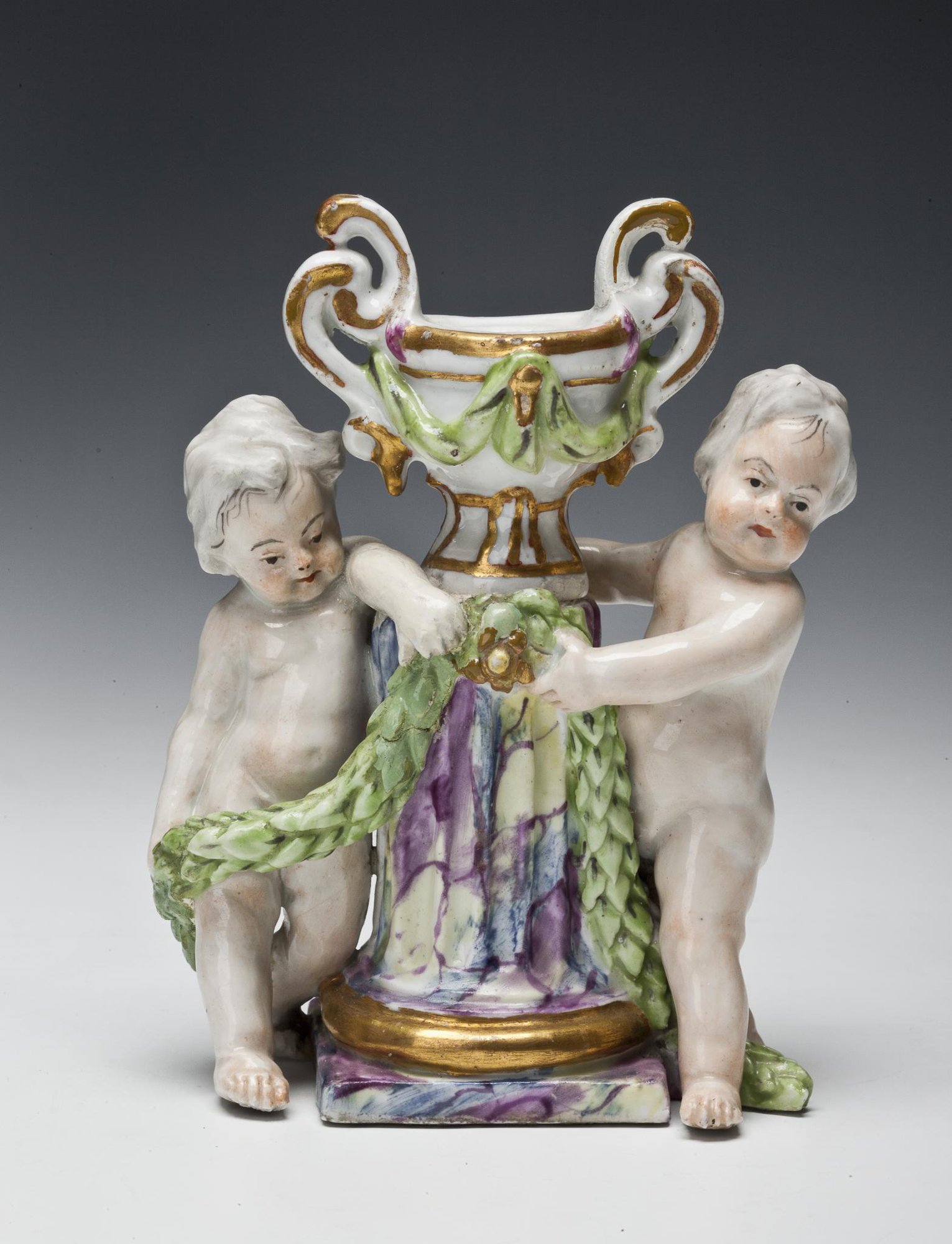
Sculptures: candlestick with cupids. The State Hermitage Museum.
The candlestick entered the Hermitage in 1919, handed over by the Department for the Protection of Monuments of Art and Antiquities and originally in the collection of A. K. Rudanovsky. It is on display in the Winter Palace, in room 166.
It is a small object — 11.8 centimetres high — with two white cupids, a marbled column and a candle cup on top.
The Object
The candlestick is built around a central column.
The column is painted with purple and blue marble, and it rises from a square base and a gold ring. On top, a white candle cup, with scroll handles and a green festoon, holds the candle.
Two cupids stand at the sides, holding a green garland that wraps around the column.
The Cupids
The cupids are the object’s figures.
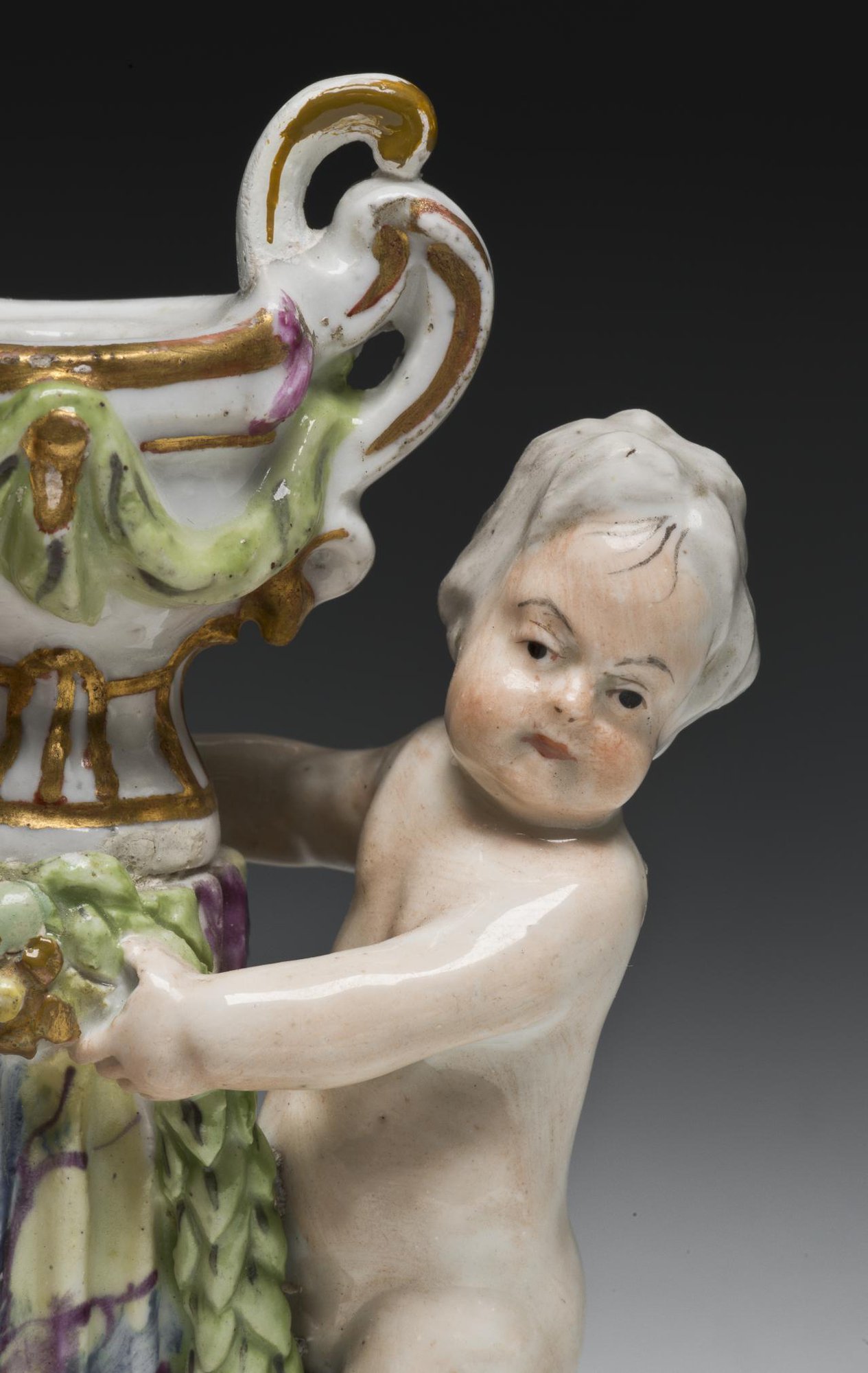
They are small, naked children with curly hair and plump bodies, and they stand on either side of the column. Their faces are turned toward each other, and their arms support the garland.
Cupids are a classical motif, and their presence turns a functional candlestick into a small mythological scene.
The Column
The column is the object’s structure.
It is painted with a marbled pattern of purple, blue and green, and it imitates a column of coloured marble. Its surface is smooth, and its colours are rich.
Marbled columns are a feature of baroque decoration, and they give the object its weight and its colour.
The Candle Cup
The candle cup is the object’s function.
It is white, with scroll handles and a green festoon, and it is banded with gold. Its opening is a socket, into which a candle would be placed.
The cup turns the object into a candlestick, and it gives it its purpose.
The Garland
The garland is the object’s link.
It is green, with leaves and flowers, and it wraps around the column and connects the two cupids. It is painted with care, and it gives the object its movement.
Garlands are a classical motif, and they symbolise festivity, abundance and the bond between the figures.
The Imperial Factory
The candlestick was made at the Imperial Porcelain Factory in St Petersburg.
The factory was founded in 1744, and it became the principal porcelain manufactory of the Russian empire. In the 1760s, it produced figures, groups and decorative objects for the court.
The candlestick belongs to that production, and it shows the factory’s early style.
1760
The candlestick is dated to about 1760.
It was made in the early years of the Imperial factory, when its modellers were still developing a Russian style. The influence of Meissen and of European baroque is visible.
The candlestick is therefore an early work, and it shows the factory finding its voice.
The Marble
The marbled column is painted to imitate stone.
The pattern is applied over the glaze, in purple, blue and green, and it reproduces the veins of marble. The imitation is convincing, and it gives the object a monumental look.
Trompe-l’œil of this kind was popular in eighteenth-century porcelain, and it allowed the maker to imitate expensive materials.
The Base
The candlestick stands on a square base.
It is painted with the same marble pattern as the column, and it is edged with a gold line. The base gives the object stability, and it turns it into a small monument.
Bases of this kind are common in porcelain candlesticks, and they give the object its architectural character.
The Festoon
A green festoon hangs beneath the candle cup.
It is painted with leaves and flowers, and it ties the cup to the column. The festoon softens the transition between the white cup and the marbled shaft.
Festoons are a classical motif, and they are common in baroque and rococo decoration.
The Handles
The candle cup has two scroll handles.
They are white, edged with gold, and they curl out from the cup like small wings. The handles are decorative rather than practical: they do not support the candle, but they give the cup its shape.
Handles of this kind are a feature of eighteenth-century porcelain, and they show the maker’s taste for fantasy.
The Table
The candlestick was made for a table.
It stood on a dining table, a writing desk or a mantelpiece, and it held a candle for the evening. Its light would have illuminated the room, and its colours would have glowed in the dark.
That table is gone, but the candlestick still carries its function: a small object for light.
The Light
The candlestick is an object of light.
It held a candle, and the flame would have lit the cup, the cupids and the marbled column. Its colours were chosen for candlelight: white, gold, purple and green.
In a museum case, the candlestick is lit from above, but it was made for a flame.
The Cupids’ Hair
The cupids have curly hair.
It is modelled in soft locks, and it is painted in white and grey. The hair frames their faces and gives them their childish look.
Hair of this kind is a test of a modeller’s skill: it must be soft and varied, and it must not overwhelm the small faces.
The Colours
The colours are soft and rich.
White, gold, purple, blue and green: the palette is harmonious, and it gives the object its character. The white cupids and the marbled column are the dominant notes.
The colours are applied as enamels, and they have survived with some wear.
The Candle
The candlestick held a candle.
The candle was wax or tallow, and it burned with a flame that lit the room. The candlestick raised it above the table and caught the wax in its cup.
A candle was a daily object in the eighteenth century, and the candlestick was its support: a small piece of porcelain that turned a stick of wax into a source of light.
Provenance
The candlestick carries the inventory number ERF-165. It entered the Hermitage in 1919, handed over by the Department for the Protection of Monuments of Art and Antiquities and originally in the collection of A. K. Rudanovsky.
In the Hermitage
The candlestick is on display in the Winter Palace, in room 166.
It is a small, charming object, and it preserves a moment of the Russian baroque: two cupids, a garland and a candle, modelled in porcelain.
It is a candlestick, and it is also a small sculpture, and it has held its garland and its cupids for more than two centuries.
It is a small monument to light and to the pleasure of making something useless beautiful.
And it is still, in its way, a small light in a dark room. It is a candle-holder, and it has outlasted every candle it ever held. And it is still standing, with its garland and its cupids, in a case in the Winter Palace.